Planning To Gift Gold, Cash Or Property This Diwali? Know These Tax Rules

Diwali is a time for exchanging gifts. From cash and gold jewellery to shares and property, many families use the festive season to give something valuable to their loved ones. But before making a big-ticket purchase or transferring money, it is important to understand the tax rules.
A gift does not automatically become tax-free simply because it is given during Diwali. Its tax treatment depends on the value and nature of the gift, the relationship between the giver and the recipient, and whether it falls under any exemption provided by law.
Under Section 92(2)(m) of the Income-tax Act, 2025, which corresponds to Section 56(2)(x) of the Income-tax Act, 1961, certain gifts received without payment or for inadequate consideration may be taxable in the hands of the recipient under the head "Income from Other Sources".
Also Read | Layoffs Are Rising In Tech, But These Skills Are Helping People Unlock Better Pay
The rules cover cash gifts, specified movable assets such as jewellery, shares and paintings, and immovable property. The tax liability can arise even when the recipient does not pay anything for the gift, CA Suresh Surana told NDTV.
When Can A Diwali Gift Become Taxable?
According to CA Surana, the Rs 50,000 threshold is important when determining the tax treatment of several types of gifts. However, the applicable calculation differs depending on whether the gift is cash, movable property or real estate.
For monetary gifts received without consideration, if the aggregate amount during the tax year exceeds Rs 50,000, the entire amount becomes taxable, rather than just the portion above the threshold.
A similar rule applies to specified movable property received free of cost. If the aggregate fair market value exceeds Rs 50,000, the entire fair market value may be taxable.
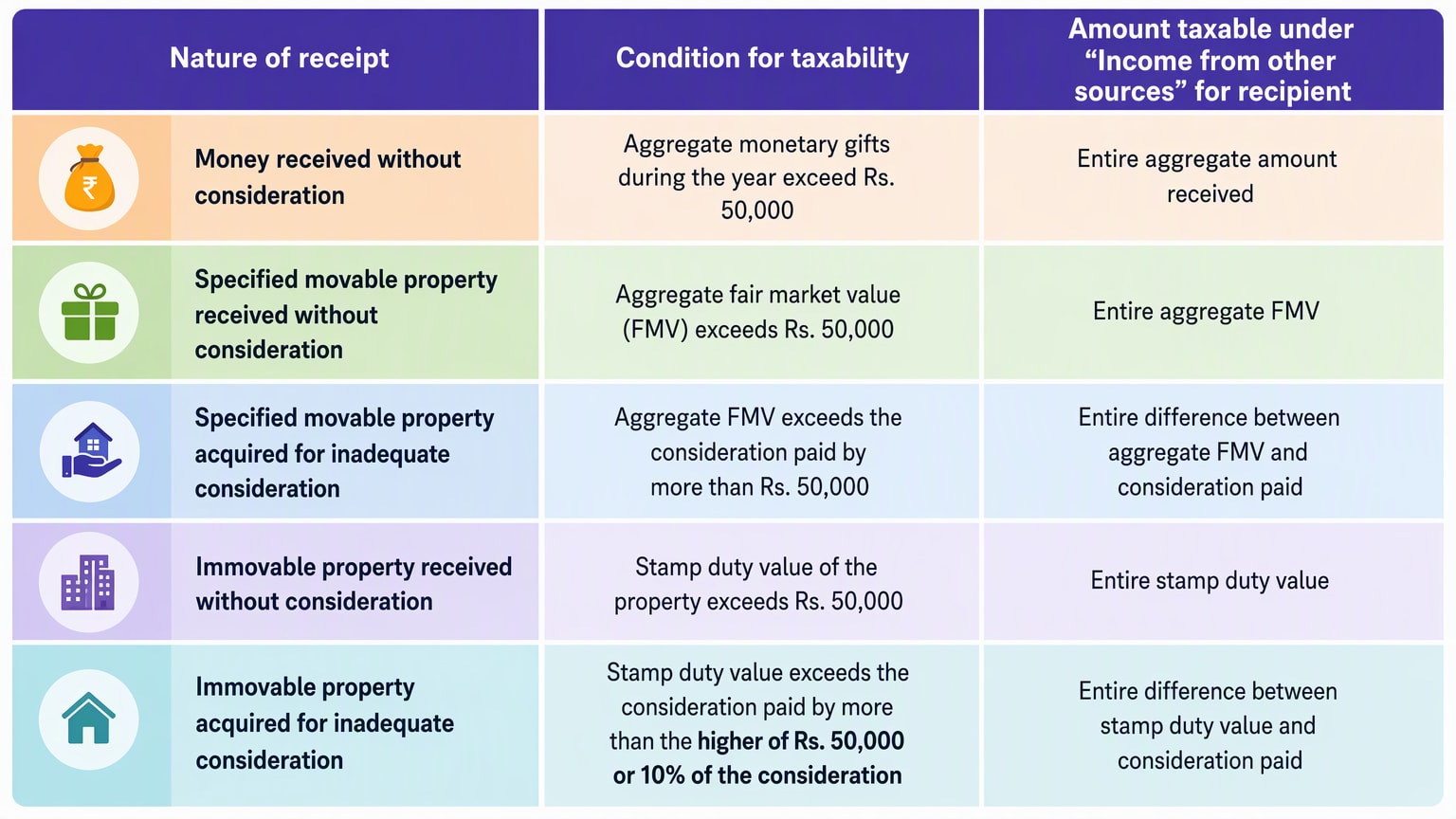
For movable property purchased at a discount, the difference between its aggregate fair market value and the consideration paid becomes taxable if that difference exceeds Rs 50,000.
Property transactions have separate conditions. If immovable property is received without payment and its stamp duty value exceeds Rs 50,000, the entire stamp duty value may be taxable.
If a property is purchased for less than its stamp duty value, the difference may be taxable when the stamp duty value exceeds the consideration paid by more than the higher of Rs 50,000 or 10 per cent of the consideration.
Therefore, a person receiving an expensive Diwali gift should check the applicable threshold and valuation rules before assuming that no tax is payable.
Gifts From Relatives: When Is The Exemption Available?
The law provides important exemptions for gifts received from specified relatives. These include gifts from a spouse, siblings, siblings of the spouse or either parent, lineal ascendants and descendants of the individual or spouse, and the spouses of these specified relatives.
For example, a person receiving cash or gold jewellery from a sibling during Diwali would generally qualify for the relative-based exemption, subject to the applicable legal provisions.
However, the exemption does not extend to every person considered close to the recipient. Gifts from friends, colleagues and other people who do not fall within the specified categories may be taxable if the relevant conditions are met.
The law also provides exemptions for gifts received on the occasion of the recipient's own marriage, as well as gifts received under a will or through inheritance, among other specified circumstances.
The occasion matters here. A gift received on Diwali does not qualify for the marriage-related exemption merely because it is given during the festive season.
What About Gifts From Employers?
Employees should also check the tax treatment of festive gifts received from their employers.
Under the Income-tax Rules, 2026, the aggregate value of gifts in kind, vouchers or tokens received by an employee during the tax year is generally treated as nil if it is below Rs 15,000.
Employees receiving gifts above this threshold should check the applicable valuation and tax treatment to understand whether any amount becomes taxable.
What Should You Check Before Giving An Expensive Gift?
CA Suresh Surana advises taxpayers to consider the applicable tax provisions before making or accepting valuable gifts.
The first step is to identify the nature of the gift and its value. Cash, jewellery, shares and property are subject to different valuation rules. The recipient should also establish whether the giver qualifies as a specified relative under the law.
For high-value gifts, it is sensible to maintain supporting documents, including purchase bills, valuation details and records of the transfer. These can help explain the nature and source of the gift if questions arise later.
Ultimately, the tax treatment of a Diwali gift depends on the legal provisions applicable to the transaction, not simply on the festive occasion. Checking the rules beforehand can help families avoid an unexpected tax liability while celebrating the festival.
KioskNews shows a cleaned-up reading view extracted from the publisher’s page — the original always lives on their site, not ours.