Gorging on bearcam: the livestream of big beasts eating that draws millions
One of this summer’s biggest onscreen hits has had big beasts, great escapes and choppy waters, but it’s not Christopher Nolan’s The Odyssey – it’s a livestream of Alaskan brown bears catching salmon.
The Brooks Falls bearcam at Katmai national park in the US was watched 7.3m times between 22 June and 4 August – up 70% from the same period last year and more than double the views it attracted in 2024.
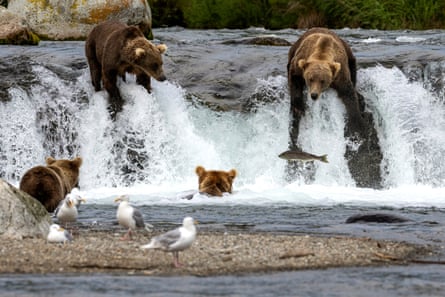
The cameras, run by the wildlife network Explore.org, show brown bears gathering at Brooks Falls waterfall to catch sockeye salmon as they make their way upstream. More than a dozen bears at a time can be spotted prowling around the rocky waters and chomping on the fish.
Candice Rusch, Explore.org’s director of new media, said the surge in viewers appeared to be driven by the bears returning to the falls in large numbers after a less concentrated season last year.
“Last year was a really high salmon run, which meant there was salmon all over the river and the bears didn’t need to congregate at the falls the way they’re doing right now,” she said.
“This year we’ve just had very good views of large congregations of bears.
“It’s like the whole world discovered they could put bearcam on their TV at the same time,” she said. “Maybe people just have it on while they’re cooking dinner.”
The cameras were first installed in 2012 as part of an effort to bring remote wildlife into people’s homes. Rusch said the idea was that people were more likely to protect animals and landscapes they had come to know and care about.
Dr Jeffrey Skibins, an associate professor at East Carolina University, said: “Recent studies have shown that nature-based webcams are beneficial to both wildlife and people. They benefit wildlife by improving conservation attitudes, behaviours and awareness.
“This is not to suggest they are replacements for getting out in nature, but rather serve as viable additions,” he said.
The stream has developed a dedicated fanbase. Viewers can identify individual bears from features such as their ears, noses and body shape, and some keep detailed records of their feeding habits.
One dedicated fan reported watching a bear called Otis eat 42 salmon over several hours, which Rusch said could equate to more than 100,000 calories.
The bears’ gorging will take on added significance next month, when Katmai’s annual Fat Bear Week begins in the autumn. The public votes in a knockout-style competition to crown the park’s fattest bear, as the animals pile on winter weight in preparation for hibernation.
“The bears are great,” Rusch said. “This is an amazing place and it deserves all the love it’s getting.”
Find more age of extinction coverage here, and follow the biodiversity reporters Rebecca Ratcliffe, Phoebe Weston and Patrick Greenfield in the Guardian app for more nature coverage.
KioskNews shows a cleaned-up reading view extracted from the publisher’s page — the original always lives on their site, not ours.