Can squirrels really survive any fall?
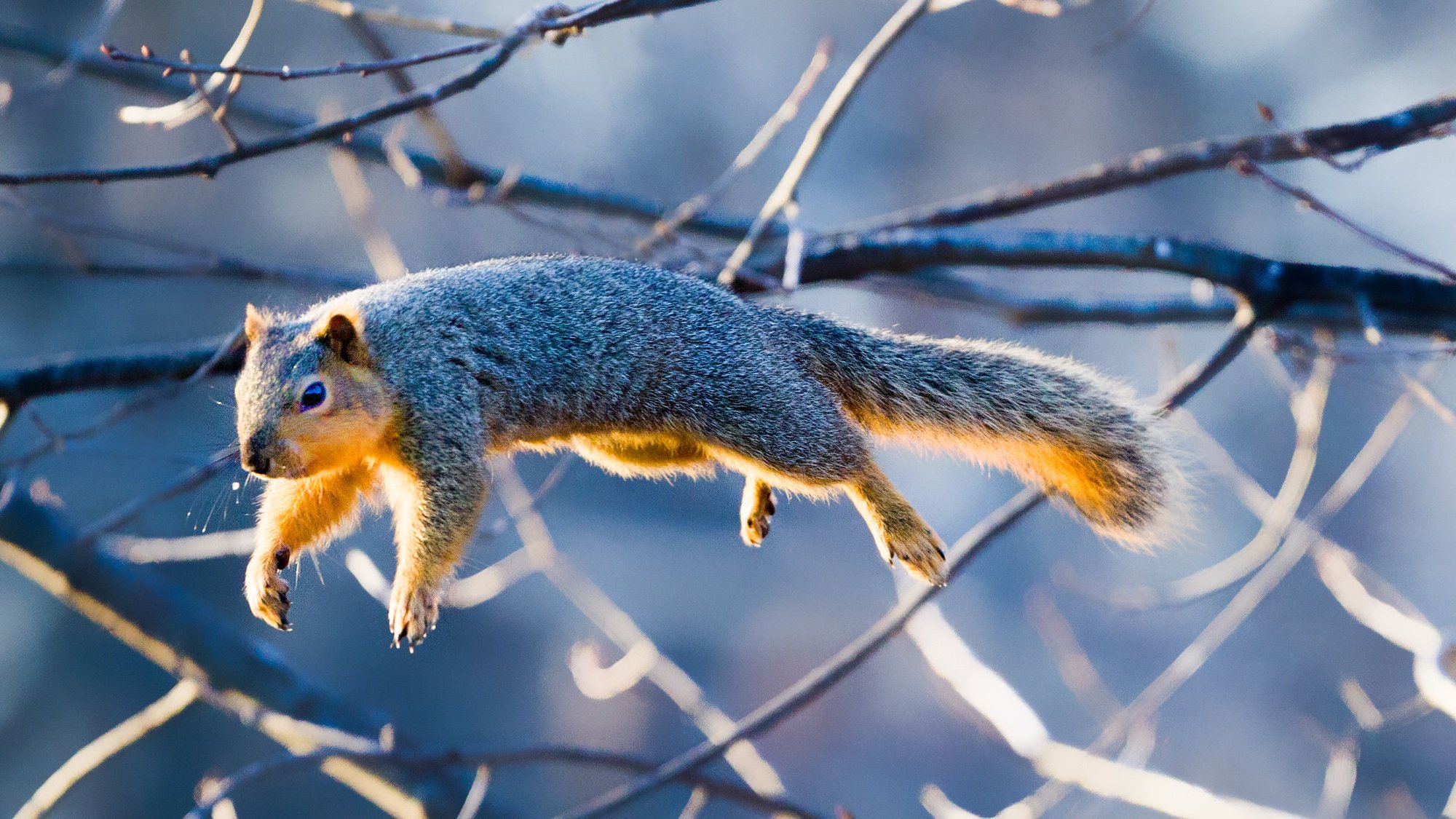
On any ordinary day, you might witness the breathtaking display of squirrels high in the trees, doing what seems like effortless, daredevilish parkour. They might launch themselves off one branch, bounce off another, and somehow reorient themselves in midair like it’s nothing.
A large, heavy human being attempting these same maneuvers would likely fall—and would be looking at a trip to the E.R., at best.
Yet squirrels, it seems, tend to walk away from these situations unscathed. You’ve probably even heard that squirrels can survive a fall from any height. But according to Dr. Nathaniel Hunt of the University of Nebraska at Omaha, this comes with an important caveat: Even these brazen little gymnasts don’t stick the landing every single time.
“I would put an asterisk on the claim that squirrels can survive a fall from literally any height,” Hunt tells Popular Science. “Their size makes large falls surprisingly survivable, but they are not invulnerable.”
So, can squirrels survive, if not all, most falls? And if so, how?
Anatomy of a (squirrel) fall
It’s much more than luck that keeps squirrels landing safely; they are no more immune than we are to the laws of gravity. It’s what happens in the air—both in terms of their anatomical engineering and their instincts—that allows them to survive most falls and get right back to their nut-hiding hijinks.
According to Hunt, a falling squirrel faces three challenges: the speed of the fall, its orientation midair, and the impact when it lands. A squirrel’s small body helps; at about a pound, a squirrel weighs about as much as a loaf of bread.
“Being small gives it a lot of aerodynamic area relative to its weight, so air resistance limits its speed,” Hunt says. “It also has much less kinetic energy than a larger animal.”
So, squirrels’ light and small bodies help them hit the ground with less force, but that’s not all that’s going on. Hunt says squirrels instinctively know how to move through the air and land on the ground, which helps to optimize their already “favorable physics.” The tail is a key player in these midair maneuvers.

Awesome Slow Mo Video Of A Squirrel Jumping
“The tail is more interesting than a fluffy parachute,” Hunt notes. “At low airspeeds, aerodynamic forces are small, but the squirrel can still use inertial tail movements to exchange angular momentum with the body and control orientation.” In other words, squirrels use their tail to control how and where they fall.
Research backs Hunt’s claim. A 2021 study found that squirrels experiencing unexpected falls were able to rapidly rotate their tails, a motion that caused the rest of their bodies to rotate in the opposite direction. Hunt compared the role of the tail to that of a “reaction wheel” on a spacecraft.
“Accelerating the tail in one direction helps rotate or stabilize the body in the other direction,” Hunt says.
As a squirrel’s fall picks up speed, the tail may function more like the feathers on an arrow, Hunt suggests. If the squirrel starts to veer off course, the airflow pushes against the tail just enough to redirect its body into a stable position. Even then, the tail isn’t acting like a true parachute; instead of slowing the squirrel’s descent, the tail is nudging its body in the right direction.
The landing is the real trick
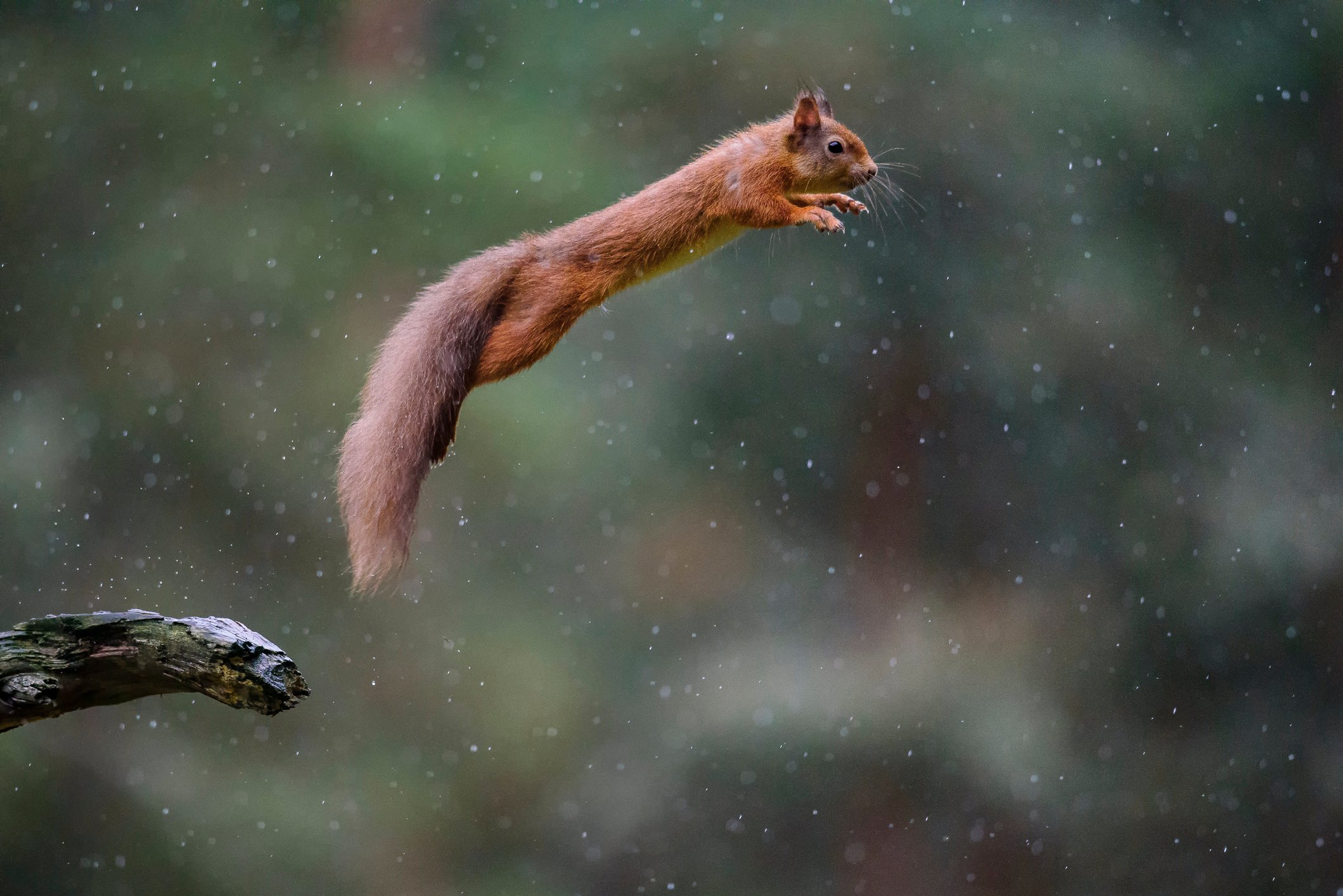
Size, anatomy, and aerial reorientation are all important to a squirrel’s seemingly magical ability to survive most falls. However, there’s a third skill that plays an equally important part, one Hunt thinks may be “the most underappreciated part of the story.” Squirrels know how to come in for a landing.
“A recent study I co-authored found that fox squirrels managed more than 80 percent of their landing energy through their forelimbs,” Hunt says of a study looking at squirrels leaping between branches. “They also adjusted their forces depending on whether they undershot or overshot the branch.”
In other words, a landing isn’t just something that happens to a squirrel. On some level, they’re doing damage control.
“They are not simply hitting the branch,” Hunt says. “They are actively controlling the collision.”
Slow doesn’t always mean safe
So, how slowly does a squirrel have to fall to be able to walk away?
The answer lies in our furry friend’s terminal velocity, the top speed something reaches while falling once air resistance balances gravity’s pull and stops it from accelerating further. Hunt says a squirrel’s terminal velocity can be reasonably estimated at about 20 to 40 mph, depending on its posture, limb position, and tail. For reference, Hunt estimates the terminal velocity of a cat—famous nine lives aside—at about 60 mph, while a belly-down human skydiver is likely to fall at about 120 mph.
“All of these are approximate, because posture matters enormously,” he says.
Posture explains some of the variation, but size is ultimately the main driver. A giant squirrel, therefore, would likely fare much worse in a fall, even with perfect tail control and posture.
“You could not simply build a squirrel 10 times larger and expect it to tolerate the same fall,” Hunt says.
Likewise, a squirrel’s comparatively slow terminal velocity doesn’t mean it’s out of the proverbial woods. It might seem that once a squirrel hits its maximum speed, height wouldn’t matter much, making a fall from 10 feet and a fall from 100 feet equally survivable. Hunt cautions against assumptions like this.
“Reaching terminal velocity does not make a squirrel immune to injury,” he says. “The landing surface, body orientation, and any collisions along the way still matter.”
This complex interplay of physics, instinct, learning, and split-second decision-making is part of what makes squirrels a fascinating study subject for Hunt.
“What fascinates me is that you cannot neatly separate ‘the brain’ from ‘the mechanics,'” Hunt says. “Squirrel agility emerges from sensing, learning, body shape, and physical dynamics working together.”
In Ask Us Anything, Popular Science answers your most outlandish, mind-burning questions, from the everyday things you’ve always wondered to the bizarre things you never thought to ask. Have something you’ve always wanted to know? Ask us.
KioskNews shows a cleaned-up reading view extracted from the publisher’s page — the original always lives on their site, not ours.