Best fries competition heats up potato-mad Belgium
Thick or thin, greasy or crispy, with samurai sauce or a more traditional mayo dip? A TV show has been on a quest to find the best fries in potato-mad Belgium.
For four years running “La Meilleure Friterie” (“The Best Fries Shop”), a lighthearted culinary competition aired by broadcaster RTL-TVI, has been seeking out perfection among fry peddlers in the country’s French-speaking region.
Watching it is a “sacred Thursday night ritual,” host David Antoine said.
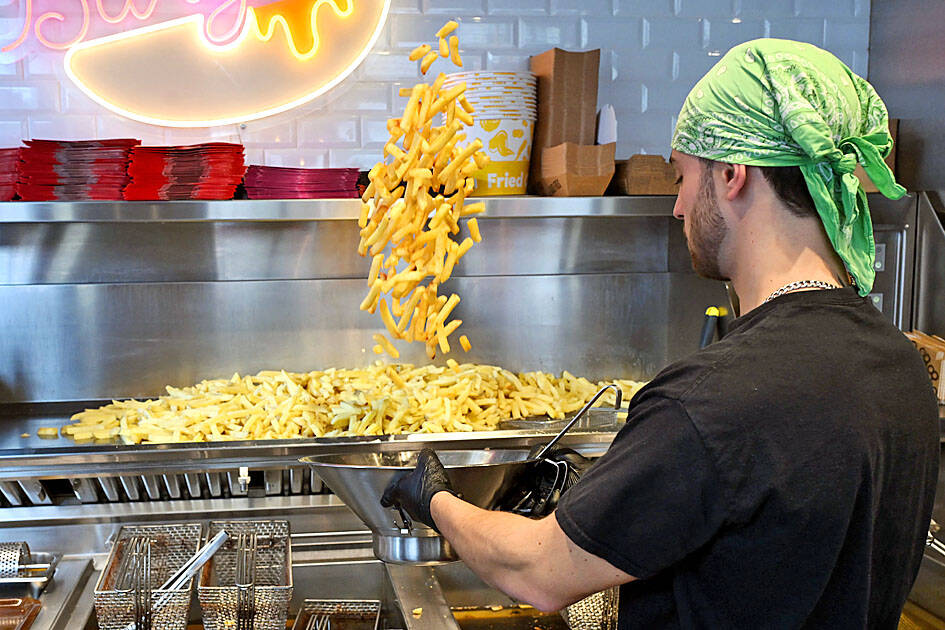
A cook prepares fries during the shooting of an episode of the TV show La Meilleure Friterie (“The Best Fries Shop”) in a restaurant in Brussels on Sept. 17.
Photo: AFP
Crowning a winner among a dozen contestants is no picnic.
“There’s sometimes friction among the judges, but we always find that famous Belgian compromise” over a portion of fries, Antoine joked, referencing the country’s penchant for lengthy political negotiations.
Fried potatoes are a national dish and symbol of pride in Belgium, home to about 4,600 diners specializing in the dish known as friteries in French or frituren in Flemish.
That number “has remained stable for many years,” said Bernard Lefevre of the National Chip Shop Union, an industry group, adding that the “market is doing well.”
Each has its own flair. To Lefevre, a good chip is preferably cut from a Belgian potato of the Bintje variety and double fried in beef fat.
Size is paramount.
“Anything under 9mm is too thin and anything over 14 is too thick,” he said.
At Hill’s Burger, a diner in Brussels, chef Massimo Sefa has gone for a “size twelve” — that is “a 2mm crust and 10mm of creamy flesh,” he said.
The 23-year-old smiled nervously when the TV show’s judges entered his joint and the cameras started rolling.
The stress is worth it, he said, as the broadcast would shine a spotlight on his friterie and a win would likely send sales skyrocketing.
Sefa opened up shop with his two younger brothers, Lorenzo and Marco Sefa. For them fries are a family matter: Their grandfather ran about 10 fries shops in Brussels.
“Wow, delicious, crispy, and peeled by hand,” Fabienne De Corte, one of the judges, raved upon tasting the goods.
“Fries in Belgium are our gold,” added her husband, Patrick De Corte, who is also on the judging panel. “Every little detail makes a difference.”
The show has a devout following, including some who tag along for filming sometimes dressed as fry cones and chanting: “We’ve got the fries, we’ve got the potatoes.”
It has also had its share of controversies, particularly on the hot topic of sauces.
A technical glitch caused trouble during public voting in the first season and some grumbled the winner had bamboozled jurors with dazzling sauces, while the fries were not to everyone’s taste.
Still the show has established itself in the French-speaking Belgian media landscape at a time when fries are sometimes changing along with Belgian society.
“There are halal, vegetarian and vegan fry shops — that’s perfectly normal; society is evolving. We’re not a museum of bygone folklore,” Lefevre said.
KioskNews shows a cleaned-up reading view extracted from the publisher’s page — the original always lives on their site, not ours.