Sheinbaum meets with US business leaders and ambassador amid controversy over US-backed police academy
During a week in which she has questioned intrusive U.S. security policies, President Claudia Sheinbaum met with U.S. business leaders at the National Palace, but avoided discussing security initiatives with U.S. Ambassador Ronald Johnson who was in attendance.
Sheinbaum said Thursday’s meeting with the U.S. Chamber of Commerce and the American Chamber of Commerce of Mexico (AmCham) addressed issues related to the investment climate in Mexico, adding that she will address her concerns with Johnson at a later date.
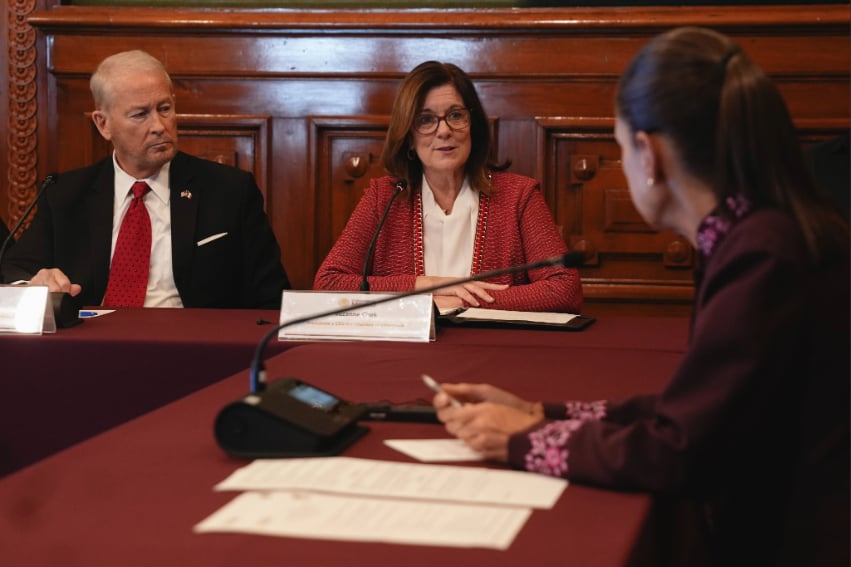
“We focused on responding to the companies’ concerns, explaining the controversial new revenue law, discussing requests regarding trade and promoting the favorable environment for business investment in Mexico,” she said.
Also in attendance were the president of Mexico’s Business Coordinating Council, José Medina Mora, and the coordinator of the Advisory Council for Regional Economic Development and Relocation, Altagracia Gómez Sierra.
For its part, AmCham expressed interest in broader security issues, investment and greater private sector participation.
AmCham president Óscar del Cueto said his organization is eager for greater collaboration between the Mexican government and private enterprise, while also citing issues such as security, investment and greater private sector participation.
Several investment agreements were finalized (to be announced at a later date) and the U.S. contingent was given a detailed update on Plan México, Sheinbaum’s strategy for economic development, industrialization and regional growth.

The meeting took place amid an ongoing review of the Mexico-U.S. trade relationship as outlined in the U.S.-Mexico-Canada Agreement (USMCA). AmCham has publicly stated that the USMCA should be used to deepen regional integration and preserve the competitiveness of the economies of Mexico, the United States and Canada.
Del Cueto insists the trade scenario presents a key opportunity for Mexico if the United States goes through a new stage of growth and industrialization and China loses dynamism.
“I firmly believe that next year we could be returning to the topic of nearshoring as the hot topic,” he said.
While Sheinbaum preferred discussing plans to allow for increased investment and greater North American productive integration, the kerfuffle involving Ambassador Johnson was a hot topic with the media.
After participating in a groundbreaking ceremony for an International Police Training Academy in the state of Querétaro on Oct. 2, Johnson — and Governor Mauricio Kuri — have faced criticism over the apparent failure to obtain federal authorization as required by law.
Sheinbaum publicly questioned the project several times, asserting that state governments cannot forge international security agreements or launch such academies without federal and Foreign Ministry authorization.
While clarifying that Mexico is not fundamentally against international cooperation, Sheinbaum explicitly demanded “cooperation with dignity and transparency” rather than “subordination,” adding that it is imperative that federal frameworks not be bypassed.
During a meeting with legislators on Thursday, Security Minister Omar García Harfuch addressed Mexico’s concerns about foreign interference in security matters, insisting that bilateral cooperation is subject to the provisions of Mexican law.
Sheinbaum said Johnson has agreed to meet soon with Foreign Affairs Minister Roberto Velasco to discuss the police academy and other issues related to security and the border.
With reports from Informador, Milenio, El Heraldo de México and Heraldo USA
KioskNews shows a cleaned-up reading view extracted from the publisher’s page — the original always lives on their site, not ours.