‘Everyone can relate to pain and struggle. So I’m sharing mine’: Michael Kiwanuka on life after his devastating stroke
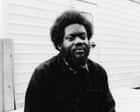
At the end of July 2025, Michael Kiwanuka was back home in Southampton after a series of European gigs. His 2024 album Small Changes had been critically acclaimed and was kept off the UK No 1 slot only by Kendrick Lamar’s GNX. His fifth record, Fudge, was due that autumn. All was going perfectly for the virtuoso singer-songwriter, whose eccentric, genre-busting mix of psychedelic rock, prog soul, blues and gospel had marked him as a real one-off.
Kiwanuka had been expected to appear at the All Together Now festival in County Waterford, Ireland, in the coming days, when an announcement was posted to his Instagram story: “We are so sorry to announce that due to continued illness, and on the advice of doctors, Michael will sadly be unable to perform at the rest of his scheduled festival performances throughout the rest of the summer and the shows in North America in October.”
Until now, fans have heard nothing from – or about – Kiwanuka. Fudge wasn’t released and his social media channels fell silent. This week, Kiwanuka revealed the devastating reason: at just 38, he’d had a haemorrhagic stroke. His brief post updating fans on his health drew messages of support from the likes of Alicia Keys, Cat Power, Olivia Dean and Alabama Shakes.
His team tells the Guardian that he underwent emergency surgery and was then in intensive care for months to support his breathing. Kiwanuka has no memory of this. Once he was well enough to breathe on his own, he left the ICU and spent five further months in hospital before moving into a rehabilitation centre in Hampshire. In that time, he has not once been able to return home, and the trajectory of his rehabilitation remains uncertain.
Kiwanuka is now releasing Fudge in October, and wanted to do one interview about the album. “It feels poignant to do it now after I got sick, because I don’t know how long it will be until I can release another record,” he says.
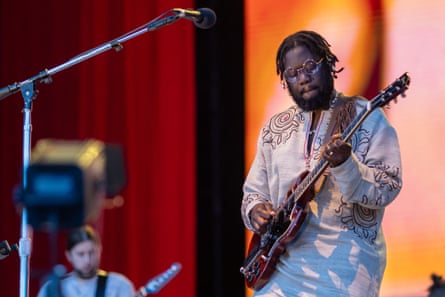
Photograph: Diogo Baptista/SOPA Images/Shutterstock
I speak to Kiwanuka over the course of two 30-minute calls from his accommodation at the rehabilitation centre. The calls are off-camera, and he is accompanied by his wife, the Christian singer and worship leader Charlotte Kiwanuka. He has been determined to speak, though he is still in recovery. His speech is slow and fragmented; the traumatic details of his stroke are clearly off limits.
Kiwanuka is famed for his introspection yet also fiercely protective of his privacy. Despite his success, he always enjoyed relative anonymity – he could still travel by bus or visit the pub without being swarmed. It means that going public about such a health crisis is a difficult step. But the vulnerability of this moment is tempered by a desire to connect with the world again.
“It’s a bit nerve-racking,” Kiwanuka tells me. There is palpable reticence in his voice. “But it feels a bit like responsibility as well. I want to tell people why I haven’t been around. It’s been a while. And I think something that everyone can relate to is pain and struggle. That’s one thing all humans have in common. So I’m just sharing mine with the world.”
Kiwanuka tells me the stroke was brought on by high blood pressure. He was unaware that he had the condition, having experienced no symptoms before the stroke. He does not know if his lifestyle or career contributed to it; naturally, the life of a touring musician is intense, with frequent early flights and late-night shows. “Quite a lot of work, quite tiring, but it was all exciting,” he says.
He realises now that he was particularly at risk of a stroke because of the increased susceptibility to high blood pressure among Black African males. That’s also why he decided to go public. “If I’d known, I would have got checked out and been on medication to lower the blood pressure,” he says. He sounds overwhelmed and frustrated. “I wouldn’t have had a stroke. So I want to make Black people aware that you could be at risk.”
Dr Maëva May from the Stroke Association confirms that the higher rate of high blood pressure and diabetes in Black African and African-Caribbean communities is a risk factor for strokes. What can be done about it? “We can make sure that people are measuring their blood pressure earlier, that we’re monitoring for any kind of developing diabetes earlier, that we equip people with the right information to take control of their health earlier,” she says.
I do not disclose Kiwanuka’s identity to May, but mention his age and his work as a musician. “That is so young for a stroke,” she says. “There are some studies, especially in younger people who experience a stroke, [suggesting] that occupation may be tied to it, especially if you’re suffering high levels of stress, really long hours. We don’t know why that drives increased stroke, but we do think it’s a factor beyond the fact that, in general as a population, we’re just getting unhealthier. Though this is just emerging data – we don’t have really good answers yet.”
It all feels maddeningly unfair. Kiwanuka is young, and he has two small children. In his words: “Things were going well before getting sick – the gigs were going well and the music was sounding good and seemed to be connecting with people, and that was a dream come true.”
Before his stroke, Kiwanuka had been enjoying incredible success. His 2016 track Cold Little Heart went platinum in the US, partly thanks to its use on the opening credits of the TV drama Big Little Lies. In the UK, all four of his albums reached the Top 10; in 2020, his third, Kiwanuka, won the Mercury prize.
He had also reached a newfound level of artistic confidence. He had a long-term creative partnership with the esteemed alternative hip-hop and neo-psychedelia producer Danger Mouse (Brian Burton). “When I was at school and I heard Danger Mouse’s music, I really connected to it because it seemed like someone who was Black, liked indie music, was in between two cultures,” says Kiwanuka. “So making songs like Lowdown, which was showcasing that with Brian, felt amazing.” And on his last tour, he strummed an acoustic guitar while wearing a kanzu tunic, reflecting his Ugandan heritage. “It felt great, felt really freeing and empowering,” he says.
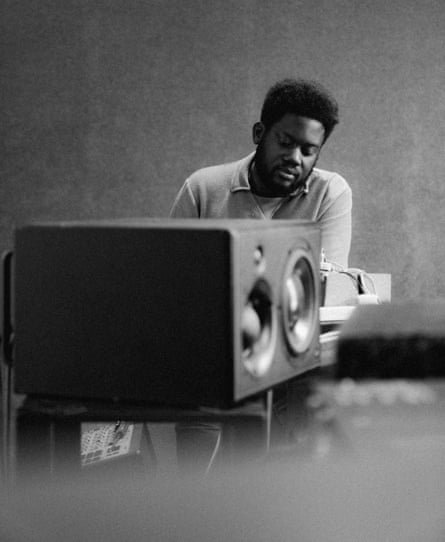
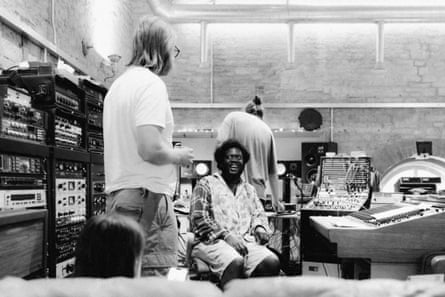
The creative process behind Fudge was different. His first self-produced record, it started life while he was partway through making Small Changes. Fudge, he told Mojo in 2025, in the only preview that ran before the record was pulled, was his chance to take a renegade approach, down to the title: “This is my life and screw everything, I don’t care.” In his downtime, he wanted to keep creating music “to keep the juices flowing”, he says today, and so he invited his live band’s multi-instrumentalist, Joe Connell, down to a makeshift studio in Southampton, which they named Dreamers. Soon, there were eight of them squeezed into this compact space. Kiwanuka had used his Mercury prize money to buy a mixing console, which became the centre of the record.
In Dreamers, jamming sessions alchemised fresh melodies into new work. One night after dinner, he and the band were playing and the track Love in My Heart “came together like one brain. It was almost telepathic,” he says. He is most lucid when talking about music, clearly buoyed up by the memories; his voice lifts with excitement. “It sounded like we had rehearsed it but we hadn’t – it had only come from years of playing together, and it sounded larger than the sum of its parts.” It’s a slow-blooming, languorous seven-minute composition, Kiwanuka’s vocals floating over delicate psychedelic grooves that explode into rich orchestration.
Pianist Steve Pringle played the contemplative outro. “The sound is one of my favourite parts of the album,” says Kiwanuka. “All the music sucks into one and you hear this beautiful piano piece that he just improvised on the day. You can only get these special moments when you’ve got a relationship with musicians you’ve played together with so much.”
It was this moment that convinced Kiwanuka that these sessions weren’t just some romantic indulgence, but the makings of his next album, one looser and more unstructured than ever before. Fudge builds on the direction he set with Small Changes, with his musical output becoming smaller and more personal, rather than bigger and more commercial: he calls it “a continuation of the focus on the melody of the song, the lyrics and the voice, as opposed to big production”. The closeness between Kiwanuka and his band meant that much of the album came together live in the studio, in inspired bursts. He cites the unadorned, heartfelt Move in my Direction: “I played guitar and sang with the string quartet at the same time in the room. That was special. That string moment was written on the spot as well. There’s a lot of that in this album: a real honesty to the playing, sort of blurring the lines between composition and performance.”
Fudge was completed before Kiwanuka’s stroke, but it is difficult to listen to without finding new resonances in light of his illness. He now finds a double meaning in some of its lyrics. On California, he muses on the idea of home: “California rise again / Be my sweet medicine I need / California to live again.” Parts of Small Changes were recorded in Los Angeles, but Kiwanuka says this track wasn’t really about the state: “It’s funny, the word California just sounded good in that part of the song and I couldn’t think of anything else. But that bliss that comes with being in California, I was thinking of that – it feels like eternal sunshine, good food, fresh weather, blue skies.” Does this song make him think quite differently about home now? “Sort of,” he says. “Just being with people you can be yourself with. That sort of blissful state.”
Perhaps the most poignant is the bluesy track Stars, on which he sings: “I remember when I played I used to feel / Now I don’t feel a thing.” With its unruly guitar solos set against more tonal strumming and percussion, it conveys a sense of discord, of being lost. “That’s a bit more resonant now,” Kiwanuka says. It was written many years before it found a home on Fudge. “I wrote that at a time when I hadn’t written songs for a while. I thought I’d lost the ability to write good music,” he says. “I used to focus on my feelings a lot to get music out. And for a while, quite a few years ago, that didn’t seem to work. But I feel like that will work even more now.”
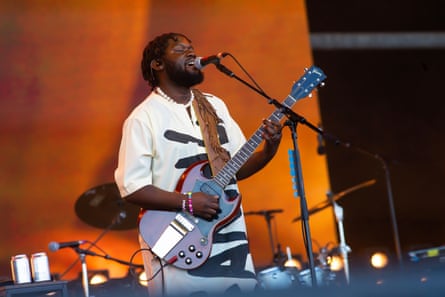
It is not yet clear what the future of Kiwanuka’s music will be. For now, rehabilitation is a day-by-day process. He is incredibly thankful for the care and support he and his family have received from the NHS and medical professionals. “People have been helpful and kind and diligent and patient,” he says. “But it’s been hard as well. Things like sessions of rehab every day, which can get tiring.” What do the rehab sessions involve? “A lot of stretches and getting your body back in shape. The brain injury affected some of the pathways to parts of my body, so I’ve been working on that.” Charlotte reminds him to mention speech therapy. “There was a point where my volume was really low when I spoke because I had a breathing tube, so that affected my vocal cords. I had to re-energise those.”
But music has also aided his recovery. “Singing along to my favourite songs, that’s helped a lot.” What kind of music? “Some Bob Dylan songs, because they are easier to sing,” he laughs, “because it’s more like talking. Some stuff off [the Beach Boys’] Pet Sounds, like I Just Wasn’t Made for These Times. I love the lyrics on that album. Very melancholy, so it reflected how I felt in recovery.” Singing has helped him to talk, improving his vocal volume. And some of the breathing exercises to rebuild his stamina are the same as those he would do on tour, such as blowing bubbles through a straw into a cup: “It soothes your vocal cords.”
Writing has also aided him emotionally. “There was a point in hospital where I had a notepad and I wrote lyrics down every day,” he says. The brain damage from the stroke affected the regulation of his tears, meaning he would cry uncontrollably, all the time, over anything. “So I wrote about crying and how it’s OK to cry and how it feels when you finish crying. You feel better. I never used to cry that much. My brain just didn’t have a filter for that any more.”
Still, even if creativity can help him process those emotions, it does not give him total control over them. “There’s some days of hope, some days of real anger, some days of sadness and loss and grief,” he says. “But it feels quite therapeutic to feel emotions so heavily, and the crying, quite soothing.”
The extent to which Kiwanuka’s stroke has affected him physically is not made clear to me beyond what I can infer from his speech. Even though he is partially disclosing what has happened to him, he is clear that it’s not an invitation for intrusion or speculation. But no doubt fans and well-wishers will be wondering if a sustained return is possible. He can’t truly know yet, and all live commitments are indefinitely on hold, but his ambitions have not disappeared. “I still have as much drive to create good music as I’ve ever done,” he says. He imagines himself leaning more into collaboration, recruiting musicians to play the instruments that he usually plays, and cutting down on travelling and antisocial hours.
Fudge was created to convey a sense of optimism and play, hence its sweet name. Its artwork, by Kiwanuka’s friend Stevie Gee, is a vibrant, psychedelic portrait of a bespectacled Black man surrounded by bright pink swirls. Releasing this album is one way of reclaiming the fun and freedom that had become so important to Kiwanuka. “A stroke can take away a lot of things, but it can’t take those songs away,” he says. “So I’ve got hope from that. Who I was still exists in those songs and in that music.”
KioskNews shows a cleaned-up reading view extracted from the publisher’s page — the original always lives on their site, not ours.