Chile’s Kast meets China’s Xi for first time to steady ties strained by US pressure
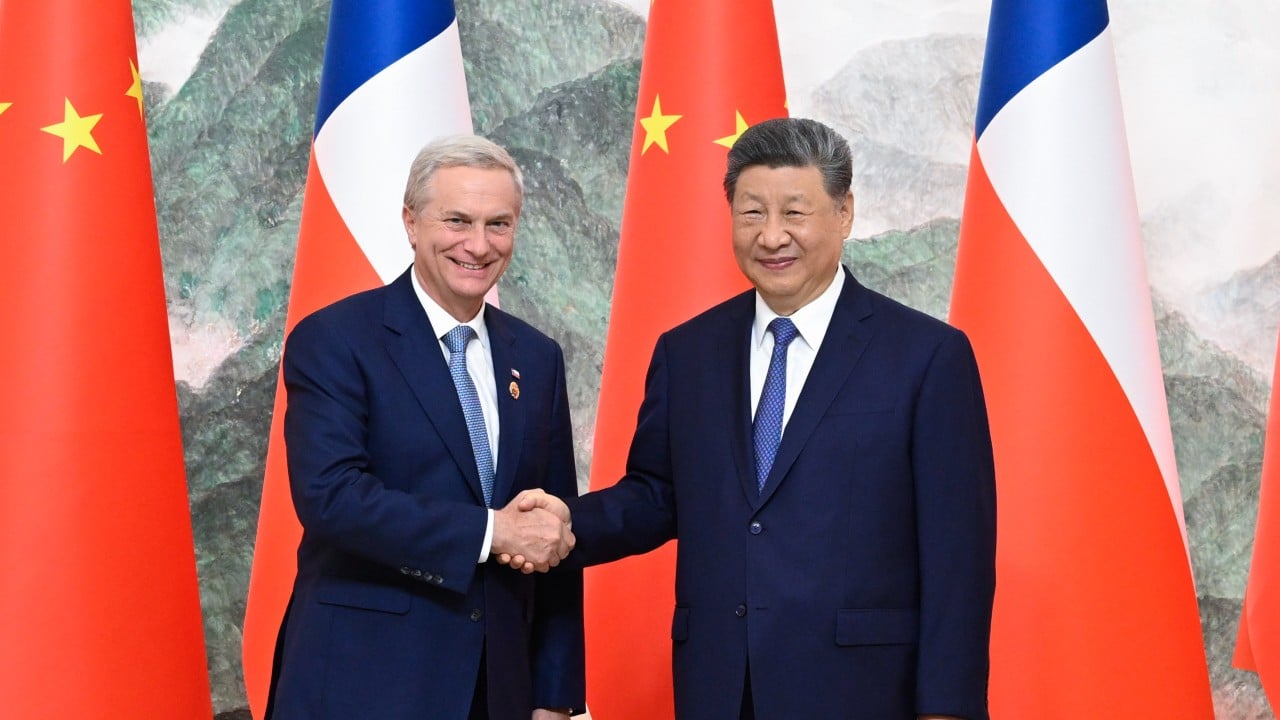
Chilean President Jose Antonio Kast told Chinese President Xi Jinping on Tuesday that he represented “the state, not a political faction”, in their first meeting since he took office in March, after disputes over a Chinese undersea cable and a UN treaty body strained ties with Chile’s largest trading partner.
The two leaders met in Shenzhen a day before the southern Chinese city hosts the Apec leaders’ summit, in a year that marks a decade of their comprehensive strategic partnership and two decades of the free-trade agreement that made Chile the first Latin American country to sign such a deal with Beijing.
Speaking during the public part of the meeting in front of the press, Kast opened by saying relations had “remained stable, beyond internal situations that may have affected our country”. He also praised China for lifting people out of poverty.
“Chile has been an example of democratic handovers from one political persuasion to another, and we are always grateful for the respect shown for the way we govern ourselves, just as we respect the political organisations of each nation,” he said in the same remarks.
According to state news agency Xinhua, Xi told his guest that ties were at a “crucial moment” to “open a new future”.
10:37
Why the US is worried about China’s growing influence in South America
He proposed keeping up cooperation in trade, energy, mining, infrastructure and astronomy while expanding into artificial intelligence, polar research and deep-sea exploration.
Kast spoke of the “20,000 kilometres” between the two countries and the trust that had allowed them “to progress together”, but acknowledged that Chile, after years of strong growth, was “going through a somewhat more complex moment”.
His government had cut taxes and eased regulation to bring in investment, he told Xi before the talks moved behind closed doors.
Neither side’s public account of the meeting mentioned the UN High Seas Treaty, which governs marine biodiversity in international waters.
Pushing for Xiamen, China accused the two countries of “deciding behind its back on a matter it said all parties should settle together”, while Santiago defended its bid and said it respected the Chinese proposal.
Speaking to reporters afterwards, Kast said business leaders from both countries had also met during the visit.
“They are our main trading partner, and we value that and we look after it,” he said. Xinhua reported that he also raised the possibility of working together on electric vehicles without giving details.
“Those of us who are resource-rich countries do not want to merely be a place where raw materials are extracted,” he said.
“We want processing, research and innovation to happen there as well.”
Most Chilean copper is exported as unprocessed concentrate, and about 60 per cent of those shipments in the first half of the year went to China, according to central bank figures.
The United States is the main buyer of Chile’s refined copper. Foreign Minister Francisco Perez Mackenna, who travelled with Kast, said in July that Chile needed to find more buyers for its copper and aimed to attract about US$100 billion in mining investment over the next decade.
Cable dispute and US tariffs
The transport minister in Gabriel Boric’s outgoing government signed a decree in January opening proceedings on the project, only to rescind it two days later after the US embassy warned of security risks.
In late February, US Secretary of State Marco Rubio imposed visa restrictions on three Chilean officials over the cable.
Boric later said he had ordered the reversal after explicit threats from Washington, including the possibility of Chile losing its place in the US Visa Waiver Programme.
China’s ambassador Niu Qingbao said this month that the project was still alive and that the previous government had been wrong to suspend it under US pressure.
Chile had previously blocked Chinese-backed projects on security grounds.
08:25
How Maduro’s abduction is set to change Latin America
In 2021, then-president Sebastian Pinera cancelled the Antipodas plan to export solar power from the Atacama Desert to China and halted an astronomical observatory at Cerro Ventarrones built with the Chinese Academy of Sciences after a US ambassador warned it could be used to track satellites.
A White House report released in August then named Chile among nine Latin American countries it accused of helping Chinese exporters evade US tariffs by re-routing goods through their territory.
China buys 37 per cent of Chile’s exports, mainly copper, lithium, lemons and cherries, and supplies a quarter of its imports.
Bilateral trade reached US$65.33 billion last year. The United States remains Chile’s largest foreign investor, with a cumulative US$12.5 billion compared to China’s US$4.6 billion, according to the Economic Commission for Latin America and the Caribbean.
Kast was due to have lunch with Peruvian President Keiko Fujimori in Shenzhen on Wednesday before flying to Japan to meet Prime Minister Sanae Takaichi.
KioskNews shows a cleaned-up reading view extracted from the publisher’s page — the original always lives on their site, not ours.