Geoff Russ: Anglo-Canadian culture lives
Does Canada — or Anglo-Canada, to be precise — have a culture?
Sign In or Create an Account
Last week, people around the world learnt of the existence of Soirée canadienne, a television program that aired in Quebec from 1960 to 1983. Host Louis Bilodeau brought folk singers and other performers into living rooms across the province, showcasing songs that were hundreds of years old.
Well into the era of smartphones, the show has been rediscovered, and its clips have spontaneously garnered tens of millions of views on social media. Why are the clips so popular?
Novelty is certainly part of it. But they also tap into an almost primordial instinct that has largely faded or been suppressed in Canada and other comparable societies. That suppression has left a massive, seemingly unfillable void in modern life.

Columnist Jesse Kline keeps you up to date with what’s happening in Israel and the effects of antisemitism on life here in Canada. Friday mornings.
By signing up you consent to receive the above newsletter from Postmedia Network Inc.
A welcome email is on its way. If you don't see it, please check your junk folder.
The next issue of Channel Israel will soon be in your inbox.
We encountered an issue signing you up. Please try again
In response to the viral clips, former Alberta premier Jason Kenney wrote of Soirée canadienne, “It’s obvious these songs were passed on from generation to generation, and represent a sense of shared culture and love of home. They make us nostalgic for a simpler time of shared meaning and identity.”
It is good that the native traditions of Quebec are finding a global audience. Even better, their popularity proves that people have not lost their hunger for connection and continuity with the past.
On the other hand, one side effect of Soirée canadienne’s online revival is the resurgent accusation that “Canada would have no culture without Quebec.”
Ironically, the online world now discovering Soirée canadienne spent last October digging up Ontario-born Gordon Lightfoot’s classic song, “The Wreck of the Edmund Fitzgerald,” on the 50th anniversary of the eponymous vessel’s disappearance on Lake Superior after the gales of November came early. Very soon, the song was skyrocketing up the Billboard charts.
Lightfoot’s folk ballad about the lost freighter became a social media phenomenon, drawing younger generations into the tale of the disaster on the Great Lakes. A Canadian musician turned a tragedy on the American side of the lake into an iconic song across the English-speaking world.
Soirée canadienne itself, which ended in 1983, had a spiritual sister show of sorts in the Toronto-produced Pig and Whistle, which ran until 1977. That show recreated a rowdy British pub where people in period costume sang and danced around tables before a seated studio audience.
There is a strong element of corniness to both shows, and a retrospective viewer is as likely to cringe as they are to smile at times, but their popularity reflected the tastes of the time.
Regarding Quebec’s louder expressions of culture, it is key to remember that the province is home to a linguistic and cultural minority within Canada and the rest of North America. Maintaining a francophone and Québécois public life there requires deliberate effort and attention. The visibility of that effort, however, should not be mistaken for an absence of culture elsewhere in Canada.
When people say that the rest of Canada is culturally vapid, they do so while participating in behaviours and customs that do, in fact, set it apart.
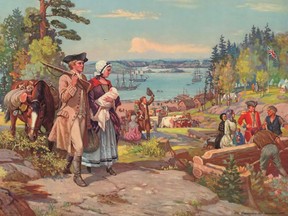
We just celebrated Thanksgiving, which many people sneer at as a sort of imitation of the American version in November. The timing and historical significance of our Thanksgiving do not get enough credit. First, it is usually held on a warmer and longer October day. Second, the traditions we associate with it were largely brought over by the Loyalists, who established them in Ontario and the Maritimes.
These are centuries-old connections, placing Thanksgiving among our most deeply rooted holidays in Anglo-Canada, whatever date Canadian officials eventually assigned it. The custom of a harvest feast was not invented by any government. Nor did the American Revolution strip those who left the Thirteen Colonies of their own history.
There is more to Thanksgiving than the food or its historical origins. The customs that make the holiday meaningful include turning up when invited, waiting one’s turn at the table, and knowing when and how to express political opinions. Such social cues and obligations, learned from childhood, shape how a people live together and who gets invited to their tables.
Much as latecomers from Britain and elsewhere adapted to what was built by the Loyalists, people today from a multitude of backgrounds have knowingly or unknowingly become part of Anglo-Canada today.
One reason Anglo-Canadian culture feels far less remarkable is simply that it is part of the wider Anglosphere, whose literature, music and norms are deeply interwoven. A person can read a book written by a Canadian author, listen to British music, and watch an American movie starring Australian actors on a single weekend.
The best analogy is how a person in Chile can watch a Mexican television show, read a Colombian novel, and listen to Argentine music in the course of a day. Much like the Latin American world, the Anglosphere is a post-imperial zone whose majority cultures do not differ sharply from one another.
The English language itself will continue to dominate, whether Canadians tell their own stories or somebody else’s. That being said, there is a great danger in mixing up the linguistic security of English with national permanence.
For generations, Anglo-Canada has been deliberately eroded as a conscious, celebrated culture, with its flags and anthems surrendered in the name of national unity. That erosion has gone even further as the term “colonial” has become an academic synonym for “British,” making that heritage a target for erasure in the name of “decolonization.”
If there is one thing to learn from Soirée canadienne, and Quebec more broadly, it is to take your own nation and people seriously rather than assume their security is guaranteed. For that reason, attachments to your past are worth maintaining.
The show’s viral clips demonstrate that new technology can circulate local traditions and give them purchase in 2026. In fact, a more self-aware Anglo-Canada might even get along far better with Quebec if it too recognizes the value of cultural preservation.
In 2026, the survival of local cultures is a choice. Whether Anglo-Canada has the will or desire to consciously live as one, rather than be united merely by the lingua franca of an economic zone, will have enormous consequences for Canada — and not necessarily bad ones.
National Post
Join the Conversation
This website uses cookies to personalize your content (including ads), and allows us to analyze our traffic. Read more about cookies here. By continuing to use our site, you agree to our Terms of Use and Privacy Policy.
KioskNews shows a cleaned-up reading view extracted from the publisher’s page — the original always lives on their site, not ours.