The Socceroos were unrecognisable against Brazil as a ‘new golden generation’ takes shape | Joey Lynch

Even before a ball was kicked in the Socceroos’ two-game series against Brazil, Tony Popovic was musing about the shift in demeanour he’d noticed among the players. Yes, it had only been three months since they last saw each other at the World Cup, but change, the coach felt, was afoot. And while that may not seem like sufficient time for a notable shift in mentality, it would be in keeping with a journey that began more than 12 months ago, when their World Cup qualification was sealed early.
Because as well entrenched as the players may now feel in the squad and the public consciousness, it’s worth remembering that when Australia beat Saudi Arabia and punched their tickets to North America in June 2025, neither Nestory Irankunda nor Mohamed Touré were regular selections. Their true international breakouts came in the October friendlies against New Zealand. Paul Okon-Engstler, Patrick Beach, and Lucas Herrington had not made their debuts, while Cristian Volpato was still playing for Italy’s junior teams. Jacob Italiano was toiling in relative obscurity in Austria and Tete Yengi was known as “Kusini’s younger brother”.
Now, though, they’ve all been to a World Cup and most have secured moves to the sink-or-swim surroundings of bigger leagues, with Herrington’s rise taking him from the A-League Men to the Premier League via MLS in 12 months. Their clubs’ expectations on them are higher, and Popovic says their “understanding of the game is certainly improving”.
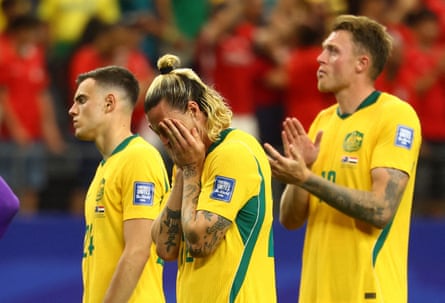
Assembling for the first time since their penalty shootout elimination against Egypt, the Socceroos acquitted themselves well against the Seleção in Queensland, letting a lead slip late and drawing 1-1 on a horror pitch in Townsville, before fading in a fiery 4-2 defeat in Brisbane. And, results aside, there was an air that the Socceroos took a step forward in both games.
The hard running and physicality expected of them were still there – until the late fadeouts when the strength of Brazil’s depth showed as they finished strongly. Yet within this framework there was a shift in Australia’s intent, too. A willingness to press higher, to drive between the lines, make the risky pass, and to try to play, not just battle, their way out of trouble.
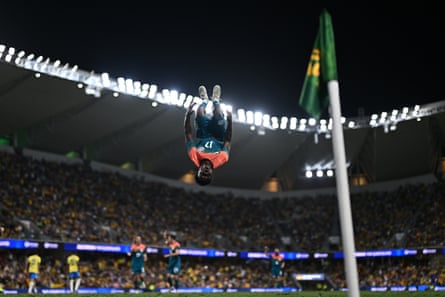
Admittedly, it didn’t always come off, it taking significant commitment and continuity to bed these kinds of things in, and pressing higher meant there was space behind for Brazil to exploit. But the contrast between how the Australians’ intent compared with previous performances was remarkable; night and day from the side that bogged down against Egypt in the World Cup round of 32, or were blown out of the water by the United States in the first half of their group stage loss.
after newsletter promotion
“It’s something that we worked on throughout the whole camp,” Okon-Engstler said. “We wanted to be more aggressive with the ball and to be a bit more controlling through those stages of the game. I think there’s a lot of confidence to take out of these two games and the way we played.”
That Okon-Engstler was the final player to speak to media before the Socceroos dispersed on Wednesday – Miloš Degenek and Paul Izzo jumping in a car with declarations they were off to Dreamworld – felt apt. For not only was he one of the Socceroos’ most impressive players across the series, he’s also emblematic of their evolution.
The 21-year-old’s ability to operate in tight spaces, turn upfield and break lines represents the type of midfielder the Socceroos need if they’re to build upon their Brazil performances. Okon-Engstler’s career progression – trading Sydney FC for 1. FC Köln and the Bundesliga since the World Cup – is the exact kind of challenge Popovic wants his players to embrace if they’re going to match the battle-hardened top nations. The midfielder is undergoing a rapid education as he is forced to adapt to the pressure, intensity, physicality and standards associated with the German top-flight.
“When [Okon-Engstler] physicality comes out even more, I think it’s going to be quite frightening,” Jackson Irvine said. “I’ve played with quite a few players in those areas over the last few years, and he’s a talent.”
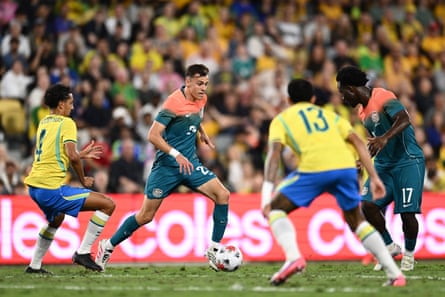
Remarkably, given how comfortable he looks at international level, Okon-Engstler only debuted last November. And while the 12 months of tinkering and experimentation Popovic undertook after securing automatic qualification was framed around the World Cup, this shows how its flow-on effects will reach far beyond it.
Indeed, in time, those wins over Japan and Saudi Arabia in June 2025 could prove some of the most defining the Socceroos have had in decades. Because without them, if the Socceroos were still playing qualifiers into 2026, this crop of players now seen as driving a new era would likely not have had their chance to break in, to go to a World Cup, secure club moves, and take that next step.
Instead, alongside the likes of Alessandro Circati and Jordan Bos, who debuted under Graham Arnold, the Socceroos have a contingent of youth that former Socceroos coach Frank Farina this week described as a “new golden generation”.
The Australian public is on board, too. A year ago, your average punter would have struggled to pick Beach or Okon-Engstler out of a lineup. Now, they’re selling out stadiums and thousands of kids are showing up to open training sessions to see them. And the journey could just be getting started.
KioskNews shows a cleaned-up reading view extracted from the publisher’s page — the original always lives on their site, not ours.