Tesla Roadster Fires Up SpaceX Tech for ‘Flying Car’ Demo

On Thursday night in Texas, Tesla unveiled the long-awaited, production-intent second-generation of its Roadster electric sports car, showcasing a wild array of unbelievable party tricks, including driving upside down, performing aerial barrel rolls and hopping over other cars with the aid of SpaceX thruster and suction technology.
Surprisingly, the angular coupe that rolled onto the stage looked almost nothing like the curvaceous concept car that the automaker revealed almost nine years ago. Back in 2017, Tesla’s would-be halo car targeted a 1.9-second 0-60 time, 620 miles of range and production in 2020. That deadline came and went, and the Roadster was delayed multiple times as Tesla CEO Elon Musk shifted his focus from robotics to robotaxis to politics. The new-look Roadster seems to be built as a showcase of the combined might of the cross-owned, Musk-helmed tech giants: Tesla, xAI and SpaceX.
‘This car sucks’
The demonstration opened with the new Roadster showcasing its angular Cybertruck-inspired design from an unconventional angle: by driving up a massive ramp and onto a wall where it was held vertically by suction fans. Tesla Vice President of Engineering Lars Moravy, on stage at the event, later said the underbody system can generate up to 2Gs of suction, allowing the EV to stick to the road — and apparently walls as well.
“I mean, this car really sucks,” Musk added. “This car could suck the chrome off a trailer hitch. It could suck a tennis ball through a hose pipe.”
What a class act.
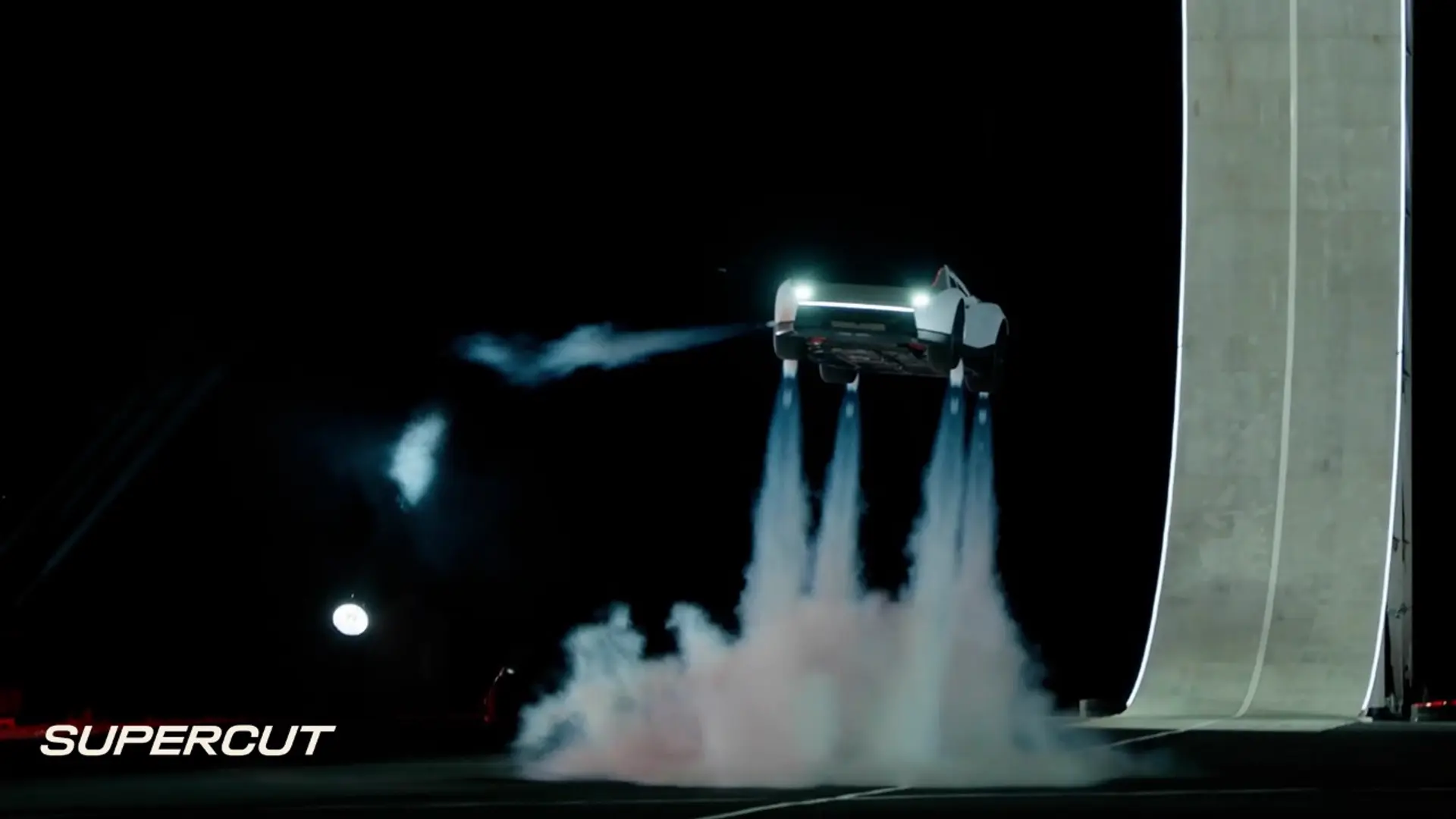
Next, the Roadster backed up, stopped and accelerated toward the C-shaped ramp again, driving upside down momentarily before launching into the air, performing a barrel roll with the aid of 10 SpaceX cold gas thrusters located under and around the vehicle’s body — the same tech used to adjust the position and attitude of satellites and craft in zero-g space. As the night continued, the Roadster was shown hopping over a lineup of Tesla vehicles while performing another barrel roll, its thrusters causing the EV to pivot in midair and cushion its landing.

I’m no rocket scientist, but I’m not sure the vehicle on display was a fully functional car that a human can drive. The windows appeared completely opaque, hinting at no cockpit, and the aerobatics seemed implausible for a long-range EV, often laden with hundreds of pounds of battery. More likely, this was a stripped-down, remote-controlled mule with just enough battery onboard to complete the demo, and it’s highly unlikely that we’ll see a true production flying car equipped with this tech.
2028 production target
Aside from the promise of pirouetting over traffic, the Tesla Roadster’s on-road performance is said to be impressive.
In addition to the promised ability to corner at more than 2 g of lateral acceleration, the company says the electric sports car will complete a 0-60 mph sprint in 1 second, or 0.81 second with the aid of the SpaceX thrusters. The automaker says the top “Rocket” spec will be a limited-edition, “invite-only” model not available to the public. (I’d wager these “flying cars” wouldn’t exactly be street-legal and would be limited to closed-course shenanigans.) All of these figures are Tesla’s own and have yet to be independently confirmed.
Musk said the car would be offered in three trim levels, including the Rocket Roadster, and that Tesla is aiming for a production target sometime in 2028. Tesla did not reveal final prices, updated range estimates or any other relevant details, but reservations have opened at a hefty $50,000 apiece on the Roadster reservation page.

Senior Writer, Electrified Cars
Antuan has nearly 20 years of expertise and experience testing hundreds of cars, including electric, hybrid, plug-in hybrid, hydrogen, and traditional combustion vehicles. See full bio
KioskNews shows a cleaned-up reading view extracted from the publisher’s page — the original always lives on their site, not ours.