From bird corners to MRT stations: How seniors in Singapore find community in everyday spaces
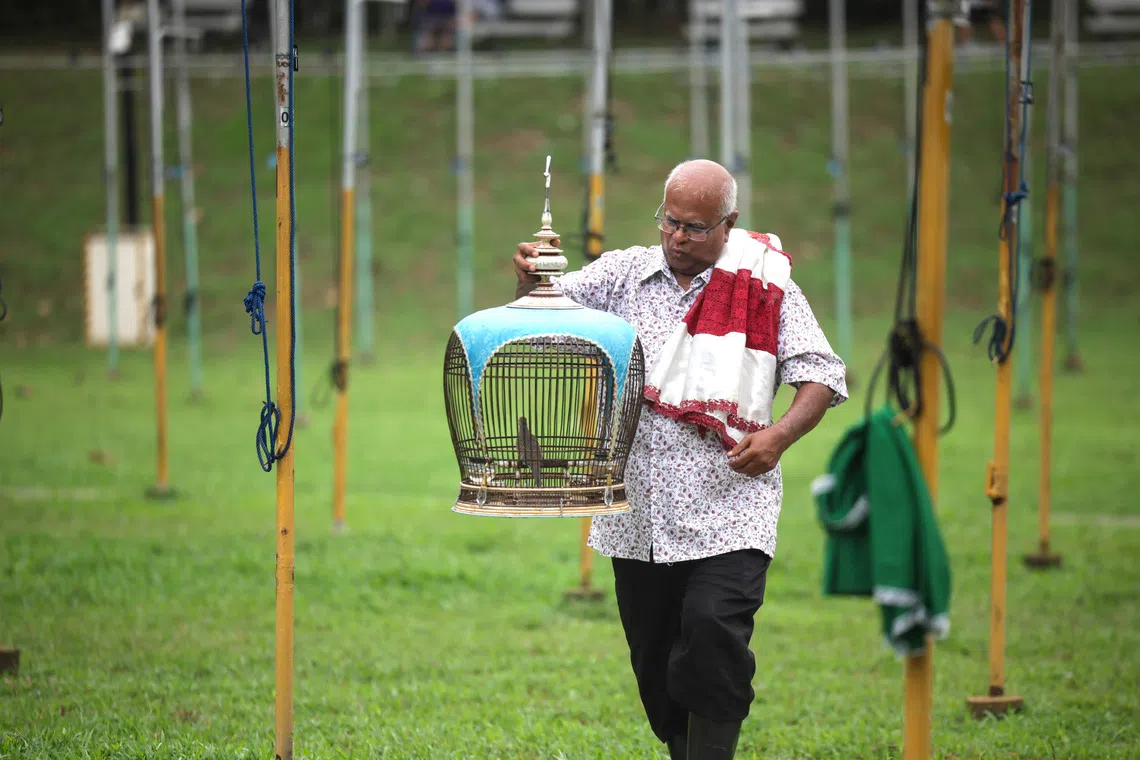
Cab driver Bashir Peermohamad, 69, has eight birds. The youngest one, named Ah Boy, is barely eight months old.
ST PHOTO: GIN TAY
SINGAPORE – For more than 35 years, cab driver Bashir Peermohamad has made the Kebun Baru Bird Corner part of his morning routine.
Three to four times a week, he spends about four hours each time there with his feathered companions.
The 69-year-old Yishun resident has eight birds – all zebra doves – with the youngest named “Ah Boy” barely eight months old.
To Bashir, the corner is an “international exchange”, where birds hanging in cages show off their vocal prowess from every direction.
“Here, you get to admire all kinds of birds singing,” he said, binoculars in hand as he tried to catch a glimpse of his pet birds from afar. “I can recognise my birds from their singing.”
The community around him is just as diverse.
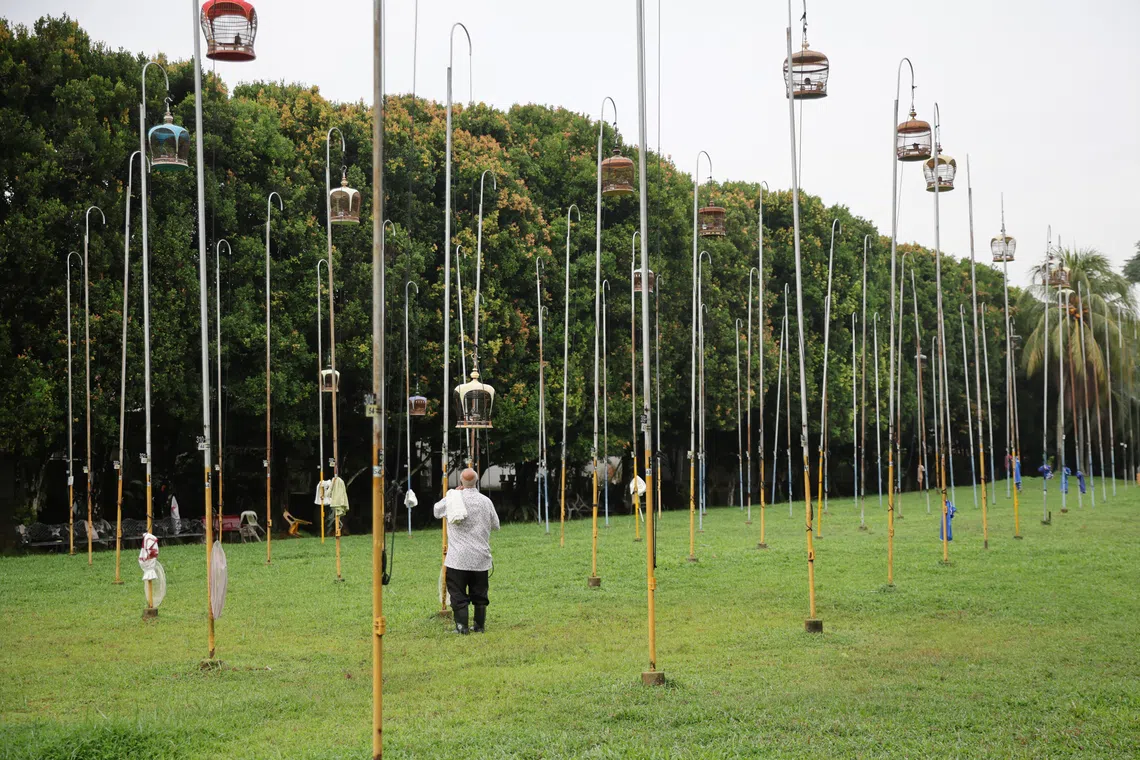
The Kebun Baru Bird Corner is like an “international exchange”, where birds hanging in cages show off their vocal prowess from every direction.
ST PHOTO: GIN TAY
“I have, like, 100 friends here,” he quipped. “They come from all over Singapore, even as far as Bukit Batok, Jurong East and Boon Lay.”
For men like Bashir, the bird corner is more than a place to indulge in a hobby. It is what sociologists call a “third place”, somewhere outside the home and the workplace where people gather and find a sense of belonging.
Such informal gathering spots like coffee shops and neighbourhood markets can play an important role in helping seniors stay socially connected as they age.
When The Straits Times met Bashir on Oct 26, he was sharing a breakfast of toast and kopi with two other bird hobbyists.
When this reporter asked if they could pose for photos together, his two companions shied away.
Unperturbed, Bashir walked to a nearby field and called out to two other men, who readily agreed to pose with him.
“These are my buddies, too,” he said, pointing to retired laundry operator Mohamed Rosman, 65, and part-time pump attendant Omar Ahmad, 71.
The three men pulled up plastic chairs at a corner and started chatting about their pet birds.
Rosman, an Ang Mo Kio resident, has been a familiar figure at the bird corner for about 40 years.
He visits daily, spending four hours there with his 10 zebra doves.
“If my birds don’t come here for ‘sun-tanning’, they will feel sad,” he said in a serious tone.
Omar, who lives in Punggol, has made the bird corner his frequent haunt for 30 years.
He spends about $40 monthly on his 10 birds of different species and brings a different one to the corner once or twice weekly on his days off.
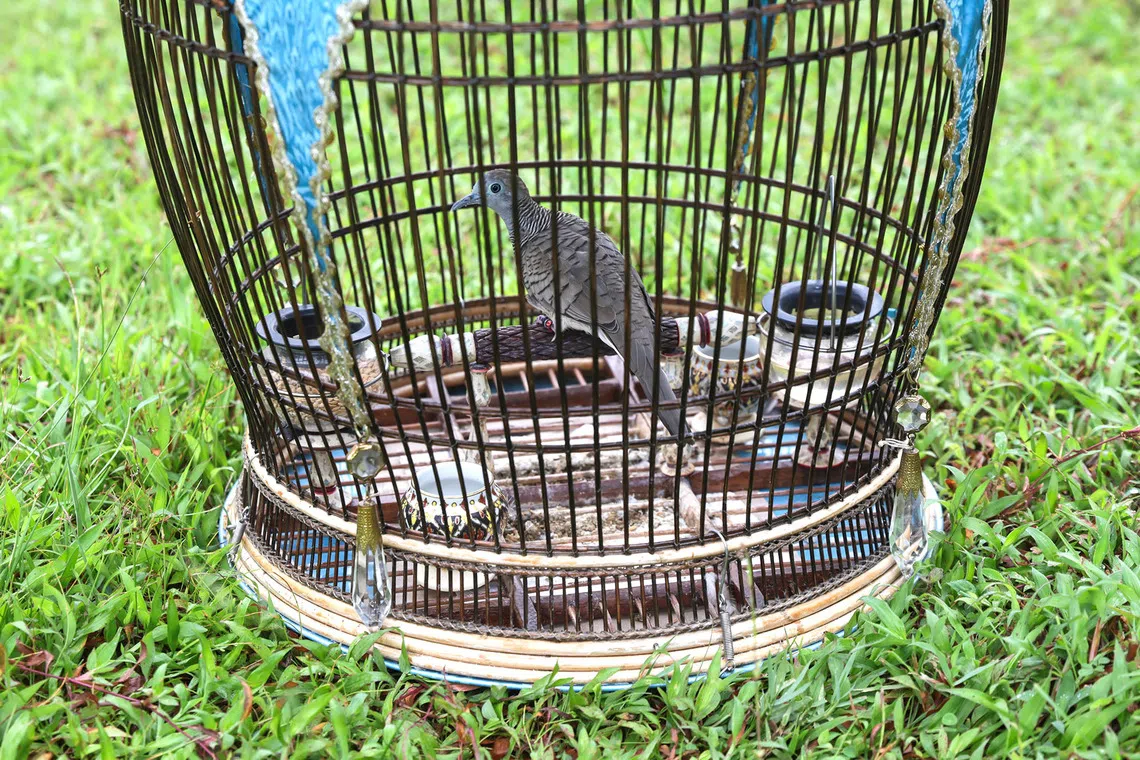
One of Bashir’s eight zebra doves.
ST PHOTO: GIN TAY
“I enjoy coming here, hang up my bird cage and chit-chat with friends,” he said.
Asked if they had joined any activities at an active ageing centre (AAC), the men shook their heads.
“I don’t like to stay indoors and take part in the organised activities,” said Bashir. “I’m healthy, so I prefer to walk and mix around as I like.”
What makes a good third place?
The bird corner illustrates how everyday neighbourhood spaces can become natural gathering spots, offering sunlight, fresh air and seating where people can gather and interact.
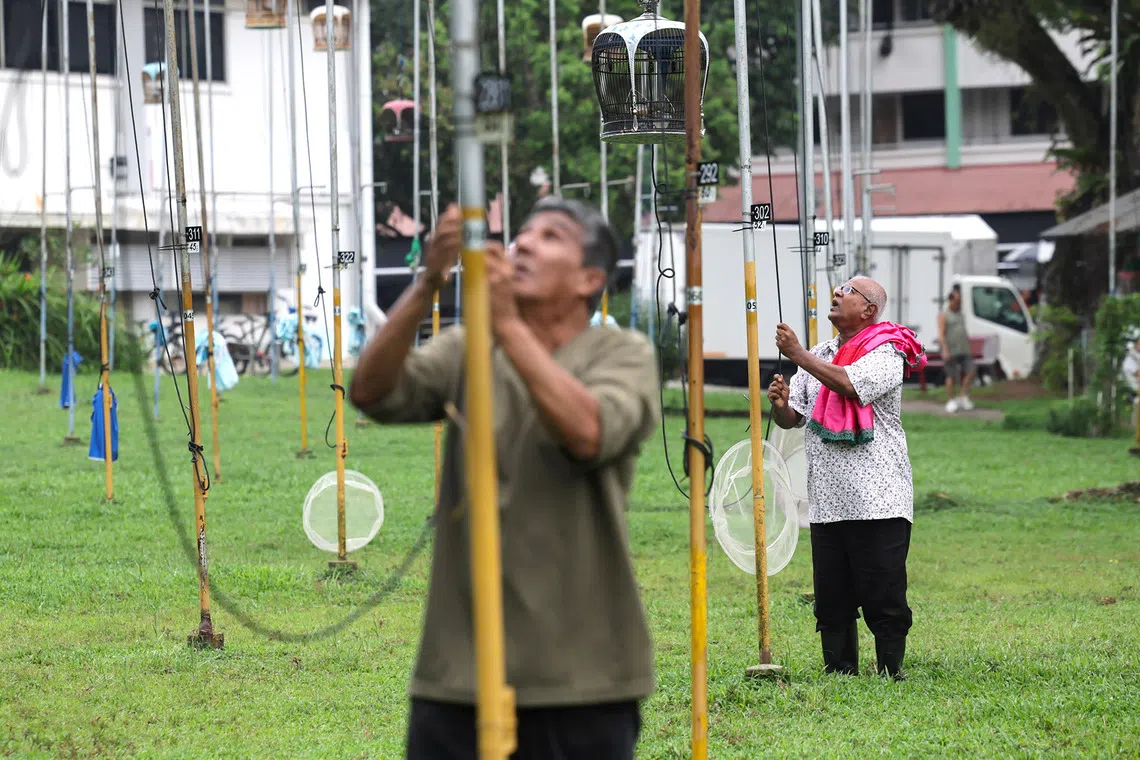
Omar (front) and Bashir positioning their bird cages. They can recognise their birds from their singing.
ST PHOTO: GIN TAY
The term “third place” was coined by American sociologist Ray Oldenburg in his 1989 book The Great Good Place. It refers to the social surroundings separate from the two primary environments of home (”first place”) and work (“second place”).
Associate Professor Emi Kiyota, director for the Centre for Environment and Ageing Well at National University of Singapore’s College of Design and Engineering, said three key features that encourage spontaneous social gatherings, particularly among older men, are an open space with movable chairs, natural ventilation and shade.
Movable chairs allow people to arrange their seating however they like, while shade and natural ventilation make these outdoor spaces more comfortable for lingering.
“Informal spaces can become an ibasho (Japanese for “a place to be”) – where people feel a sense of belonging, both physically and psychologically,” said Kiyota, who is studying how informal, community-led gathering spaces support ageing in place in Singapore’s neighbourhoods.
She has observed that while older men tend to gather informally in familiar places, women are more willing to join organised activities at AACs.
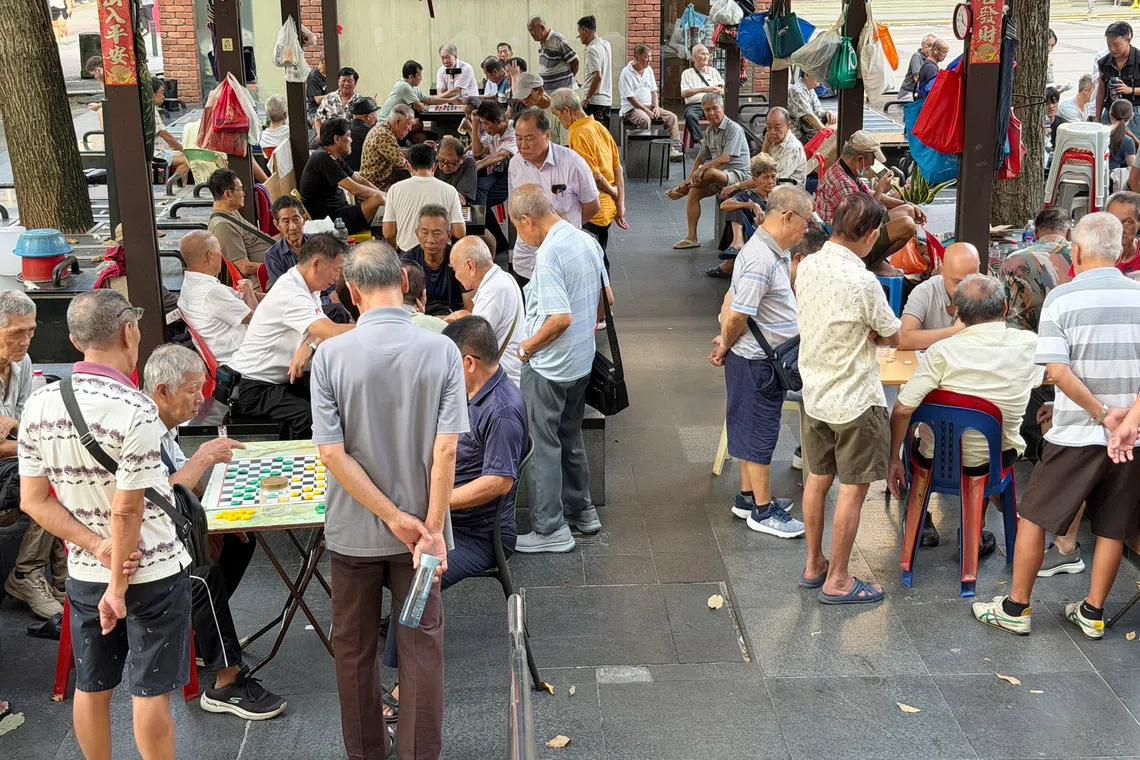
Elderly men playing board games like checkers in front of Chinatown Complex on June 28.
ST PHOTO: STEPHANIE YEOW
Paulin Straughan, director of the Centre for Research on Successful Ageing at the Singapore Management University, said a third place can be any well-located and well-equipped shared space where seniors can gather.
These include more formal spaces, such as AACs, community clubs and libraries.
But having a physical space may not be enough. What happens there matters, too.
One key characteristic of an impactful third place is purposeful programming, said Straughan.
While activities need not be designed around specific outcomes, they can turn spaces into places where friendships take root.
For instance, an exercise corner with age-appropriate equipment may attract seniors to work out on their own.
But organise a daily group exercise session with music, and the same corner can become a regular place where seniors build friendships that extend beyond their workouts.
Neighbourhood hawker centres and coffee shops also have tremendous potential, Straughan added.
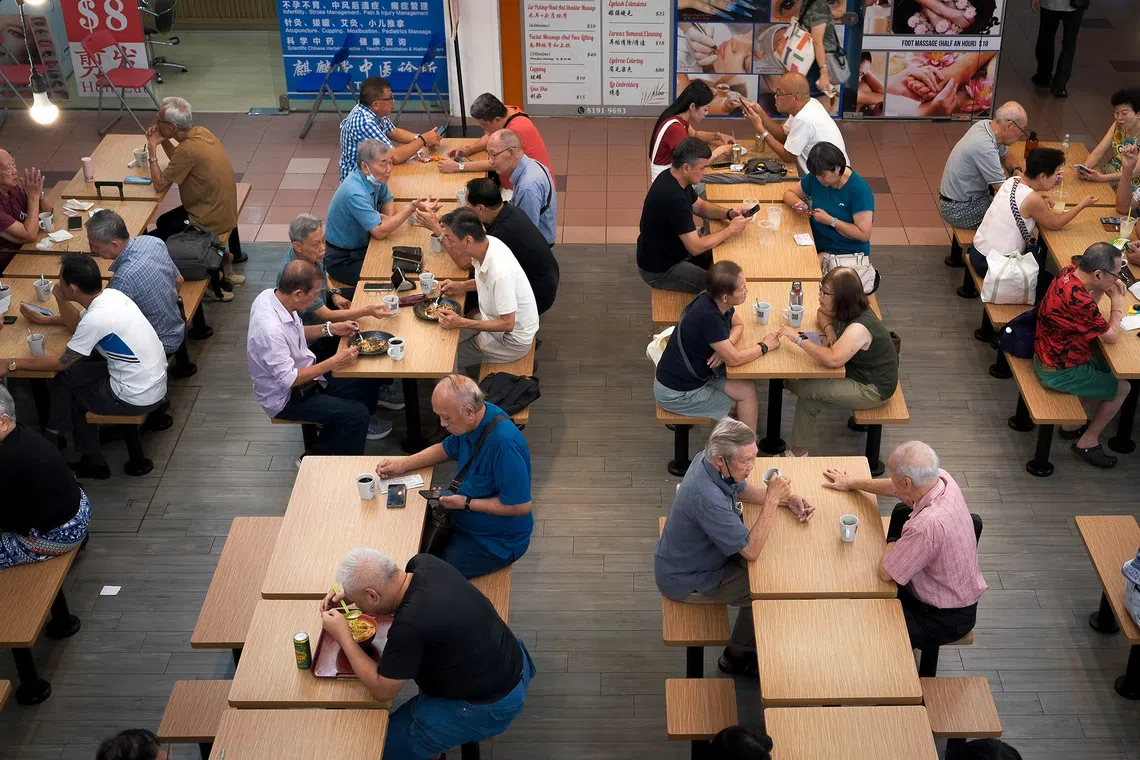
Elderly patrons sitting and chatting at a coffee shop in People’s Park Centre on May 17.
ST PHOTO: GAVIN FOO
“If we intentionally transform them into community kitchens, it will be so cool to be able to stroll down to our hawker centre, meet friends at our regular tables and enjoy good food and fellowship at every meal,” she said.
Such programming should grow organically from the community, she said.
A void deck where residents do not naturally congregate, for instance, is unlikely to become a third place simply by design.
Instead, adding fans, comfortable tables and chairs and a refreshment corner could make it more inviting. Neighbours could be encouraged to meet regularly to share home-baked treats over tea and coffee.
Kiyota cited the work of William Whyte, an American researcher who studied public spaces in New York City, and identified seven elements that attract people. These are places to sit, connections to the street, sunlight and shade, trees and greenery, water, food, and what he calls “triangulation”.
The last refers to features such as sculptures, fountains or performances that provide strangers with a shared point of interest and encourage spontaneous interaction.
“These findings remind us that we may already have many of the things we need,” said Kiyota. “The key is to coordinate and make effective use of our existing assets so that community members have more opportunities for informal encounters and social interaction.”
She added: “Compared with older buildings with void decks, newer buildings offer different spatial experiences that may limit opportunities for older persons to gather informally and socialise.”
Finding new spaces
Malls and MRT stations are also emerging as venues for seniors to socialise.
To retired human resources executive Yvonne Pan, Punggol Coast MRT station is more than a transport node. It is also where she flexes her muscles and shows off some nimble moves in full view of the public.
The 65-year-old joins close to 20 other seniors from St Luke’s ElderCare Active Ageing Centre (Care) @ Northshore for an hour of Zumba Gold at the amphitheatre weekly.
Pan, herself a line dancing coach at the AAC, said: “I don’t find it strange to be dancing here. It’s good that many people can see us. They may be encouraged to join us.”
She also appreciates the amphitheatre’s spacious layout and natural ventilation.
Among the participants on Nov 4, 2026, was her husband Albert Yeo.
The 67-year-old retired businessman used to avoid AAC activities.
“Most of the seniors in AACs are female. It’s mostly the aunties who go, with few uncles like me,” he said.
This changed when he discovered that the AAC has a pool table.
Yeo is now an active member of the AAC and volunteers as a befriender, making door-to-door visits to other seniors.
Part-time administrative assistant Tan Puay Hua, 66, said it is a “novelty” to exercise at an MRT station.
She was smiling widely as she followed instructor Sim Wen Jie’s every instruction and move.
“Act cute! Give me an apple! Now ride a horse. Next be Superman! Must have feeling!” he cheered the seniors on through the booming music.
“This makes me feel young again,” Tan said.
Then, with a grin, she added: “But in the first place, I don’t think I look my age right?”
The ties that bind
For retired engineer Victor Yue, the gradual disappearance of familiar faces has chipped away at his connection to Chinatown, his third place.
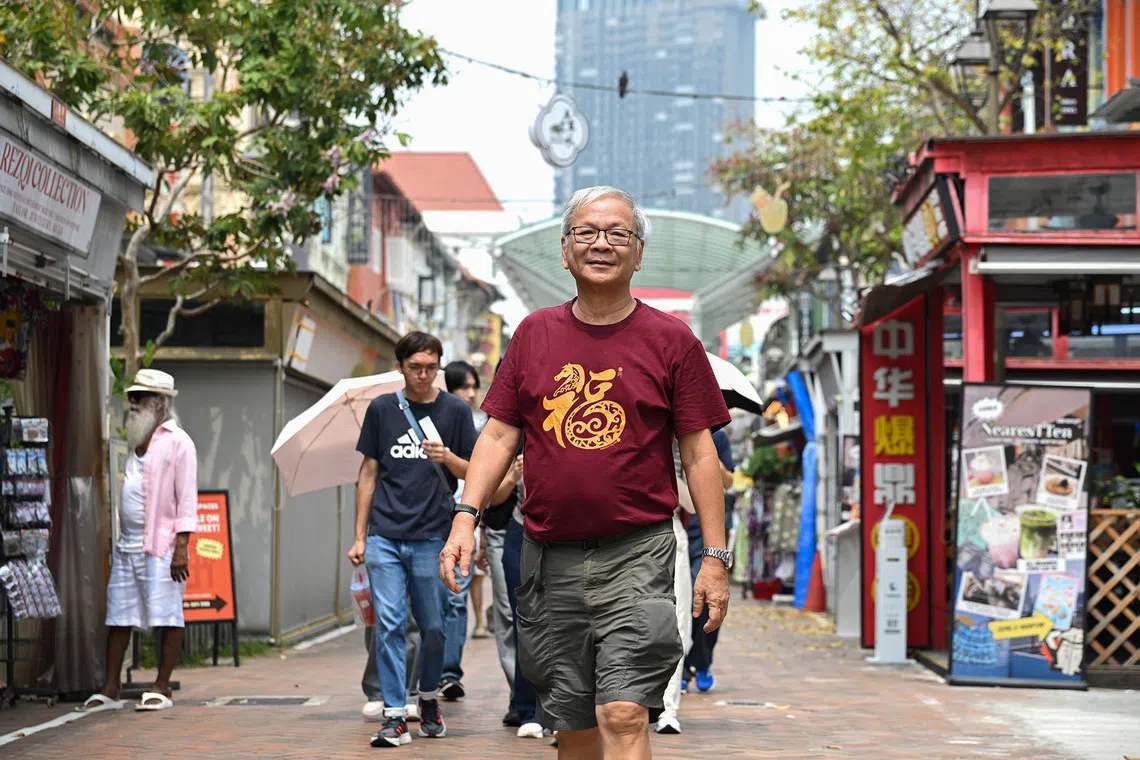
Retiree Victor Yue, 74, on his way to meet friends in Chinatown on Oct 23.
ST PHOTO: AZMI ATHNI
“Chinatown has witnessed many changes and some of the shops have closed down due to high rents,” the 74-year-old said, citing Hup Ka Foon in Sago Street as an example.
The Cantonese dessert shop shuttered in March and has since relocated to Orchard Towers.
Yue grew up in Craig Road and now lives in Upper Cross Street, a 10-minute walk from Chinatown Complex.
He knows the neighbourhood inside out and has forged friendships with many shopkeepers.
One of them is Syed Abdul Kader, 55, whom he has known for more than 20 years.
Kader sells a wide variety of items, including traditional Chinese wear and cheongsams, at Best Classic Corner in Chinatown Complex.
He speaks nine languages, including Mandarin, Malay, Tamil, English and Japanese as well as a range of Chinese dialects.
The two men call each other “uncle”.
Yue is often among the first to see Kader’s latest stock, which he then helps promote on social media.
“Customers recommended by him will get 10 per cent off all prices,” said Kader.
Yue also pops in and out of other shops, including Pek Sin Choon, a 101-year-old Chinese tea business in Mosque Street.
When ST followed him around on Oct 23, he walked into the tea shop and asked for its boss, fourth-generation owner Kenry Peh.
Peh, 57, happily sat him down over freshly brewed cups of tea.
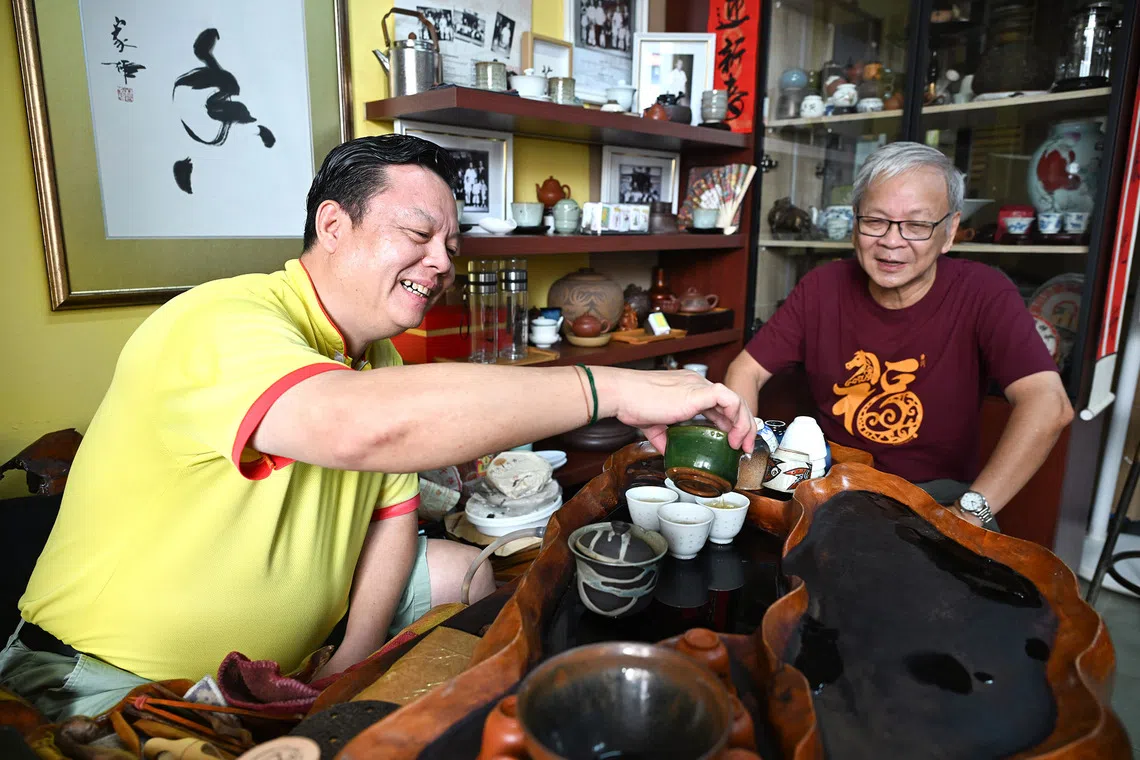
Yue drinking tea with Kenry Peh, 57, the fourth-generation owner and tea master of Pek Sin Choon, at his shop in Chinatown.
ST PHOTO: AZMI ATHNI
The two men spoke in Hokkien, discussing ideas for events and catching up on happenings in the neighbourhood. Such conversations can go on for hours, they said.
“This is kampung style,” said Peh. “Even among the shopkeepers, we always walk in and out of each other’s shop and offer help whenever needed.”
Yue drops by for tea weekly. Occasionally, he gets to sample Peh’s new tea blends.
“I get to know some secrets of teas, but since I’m a bad student, I only know how to drink tea,” he said with a chuckle.
ST Photos and videos by: Azmi Athni, Gin Tay and Kevin Lim
Produced by: Amelia Teng, Chin Soo Fang, Stephanie Yeow and Yu Sheng Sin
KioskNews shows a cleaned-up reading view extracted from the publisher’s page — the original always lives on their site, not ours.