AfD and the history of right wing in Germany after World War II
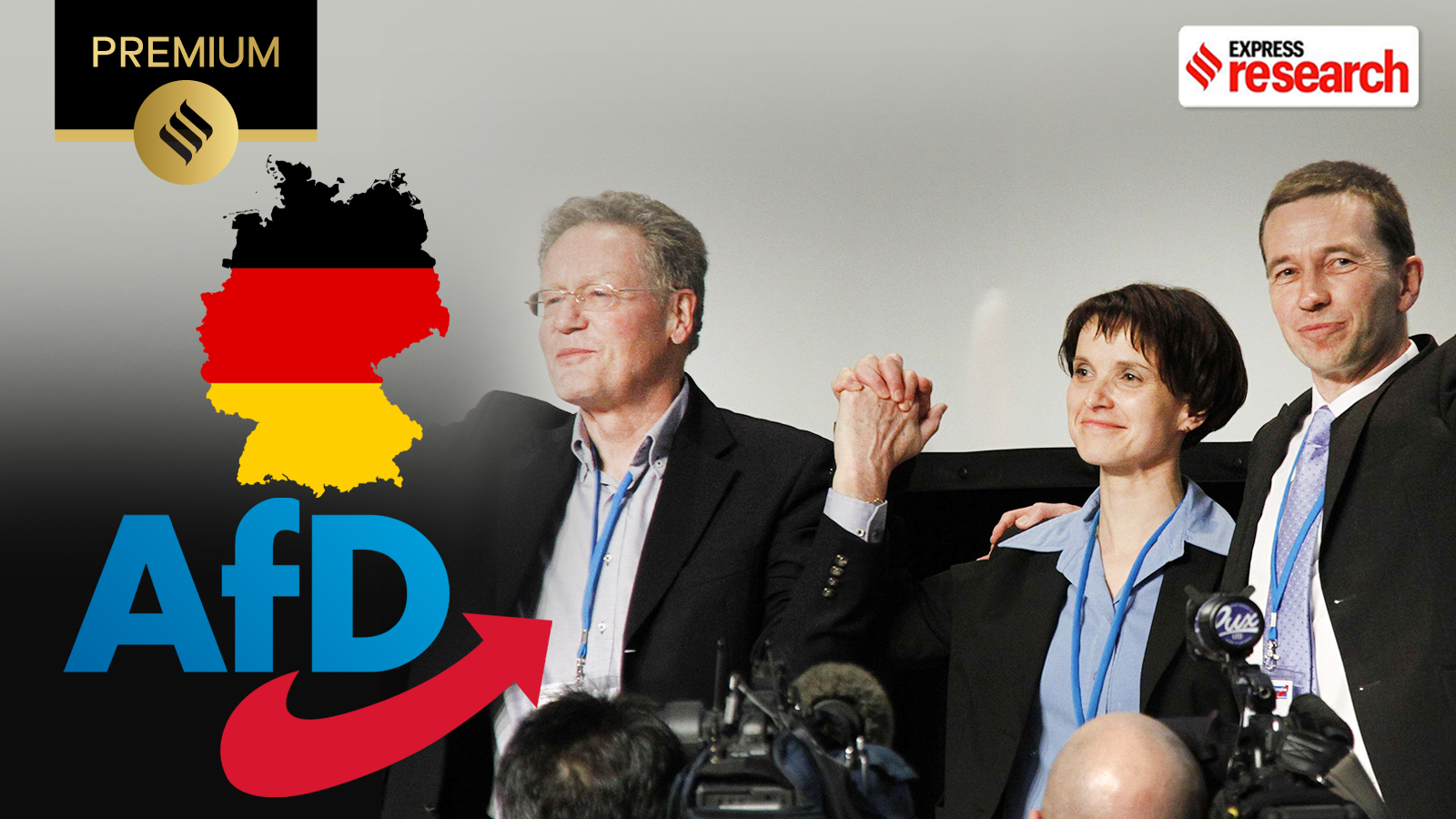
Born out of the euro crisis, the AfD’s transformation during the 2015 refugee crisis helped turn it into a major political force, especially in East Germany.
l-r: Konrad Adam, Frauke Petry, and Bernd Lucke at the first AfD convention in Berlin, 2013 (Wikipedia)
11 min readNew DelhiSep 25, 2026 10:30 AM IST First published on: Sep 25, 2026 at 10:27 AM IST
For anyone chronicling German politics, it’s impossible to write the far-right ideology out of its history. From the Nazi atrocities during WWII to the longstanding presence of the National Democratic Party of Germany, founded in 1962, and Die Republikaner, founded in 1983, the ideology has persisted into the early 2000s.
Scholar Valerie Shatilov notes in her 2017 research, From the Margins to the Mainstream: “Regardless of actions taken by the German government in the post-1945 era, like banning of anti-democratic parties and organizations…and including anti-fascist policies in GDR’s constitution [The German Democratic Republic] in 1968, right wing parties continued to have followers, though not a significant say in national politics and never enough to become part of the Bundestag [Parliament in Germany].”
This changed with the rise of the Alternative for Germany (AfD). “Having narrowly missed the five percent threshold in the 2013 federal election, the AfD achieved an impressive success in the European elections at the end of May 2014, just over a year after its founding, with 7.1 percent of the vote,” notes political scientist Frank Decker in his 2015 article, APuZ: AfD, Pegida and the shift in the political centre.
That support would only grow in the years to come. Last week, protests followed a striking result for the AfD in Saxony-Anhalt, where the party won nearly 44 per cent of the vote on September 6, far ahead of the roughly 17 per cent secured by Chancellor Friedrich Merz’s Christian Democratic Union (CDU).
How did the AfD emerge? Why has it gained such support? Is the party a return to Germany’s past, and is it here to stay?
KioskNews shows a cleaned-up reading view extracted from the publisher’s page — the original always lives on their site, not ours.