Dung beetles bring poo-sitive news about animals in Central Catchment Nature Reserve
SINGAPORE – Deep in the Central Catchment Nature Reserve, shiny black beetles roll animal dung for their food and nests, and some navigate with the light of the Milky Way.
New research has proven that dung beetles not only help to break down animal faeces, but that their unusual diet can also give clues about the elusive mammals and birds that roam the forests.
These tiny but mighty insects can help to fortify biodiversity surveys that currently rely on camera traps, and assess the health of forests.
Between January and March 2023, an NTU team led by associate professor Eleanor Slade and research fellow Ong Xin Rui placed 100 traps made of plastic bottles and disposable plates on the forest floor and canopies across 50 sites in the Central Catchment Nature Reserve – Singapore’s largest green lung.
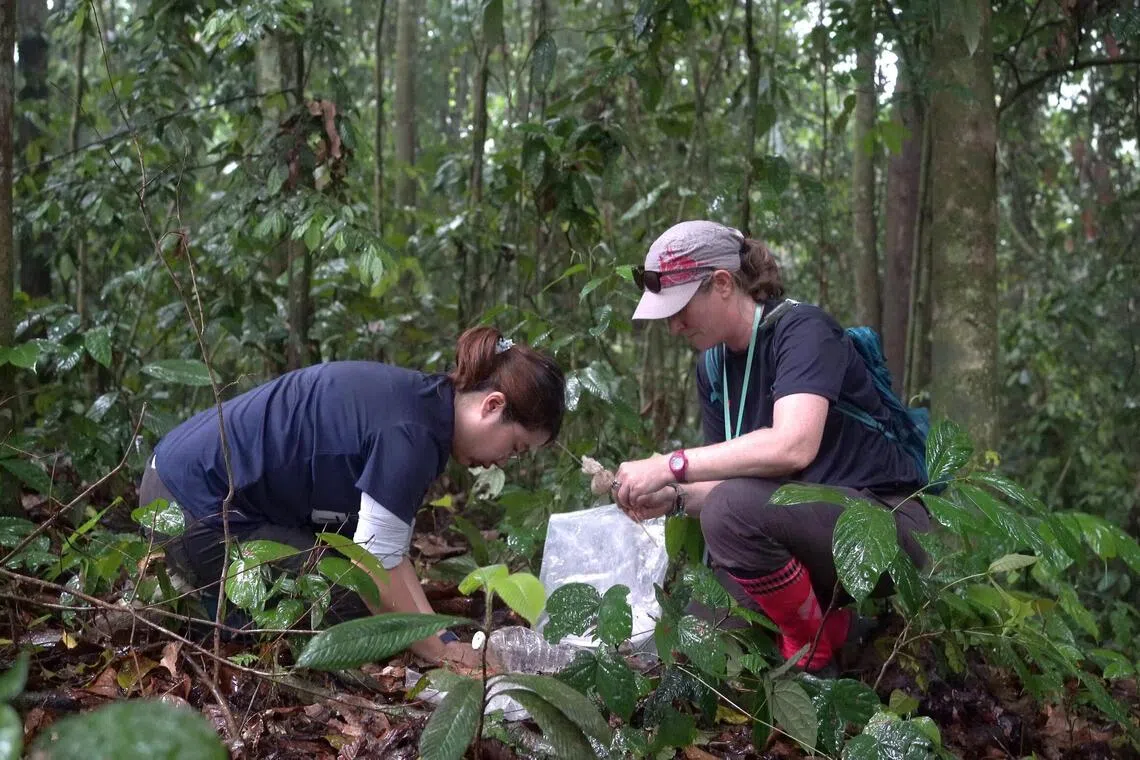
Ong Xin Rui (left) and Eleanor Slade preparing a trap using plastic bottles and disposable plates at one of the 50 sites of the Central Catchment Nature Reserve. Slade is holding bait made of human faeces wrapped in a thin cloth, to attract dung beetles to the trap.
PHOTO: NTU
To lure scuttling dung beetles into the traps, the scientists placed a bundle of human faeces, wrapped in cloth, at each trap. Harnessing their strong sense of smell, dung beetles are particularly drawn to human waste.
Each trap was left in the field for 24 hours before the researchers returned to collect the beetles. Tropical dung beetles typically move around 100m a day, stopping to slurp nutrients inside animal droppings.
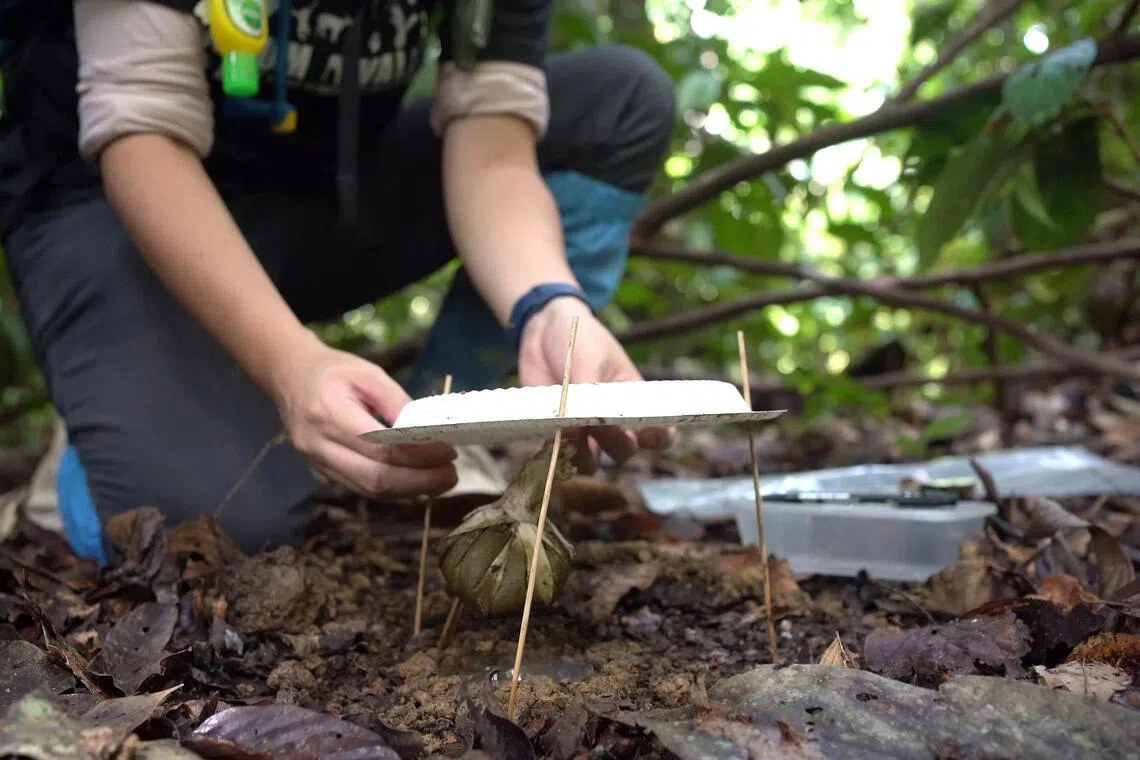
A trap with a plastic bottle dug into the soil to catch dung beetles, and a disposable plate overhead. The bait hangs under the plate to lure the beetles.
PHOTO: NTU
Slade, who heads the Tropical Ecology and Entomology Lab at NTU’s Asian School of the Environment, said: “The dung beetles will have been flying around and eating dung that’s in the forest, and we’re just using (the bait) to draw them in, and then they land. But their guts are full from what they’ve been eating previously.”
Their stomachs would contain a mush of mammal and avian DNA that the scientists sought to identify.
Ong said: “The main objective of this study was to draw the interactions between the dung beetles and the types of vertebrate or mammal dung they were feeding on.”
More than 540 dung beetles belonging to 14 species were trapped over two months, with the contents of their guts analysed in the lab.
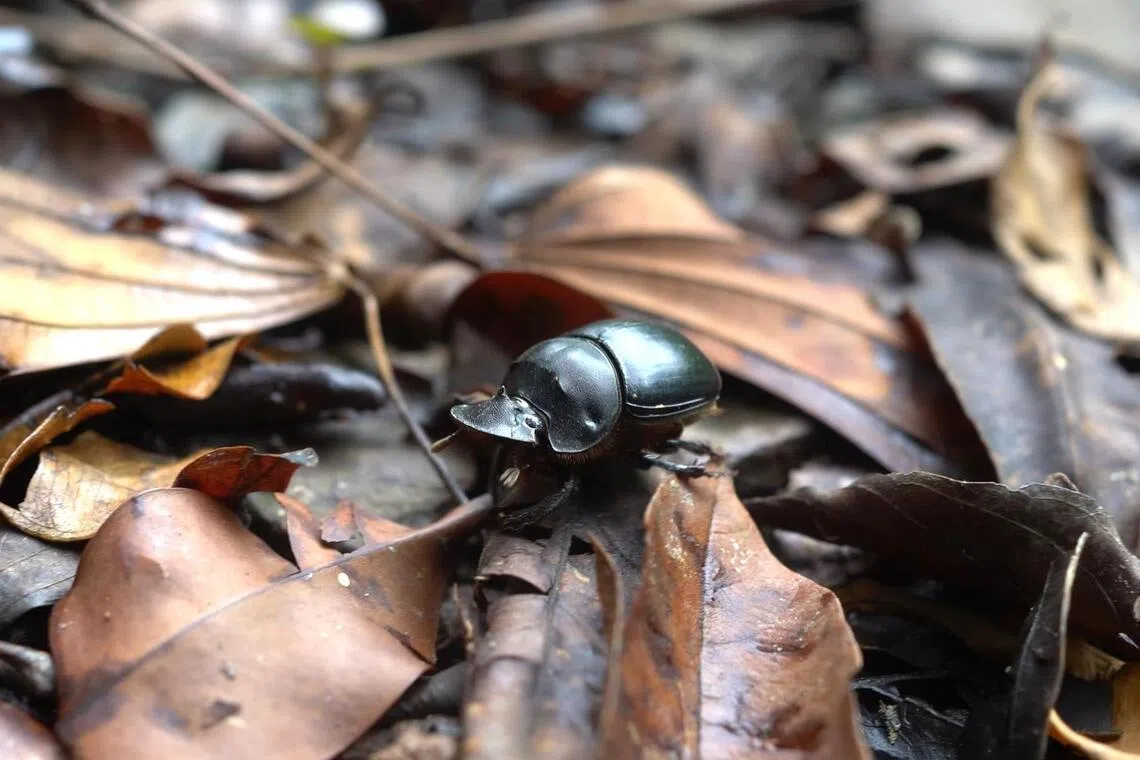
A dung beetle from the group Catharsius, found in the Central Catchment Nature Reserve.
PHOTO: NTU
The team estimates that there are around 25 dung beetle species in Singapore – including those that are new to science.
After dissecting the beetles, Ong and her team separated the half-digested materials from their stomachs and transferred them inside solutions that amplify the DNA of mammals and vertebrates such as birds and frogs.
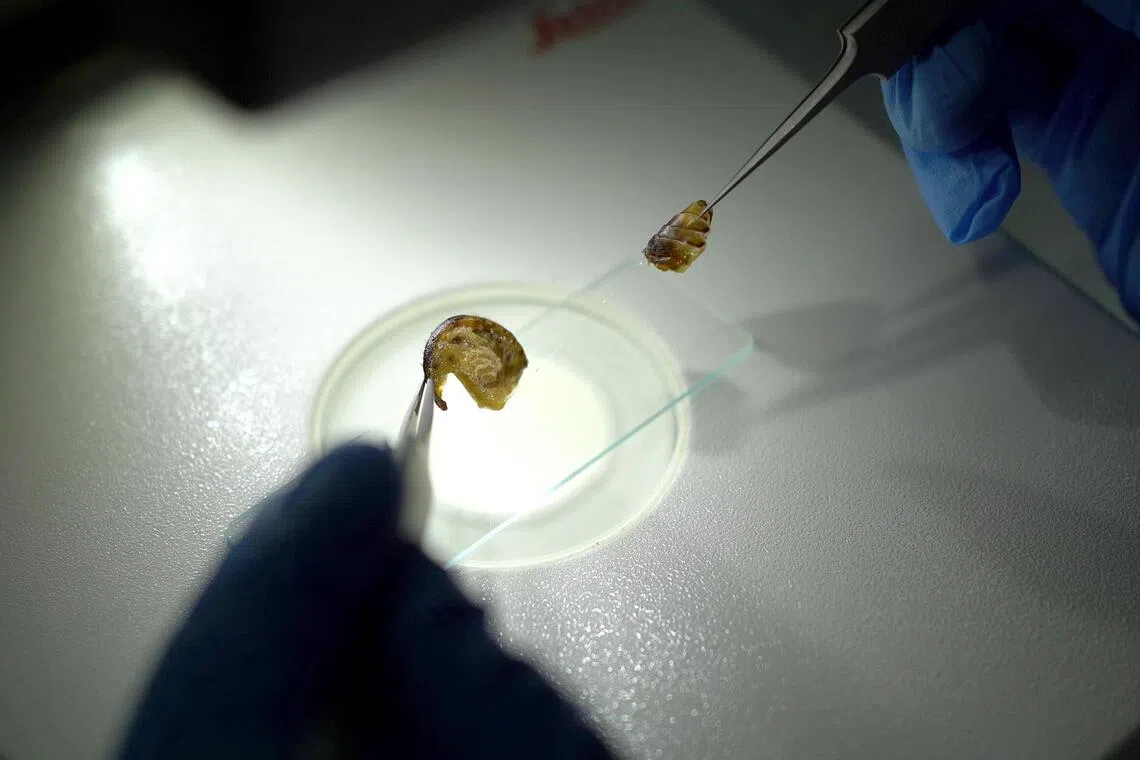
After dissecting the beetle, its gut contents are separated for processing and DNA analysis.
PHOTO: NTU
The samples were sent to a company that sequenced or mapped the DNA found in the beetles’ guts.
A total of 18 animal species were detected through DNA matching, including the elusive sambar deer, Sunda pangolin and Sunda slow loris. Other wildlife detected include the brahminy kite – a bird of prey – and a few squirrel and frog species, such as the black-eyed litter frog.
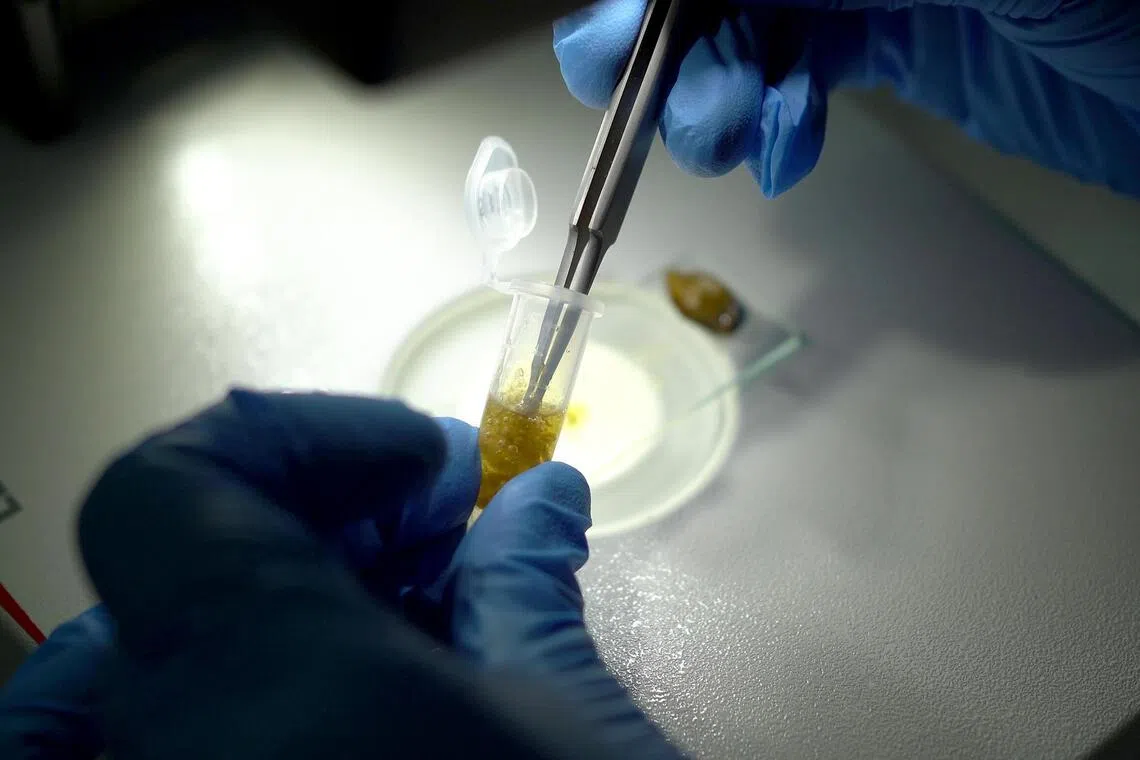
As part of the processing, the contents of the beetle’s gut are transferred to a solution that extracts the DNA.
PHOTO: NTU
Ong noted: “The ones that jumped out to me were the two frog species. You would think dung beetles would feed on the (waste of) a python or a monitor lizard, not a frog. But there are species of dung beetles that feed on carcasses, or the beetle could have fed on something that ate a frog.”
She highlighted how the study can also map food webs.
The research findings were published in scientific journal Molecular Ecology Resources.
While the Central Catchment Nature Reserve is known to be rich in biodiversity, the study was exciting for the NTU researchers because they demonstrated that dung beetles can be used as a DNA resource for surveying wildlife in tropical forests.
While such biodiversity surveys are commonly done through camera traps, the cameras are usually placed on the forest floor, which might miss wildlife residing in the canopy.
It may also be difficult to identify the specific species of forest rodents through a camera, and having specific DNA sequences helps, noted Ong, who is also a researcher at the NUS Lee Kong Chian Natural History Museum.
Beyond just documenting the types of animals in the forest, the researchers were also able to map the interactions between dung beetles and animals across the forest sites.
Slade said: “What happens if you lose some species? Is the resilience in there? The next step in ecological research, for conservation, is to look just beyond counting species to actually looking at how they interact, and that’s not been done a lot in the tropics.”
These efforts can help to measure the ecological value of a forested area that is planned for development, or track how a degraded forest is improving through conservation projects, she added.
Moving forward, the team is looking to test another way of extracting mammals’ DNA from dung beetles without dissecting them.
They plan to swab the beetles’ surfaces, such as the mouths and bodies, which potentially contain traces of wildlife DNA, before sending the swabs for DNA analysis.
Ash Welch, a nature-based solutions and biodiversity specialist at infrastructure consultancy AECOM, said the NTU research shows the effectiveness of emerging sampling techniques, giving consultants the grounding to adopt them alongside traditional survey methods.
In environmental assessments, what tends to be lacking is an in-depth understanding of ecological networks and the interactions that occur within an ecosystem, he added.
Knowing about these is important, he said, because ecosystems can provide benefits such as urban cooling against heat and soak up planet-warming greenhouse gases.
“That matters because a species list tells you only what is present. A network tells you whether the system is actually working,” said Welch.
While the research is clear, using dung beetles for surveys needs to be adopted by frameworks that govern environmental impact assessments, he added.
KioskNews shows a cleaned-up reading view extracted from the publisher’s page — the original always lives on their site, not ours.