'Inside-out submarine' for bombs: How Army plans to detect and contain IED threats
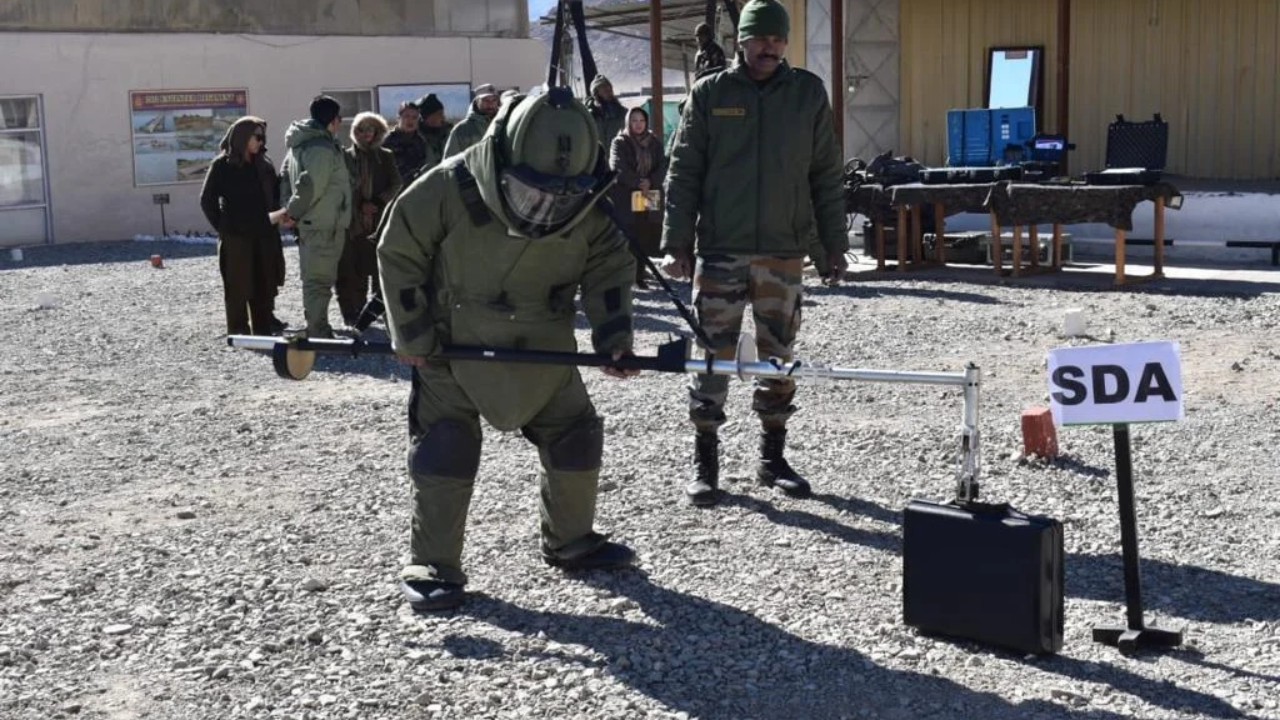
An army's bomb disposal team member handling an object during an explosive ordnance device exercise. (Image credit: Indian Army)
The Army has set in motion a sweeping upgrade of its counter-Improvised Explosive Device (IED) and night-fighting capabilities, issuing requests for information, which are expected at a later stage to lead to the procurement of 350 portable stand-off explosive detectors and 13 specialised bomb containment vehicles, as part of a coordinated push to modernise how frontline troops detect, neutralise and operate around explosive threats.IEDs have been used to target security forces in J&K, insurgency-affected areas of the North East and areas affected by Left-wing extremism.The explosive detectors, sought by the Army's Combat Engineers Directorate, are meant to identify trace and vapour residues from military, commercial and improvised explosive materials without requiring direct physical contact.These portable systems are expected to support personnel at checkpoints, critical installations and vehicle inspection points, as well as in field conditions.The devices are expected to give bomb disposal and counter-terror teams a faster, safer way to screen suspicious objects. They will need to run on battery power for a minimum of four hours continuously, with USB and Bluetooth connectivity built in for data transfer and for updating their explosive detection libraries as new threat signatures emerge.Alongside the detectors, the Army is also looking to acquire 13 total containment vehicles, specialised units designed to safely transport and, where necessary, neutralise explosive devices.
These vehicles are required to allow liquid or vapour samples to be extracted through a vacuum-based system without any risk of external contamination, a critical requirement for preserving forensic evidence while keeping handling teams safe.
These containment vehicles are designed in a manner that allows them to safely transport a bomb.In this case, the requirement states that the device should be able to carry an explosive with a blast effect equivalent to 8 kg of TNT, a common explosive used for benchmarking.
The chamber is designed as what is called an "inside-out submarine", as it is meant to keep the massive shockwave, high-pressure gases and shrapnel inside the chamber, which is made from high-grade steel.These procurement threads reflect a broader, layered approach to force protection: systems to detect explosive threats before they cause harm, equipment to contain and dispose of them safely once found, and sensors to ensure troops retain the ability to spot and engage hostile movement regardless of lighting conditions or terrain. These procurements are expected to move forward through the self-reliance, or Atmanirbharta, route.
KioskNews shows a cleaned-up reading view extracted from the publisher’s page — the original always lives on their site, not ours.