NTHU to explore research reactor development with NuCube
National Tsing Hua University (NTHU) signed an agreement with US nuclear microreactor developer NuCube Energy yesterday to explore replacing the university’s aging Tsing Hua Open- pool Reactor (THOR).
The university said the cooperation will assess technology, research applications and deployment feasibility to sustain nuclear education, research and medical services.
Potential applications include boron neutron capture therapy, a cancer treatment, and isotope production, according to an NTHU statement.
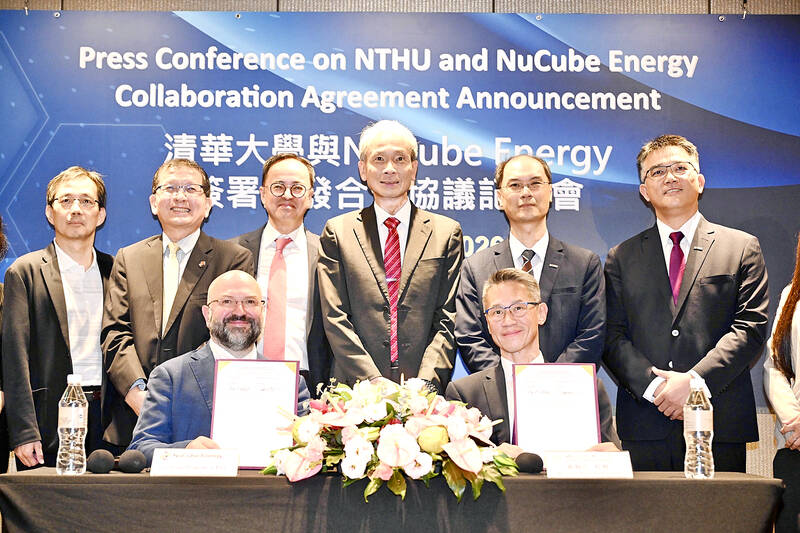
National Tsing Hua University President Kao Wei-yuan, front right, and NuCube Energy CEO Cristian Rabiti, front left, pose for a photograph at a news conference in Taipei yesterday, where they announced a cooperation agreement between the university and the US-based micro modular reactor developer to exchange expertise and assess the feasibility of advancing the technology and exploring its research applications.
Photo: Lo Pei-de, Taipei Times
University President W. John Kao (高為元) and NuCube CEO Cristian Rabiti signed the agreement at a news conference in Taipei, an exploratory step toward possible deployment of a NuCube microreactor to replace THOR, which began operating in 1961 and is scheduled to be decommissioned in 2040.
Speaking afterward, Yeh Tsung-kuang (葉宗洸), dean of NTHU’s College of Nuclear Science, described the partnership as mutually beneficial: the university wanted to understand NuCube’s reactors, while its expertise could help expand their research and medical applications.
Rabiti told the news conference that NuCube planned its first deployment for the end of 2029.
"Today we signed; from tomorrow the real work will start," he said. "We have a lot to do together."
NTHU hopes to install a reactor within two years after NuCube achieves commercial operation in the United States, the university said. Yeh said that contact with Taiwan’s Nuclear Safety Commission was already underway.
NuCube is separately working with Idaho State University on a proposed research and test reactor intended for education and technology demonstration rather than electricity generation.
NTHU said it would invite Taiwanese manufacturers to participate in equipment and component supply, and could share deployment experience and provide technical advice to interested companies.
The agreement follows a podcast interview released last Friday in which President William Lai (賴清德) said restarting existing nuclear reactors would require assurances of safety, a solution for nuclear waste and public consensus.
"We should not exclude any energy source because of ideology, nor disregard environmental sustainability for short-term benefits," Lai said.
Existing reactor restart procedures should proceed and ultimately be decided by professionals, he added.
On workforce development, Yeh said NTHU’s Institute of Nuclear Engineering and Science attracted 66 applicants for 11 places this year, describing the interest as unprecedented in the past decade.
Previously, attracting even 11 applicants had been difficult, he said, attributing the increased interest to a changing policy climate.
KioskNews shows a cleaned-up reading view extracted from the publisher’s page — the original always lives on their site, not ours.