Why food inflation could be Modi government’s biggest economic and political challenge in 2027
India experienced an episode of high food inflation last during July 2023 to December 2024, when it averaged over 8.5% year-on-year. That was courtesy of a “strong” El Niño, which formed around June 2023 and ended by April 2024.
The current El Niño, officially confirmed from June 2026, has already developed into a “very strong” event. Most global weather agencies project it to persist in a “strong-to-very strong” form through January-March, before turning “moderate-to-weak” towards April-May 2027.
The effects have been felt in rainfall for the country as a whole during this southwest monsoon season (June-September), being 12.6% below its “normal” long period average. The northeast monsoon season from October has also registered 33% below-normal precipitation as of November 15. The southern states, Maharashtra, Gujarat’s Saurashtra and Kutch regions, Rajasthan, western Madhya Pradesh, Bihar and the Northeast have borne the brunt of dry weather.
The impact on food inflation is being seen too. The annual increase in the official consumer food price index crossed 5.3% in June, rising to 5.5% in July, 6% in August, 7.7% in September and a 23-month high of 8.9% in October (see chart).
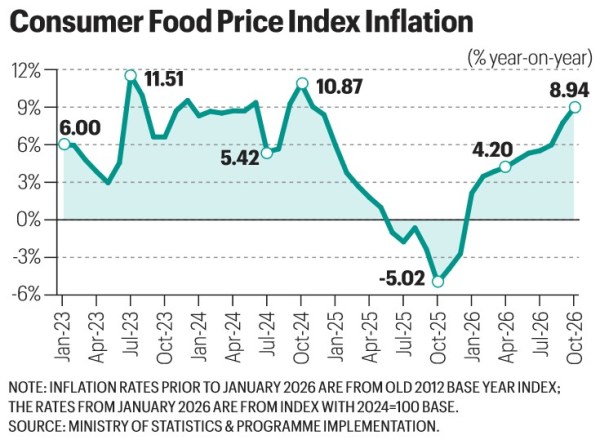 Chart: Consumer food price index inflation.
Going by the last food inflation episode — and the present El Niño being of much greater intensity than 2023-24, even tracking to be the strongest on record — one may expect a repeat, extending through 2027.
The redeeming factor
Unlike 2023-24, however, stocks of cereals in government godowns are 3.3 times the required minimum buffer levels. Rice stocks alone, at 55.5 million tonnes (mt) on October 1, were an all-time high for this date, while the 46.3 mt of wheat were the highest in five years (see table).
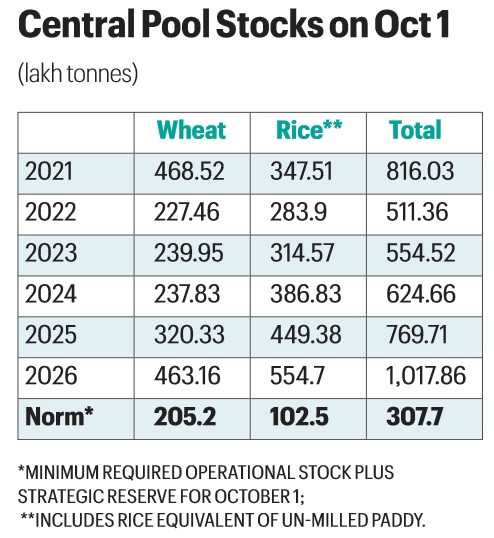 Table: Central pool stocks on October 1.
Government agencies are, in addition, holding some 3.8 mt of pulses. That includes 1.6 mt of chana (chickpea), 1 mt of arhar/tur (pigeon pea) and 1.2 mt of other pulses – mainly moong (green gram), masoor (red lentil) and urad (black gram).
Story continues below this ad
Adequate foodgrain stocks for now would enable the government to undertake market intervention operations to cool prices in the event of El Niño-induced crop failures. That leeway was less during 2023-24.
The better stocks position has been largely thanks to the back-to-back bumper harvests of 2024-25 and 2025-26. This was the case globally as well. According to the U.S. Department of Agriculture, world production of rice, wheat and corn/maize hit record highs of 545.7 mt, 844 mt and 1,334.7 mt respectively. So did that of soyabean (429.3 mt), rapeseed (96 mt), palm oil (82.1 mt) and sugar (186.1 mt).
The comfortable carryover stocks probably explain why global food prices haven’t really soared this time, notwithstanding the twin shocks from the Iran war and El Niño. The latest reading of the Food and Agriculture Organization’s (FAO) benchmark Food Price Index (having a base value of 100 for 2014-2016), at 133.9 points for October 2026, is still some way from the 155-160 peaks scaled during March-June 2022, just after Russia’s full-scale invasion of Ukraine.
The downside
That respite may not last too long though.
To begin with, the kharif (monsoon) season crop hasn’t been too great.
Story continues below this ad
Proof of it is the modal or most-quoted prices of maize in Karnataka’s Davangere and Vijayapura wholesale markets ruling at Rs 3,144-3,172 per quintal, as against Rs 1,844-1,885 a year ago. The same goes for soyabean in Madhya Pradesh’s Dewas (Rs 7,200 versus Rs 4,300), cotton in Haryana’s Sirsa (Rs 9,020 versus Rs 7,150), bajra or pearl millet in Rajasthan’s Bhusawar Bair (Rs 2,650 versus Rs 2,025) and arhar/tur in Maharashtra’s Latur (Rs 10,300 versus Rs 6,500) mandis.
Second, sowing of rabi (winter-spring) crops has been poor, with the cumulative area reported as on November 13 being 15.3% down for wheat, 21.6% for chana and 8.4% for rapeseed-mustard, compared to the coverage of last year’s corresponding period. This is clearly due to the lack of soil moisture, and relatively low water levels in major reservoirs as well as ponds and underground aquifers, from subpar rains. Moreover, since El Niño is known to also raise the risks of warmer and shorter-than-usual winters in India, that can hurt crop yields on top of acreages.
Not surprisingly, all this is playing out at the retail price level too. As per the Department of Consumer Affairs’ (DoCA) data, the all-India modal price of arhar/tur dal has gone up from Rs 110 to Rs 140 per kg over the last one year, while similarly so for chana (Rs 85 to Rs 95) and urad (Rs 120 to Rs 130) dal; sugar (Rs 45 to Rs 60); groundnut (Rs 182.5 to Rs 214), mustard (Rs 192 to Rs 210), soyabean (Rs 154 to Rs 167.5), sunflower (Rs 165 to Rs 192) and palm (Rs 132 to Rs 159) oil; and onion (Rs 25 to Rs 50).
In the last one year, the Gujarat Cooperative Milk Marketing Federation (Amul) and Mother Dairy have also hiked the retail prices of pouched toned (3% fat) and full-cream (6% fat) milk in the National Capital Region from Rs 58 and Rs 70 to Rs 62 and Rs 76 per litre, respectively.
The prospects
Story continues below this ad
The FAO’s October 2026 index of 199.2 points for vegetable oils and 121.3 points for sugar are the highest since their levels of June 2022 and November 2024 respectively.
As stocks from the previous record harvests come down — and countries such as Indonesia and Brazil divert a growing share of their palm oil, sugar and corn production towards biodiesel and ethanol for blending in petroleum fuels — global food commodity prices could further harden in the coming months.
That, together with a strengthening El Niño and its more long-drawn effects, can present a significant economic and political challenge to the Narendra Modi government in 2027.
Take pulses, where the DoCA has made it mandatory for wholesalers, stockists, big chain retailers, millers and importers to declare the stocks held by them every Friday. Tamil Nadu has even imposed limits on how much arhar/tur and urad these entities can stock with effect from November 13.
Story continues below this ad
These come amid field reports of the standing arhar crop in Karnataka (due for harvesting in November-end/early-December) and Maharashtra (from early to mid-January) being 40-50% of last year’s size, and the poor progress of chana plantings.
Under the circumstances, the government may have no option other than slashing import duties on all pulses (already 0% now on arhar and urad, 10% on chana and masoor, and 30% on yellow peas) and vegetable oils (11% on crude palm and soyabean, and 5.5% on sunflower). It might have to also consider extending the existing duty-free import window for raw sugar and cotton beyond December 31.
KioskNews shows a cleaned-up reading view extracted from the publisher’s page — the original always lives on their site, not ours.