FAA to finally ditch floppy disks in what it calls "historic" tech upgrade

“Good news America: floppy disks are out, 21st century tech is in,” US Transportation Secretary Sean Duffy said. Duffy posted a video yesterday about the upgrade in which a newscaster describing the FAA’s outdated technology says, “the FAA systems are essentially running on Windows 95.”
Like other Trump appointees, Duffy was quick to give credit to the president, although the plan was shepherded through by officials in both the Biden and Trump administrations. “The greatest nation in the world deserves a state-of-the-art air traffic control system, and under President Trump, we’re delivering just that,” Duffy said.
In August 2020, the FAA awarded a contract to Leidos to design and develop E-IDS. Leidos said in a press release at the time that E-IDS is part of the FAA’s Next Generation Air Transportation System (NextGen) modernization project, which encompasses numerous upgrades going back to 2008.
The FAA said E-IDS will replace the Information Display System 4 (IDS-4), Controller Equipment Information Display System (ACE-IDS), NAS Information Display System (NIDS), and En Route Information Display System (ERIDS).
IDS-4, one of the systems being replaced, runs on MS-DOS and “has been in constant use since the early 1990s as a vital informational resource/tool for air traffic controllers,” according to a 2018 press release issued by Systems Atlanta, a vendor that had an FAA contract to support the system. As PCMag notes, IDS-4 appears to run on desktop PCs with 3.5-inch floppy disk drives.
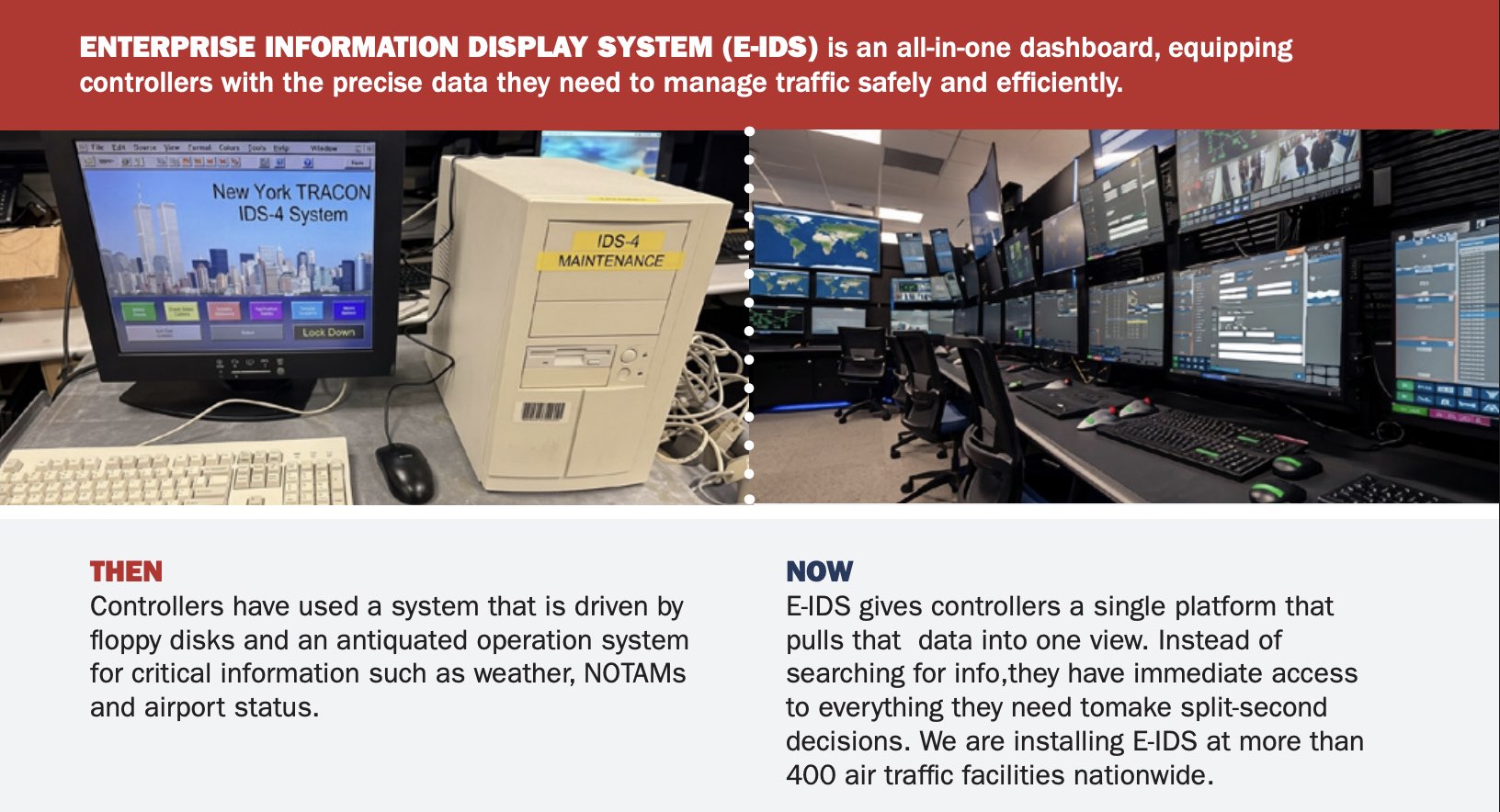
Image from Department of Transportation report on the E-IDS upgrade.
Image from Department of Transportation report on the E-IDS upgrade. Credit: US Department of Transportation
Obsolete tech “cumbersome for controllers”
An April 2026 report by the Department of Transportation said, “Controllers have used a system that is driven by floppy disks and an antiquated operation system for critical information such as weather, NOTAMs and airport status.” With E-IDS, those controllers will have “a single platform that pulls that data into one view. Instead of searching for info, they [will] have immediate access to everything they need to make split-second decisions,” the report said.
The out-of-date systems were criticized in a September 2026 report by the US Government Accountability Office (GAO). “Legacy display systems rely on obsolete technology (e.g., floppy disks) and interfaces from the 1980s, inefficient data organization, and manual update methods,” the report said. “The systems are cumbersome for controllers to search, retrieve, and display information. Multiple diverse display systems create inefficient activities needed to sustain these systems.”
The GAO report said these information display systems are used in Air Route Traffic Control Centers, Terminal Radar Approach Control facilities, and control towers. The systems display textual and graphical information, “such as flight approach charts, combined with Notice to Airmen and weather information. This information is needed to support controller-to-pilot flight operations,” the GAO said.
This post was updated with further information and a graphic on floppy disks on Nov. 6, 2026 at 15:05 pm.
KioskNews shows a cleaned-up reading view extracted from the publisher’s page — the original always lives on their site, not ours.