Documentary on Korea’s martial law crisis earns warm reception in US
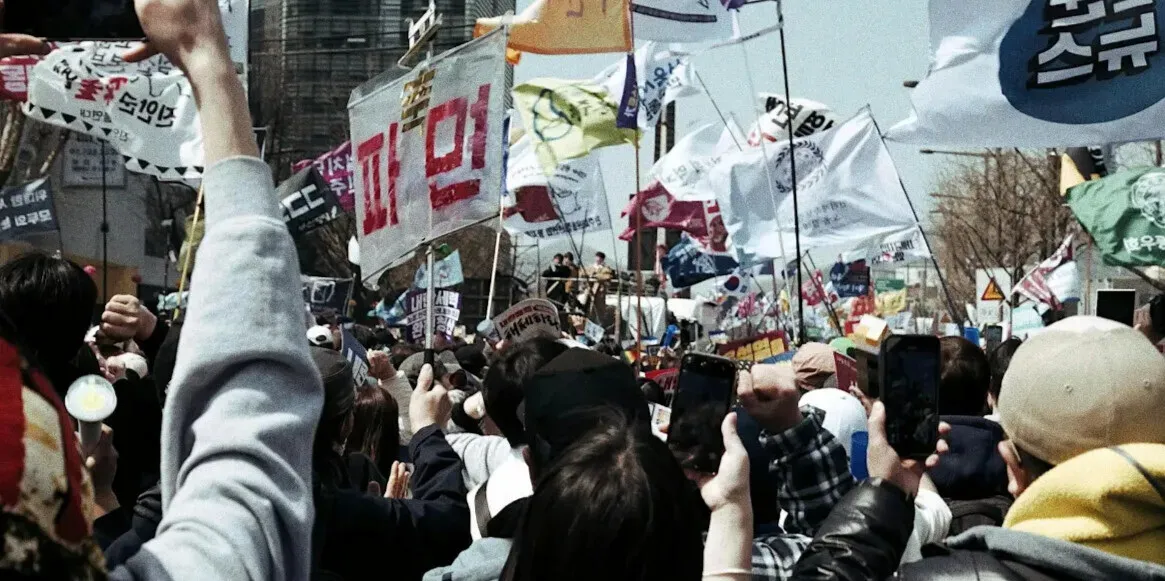
Still from the MBC documentary film “The Seoul Guardians,” which was screened at the Meyer Auditorium of the National Museum of Asian Art in Washington, DC, on Sept. 27, 2026.
A documentary on the Korean public’s efforts to block the 2024 martial law declaration has received a warm reception after its screening in Washington.
“The Seoul Guardians,” an MBC film on the events that blocked President Yoon Suk-yeol’s failed bid in December 2024 to declare martial law, earned an extended standing ovation at the Meyer Auditorium of the National Museum of Asian Art.
After the screening, the film’s co-directors Cho Chul-young, Kim Jong-woo and Kim Shin-wan held a Q&A with the audience moderated by the former CNN anchor Joie Chen.
On the work’s original title “Night in Seoul,” Cho said, “We intended to naturally evoke memories of Gwangju in 1980 through wordplay as the title is similar in pronunciation to ‘Spring in Seoul.’“ Seoul Spring refers to a period of Korean democratization from October 1979 to May 1980 whose name was inspired by the 1968 Prague Spring in Czechoslovakia.
The production team stressed that the memory of the 1980 massacre in Gwangju was the driving force behind civilians going to the National Assembly on the night of Dec. 3, 2024, to stop martial law.
“I wondered if these intangible elements that we learned and inherited — such as the memory of Gwangju — took root in the hearts of both citizens and soldiers, making them the true guardians who saved the day,” Cho said.
Quoting a line from the 2014 novel “Human Acts” by Nobel laureate author Han Kang, Kim said, “The conscientious actions of the dead have a greater impact than the words of a politician.”
Audience members raised questions expressing concern over the Trump administration and the erosion of American democracy.
One person who said he was a military veteran and federal worker for 50 years mentioned seeing pro-Yoon demonstrators in Korea waving the US flag alongside the Korean flag. He then asked if the January 2021 riot at the US Capitol and President Donald Trump’s actions might have emboldened Yoon to resort to martial law.
Another person of Russian origin asked why Yoon, who was aware of Gwangju’s history, declared martial law.
“At the Seattle International Film Festival, an American audience member asked us what to do,” Cho said. “The events unfolding in the US bear a striking resemblance to what happened in Korea prior to the declaration of martial law. It’s as if the leaders share the same playbook. I wanted to share Korea’s experience — specifically how the people mobilized when democracy was under threat — with a global audience.”
Chen called the film “impressive” for demonstrating the power of the people not only to create but also to defend democracy. Concluding the discussion, she added that protecting democracy is just as important as celebrating it, something that requires the efforts of “guardians” at times.
The screening was a public event organized by the museum, whose website described “The Seoul Guardians” as a “stirring documentary [that] resonates with audiences around the world with its message that democracy is fragile and must be defended.”
Set for release in December in Korea, the film has earned awards at film events worldwide, including three from the Far East Film Festival of Italy and the Bill Nemtin Award for Best Social Impact Documentary at the Hot Docs Festival in Canada.
KioskNews shows a cleaned-up reading view extracted from the publisher’s page — the original always lives on their site, not ours.