KMT head touts rapport at 823 memorial
CONSENSUS-ORIENTED: The site of prolonged shelling by the PLA became a soapbox for the KMT party chair to talk about collaboration and peace with the Communist Party
By Lin Hsin-han and Fion Khan / Staff reporter, with staff writer


Chinese Nationalist Party (KMT) Chairwoman Cheng Li-wun (鄭麗文) yesterday called on President William Lai (賴清德) to recognize the so-called “1992 consensus” to ease cross-strait tensions.
The “1992 consensus” refers to a tacit understanding between the KMT and the Chinese Communist Party (CCP) that both sides of the Strait acknowledge there is “one China,” with each side having its own interpretation of what “China” means. The Democratic Progressive Party (DPP) has never acknowledged the “1992 consensus,” saying that Beijing does not recognize the ROC and acceptance of the understanding would imply agreement with China’s territorial claim over Taiwan.
Cheng made the remarks during a visit to the 823 Artillery Bombardment Museum in Kinmen to mark the 68th anniversary of the battle.
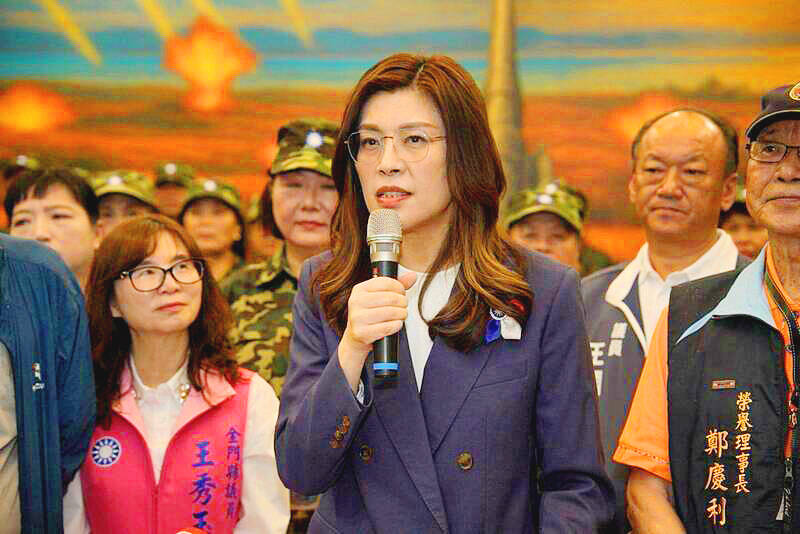
Chinese Nationalist Party (KMT) Chairwoman Cheng Li-wun, center, speaks at an event marking the 68th anniversary of the 823 Artillery Bombardment in Kinmen ysterday.
Photo courtesy of the KMT
The 823 Artillery Bombardment refers to the engagement that began on Aug. 23, 1958. China launched an offensive, firing more than 470,000 artillery shells in the bombardment of Kinmen over 44 days. Communist forces failed to capture the islands, marking a victory for the Republic of China (ROC) administration in Taiwan. Soldiers killed during the battle defended the ROC and the values of ROC Constitution, including democracy, freedom, equitable prosperity and the people’s right to live with dignity and affluence, Cheng said.
Commemorating the battle today means continuing to uphold and safeguard the values of the ROC Constitution, she said. This generation is responsible for “creating peace,” she said, saying that the KMT wants to start from Kinmen and pledge a century of peace, transforming the island from a military stronghold into a hub for peace.
If Lai would recognize the “1992 consensus,” the two sides of the Taiwan Strait could resume contact, dialogue and exchanges, reducing tensions, she said.
Cheng yesterday said that if Lai believes Taiwanese independence is not a real issue, he should shelve the DPP’s advocacy for Taiwanese independence rather than seeking to replace the ROC Constitution through constitution-drafting, nation-building or independence initiatives.
An official familiar with cross-strait affairs, speaking on condition of anonymity, said in response to Cheng’s claims that the “1992 consensus” leaves no room for the ROC.
“Only people who have lost their senses would help the CCP eliminate the ROC and annex Taiwan,” they said.
Asking Lai to accept the “1992 consensus” is asking him to eliminate his own country, they said, calling it a “massive joke.”
Cheng should first ask Chinese President Xi Jinping (習近平) to recognize the ROC and give it room to exist, they said. The August 23 Artillery Battle was fought to defend the ROC, they said, accusing Cheng of parroting Beijing’s goal of eliminating Taiwan.
“Is it appropriate for the chair of the KMT to make such remarks at an event commemorating the 823 Artillery Bombardment?” the official asked. “Does that do justice to the soldiers and civilians who defended the nation at the time?”
The KMT has degenerated to such a degree that if former presidents Chiang Kai-shek (蔣介石) and Chiang Ching-kuo (蔣經國) were alive today, they wonder what they would think of what the party has become, the official said.
KioskNews shows a cleaned-up reading view extracted from the publisher’s page — the original always lives on their site, not ours.