‘Every single patient matters’: The Sydney researcher weaponising AI to fight cancer
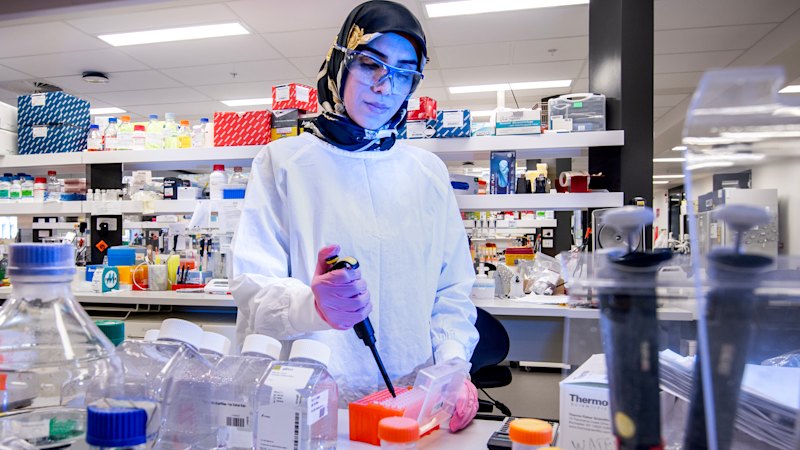
Personalised medication, drugs to combat the rarest of cancers, knowledge of our individual cell interactions and even pre-empting disease in the body – one Sydney lab is working on all of these possibilities and more, thanks to the advent of artificial intelligence.
“I’ve become very interested in how we can leverage AI to save lives and improve the patient outcomes,” said Professor Fatemeh Vafaee, deputy director of the University of NSW’s AI institute and a professor in the school of biotechnology and biomolecular sciences.
An AI drug-development platform is among the breakthroughs made possible since the technology exploded in 2022, Vafaee said. The model is upending traditional drug development, which succeeds around 10 per cent of the time, takes 15 years to develop a drug from beginning to end and costs about $2 billion.
The complexity of diseases such as cancer and diabetes means that often one medication is insufficient and combination therapy – using a mix of different drugs together – is better able to tackle the disease. But the number of potential combinations had previously slowed researchers down.
“It’s an intractable problem – if you have 1000 drugs and you want to look into the combination of two or three drugs across different dosages, there are millions of experiments that you need to run,” said Vafaee. “This is where AI can come on board to prioritise that and look into combinations that could be efficacious before we go into the lab experiments.
“We can predict possible combinations of drugs ahead of lab experiments.”
Vafaee’s lab has so far picked 24 synergistic combinations, which have been validated in pre-clinical studies at Melbourne’s Peter MacCallum Cancer Centre and are now going to higher levels of testing.
Earlier this year, Vafaee worked with a commercial partner to develop a blood test ruling out recurrent breast cancer, something that affects 15 per cent of breast cancer patients and that had plagued doctors because of its unpredictable post-cancer time frame.
These breakthroughs are among the work highlighted by the University of NSW in its forthcoming Social Impact of Science report, which will be released on Monday. The report proposes a new framework for measuring research that zeroes in on commercialisation, scholarly outputs, policy and influence, lives changed, and sustainability and development.
Born in Iran, Vafaee received her PhD in AI in 2011 from Chicago’s University of Illinois, which she has since applied to biomedicine. AI developments and access to large-scale data since 2022 – the same year that ChatGPT launched – have meant that scientists can do things “several thousand times faster” than previously.
“We don’t want just to predict for breast cancer and brain cancer,” she said. “We want to be able to adopt that into [rare] cancer or even other diseases.
“And this is where we have been developing AI tools for transfer learning, what we can transfer the knowledge from one disease to another ... that would help us to go through less common diseases and look at how we adopt AI for the patient’s benefits. Every single patient matters, and we can use this technology for patients that we have less population level data available for.”
Personalised medicine for all was around the corner, she said, if AI was granted access to large-scale data.
“We are all different and we need to move on from one solution fit everyone,” she said. “What I would love to see in future is that we go from being reactive to what we observe, to being proactive to what we predict.”
Start the day with a summary of the day’s most important and interesting stories, analysis and insights. Sign up for our Morning Edition newsletter.
KioskNews shows a cleaned-up reading view extracted from the publisher’s page — the original always lives on their site, not ours.