Why are Britain's streets still so polluted? Because the car industry dinosaurs do what they like, and politicians let them | George Monbiot

This is how it works. An industry puts tremendous effort into resisting change: lobbying governments, mobilising the media, pouring money into junktanks. It argues that a transition would threaten jobs, or damage the national interest, or harm poor people, while what it really fears is the cost of retooling its plants or developing new protocols. Then, when the inevitable cliff edge approaches, it whines that change is coming too soon. For reasons beyond its control, it isn’t ready, so the government must delay its plans.
This is what triggered the Dutch nitrate crisis, and the UK’s repeated “emergency” exemptions from the ban on a devastating class of pesticides. Now the same dynamic is driving the UK’s crisis over the transition to electric vehicles (EVs). The result is that, as the global climate summit, Cop31, begins, it looks as if our gift to the world will be a major, predictable and entirely avoidable increase in the UK’s greenhouse gas emissions.
Car manufacturers could have seen this coming more than 130 years ago, when the first electric automobiles were sold. For at least the past 30 years, as new electromotive technologies have progressed at speed, they plainly represented the future, and internal combustion engines, with their hard efficiency limits and vast impacts on human and planetary life, the past. Since 2010, it’s been obvious that China, which has not only seen the future but seeks to own it, would flatten our manufacturers like hedgehogs if they didn’t speed up. In 2023, the Conservative government gave automakers seven years to get their act together. And now they wring their hands and claim to be unprepared. To which the only reasonable answer is: tough.
But, unfortunately, this doesn’t seem to be the answer the government is giving. Instead, on Wednesday it’s expected to cut the target for zero-emission cars from 80% of new car sales by 2030 to approximately 60%. If so, this will be the latest in a series of concessions that governments have agreed since the Conservatives announced the deadline.
Both Conservative and Labour governments have permitted a series of “flexibilities” (otherwise known as loopholes). These allow companies to sell hybrid petrol-electric cars instead of purely EVs. They can also sell a lower proportion of EVs by 2030 on the promise that they’ll accelerate sales after that date. Now the government is also expected to extend the “flexibilities” to 2034, making a mockery of the promise to accelerate after 2030. One retreat after another.
Every one of these slippages has major consequences, for climate breakdown, air pollution, energy security and the cost of living (electric cars, if you can charge at home, are much cheaper to run). The transition to EVs was supposed to be the biggest of all the government’s decarbonisation measures. Now it’s in pieces.
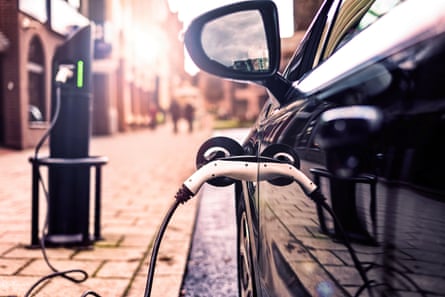
Once again, the problem is the domination of our nominally democratic systems by money. Commercial lobbyists reach ministers long before environmentalists can. As soon as the Conservative government proposed its transition plan, manufacturers pressed to weaken it. This year, they hinted that they wouldn’t invest in future manufacturing here unless the government made further concessions. It looks to me like a legal form of blackmail.
Perfecting the art of unreadiness, the car companies help to ensure that society is also unready for the great crises – from oil supply shocks to climate breakdown – we face. The people they hire deploy an armoury of clever arguments. But while these might sway British politicians, they do nothing to persuade reality, whether that reality consists of the atmosphere or Chinese competitors.
Last month, the Chinese company BYD launched a new Seagull electric hatchback for the home market at just $10,000 (£7,500). It can be flash-charged in five minutes. And where are western manufacturers? Well, Jaguar recently unveiled its reply to Elon Musk’s ill-fated Cybertruck, an unaffordable monster that can scarcely be driven – let alone parked – on our streets. Perhaps the nearest European equivalent to the Seagull, the Volkswagon ID Polo, is much more expensive and you might not get it for months. As the website Autonext comments, “Europe’s carmakers spent 2024 and 2025 telling Brussels that the CO2 targets were unrealistic because buyers would not take small electric cars in the volumes the rules assumed. Volkswagen has now put three of them on sale and cannot build them quickly enough.” Why? Because it didn’t invest in sufficient plants.
The government is now considering imposing tariffs on Chinese EVs, as part of an EU scheme. If you can’t beat them and you can’t join them, block them. So much for addressing the cost-of-living crisis.
As for allowing companies to keep building hybrids rather than EVs, this solves nothing. Hybrids are almost as polluting as 100%-petrol or diesel vehicles; more expensive to run than EVs; incompatible, in most cases, with rapid chargers and destined, very soon, for the scrapheap of history. But, thanks to government policy, last year they accounted for 14% of new car sales, which means 14% of buyers were suckered. The hybrid is the perfect motif for government dithering: given a choice between two technologies, two worlds, two futures, it says yes to both.
after newsletter promotion
The public information campaigns and public honesty required from the government in explaining why a rapid all-electric transition is necessary and what its implications are, as usual, are entirely missing. Public communications remain in private hands. The marketing budgets of the car companies are still used to sell ever bigger child-killing, planet-killing trucks.
An EV transition doesn’t solve all of our transport issues. We should be reducing transport demand, through a shift towards the 15-minute city model of which Paris is an exemplar. We need better and safer provision for cyclists and pedestrians. We need more investment in public transport. But if we can’t even get the end-of-pipe – or end-of-the-tailpipe – issue right, what hope is there for the rest of the system?
This is, or should be, easy politics. Tell the foot-dragging, planet-trashing car companies, the authors of their own failure, where to get off. They face a stark choice: move or get squashed.
KioskNews shows a cleaned-up reading view extracted from the publisher’s page — the original always lives on their site, not ours.