Sergio Camello: ‘Rayo is the last team standing – it’s football from another time’

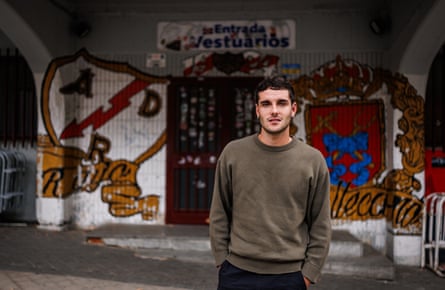
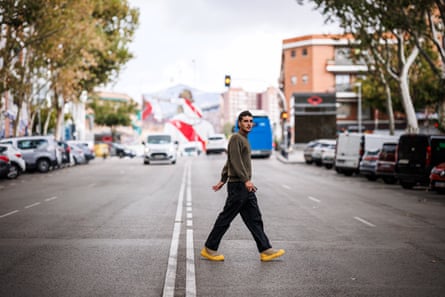
An 11-year-old, second-hand VW Beetle with more than 300,000km on the clock pulls over on Clown Fofó Street in the heart of Vallecas. The music goes off, the Smiths silenced, and out gets Sergio Camello: movie aficionado with 156 films reviewed, part-time photographer, some-time drummer, Olympic gold medallist and the second top goalscorer in Europe’s top five leagues. Engulfed in graffiti, stickers covering the glass between metal bars in red, a single step up from the street, the small door into Rayo Vallecano’s ground is locked, but in 64 hours it will open for the first time this season. “It’s my home, it’s Vallecas,” Camello says.
Forced to abandon their place, on Saturday at 2pm the tenants return. With the Madrid council declaring Estadio de Vallecas unsafe, unfit for purpose, Rayo’s home matches have instead been played in Leganes, out of the city to the south and boycotted by fans. Walking the neighbourhood that is proud of its social conscience, its community and its team, Camello can’t wait to be back again. And not just for the football; maybe not even for the football. “It’s the pre-game, the post-game, the people,” he says, passing the bar where they’ll be waiting for him after, same as always.
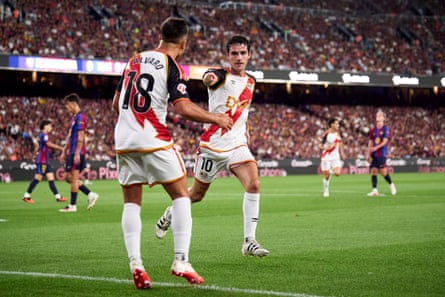
Yet the football is good too, good as it’s ever been. Across the continent’s top five leagues only Raphinha has more goals than Camello’s seven in seven league games, and Camello himself has never had so many either. “I try not to think about it but my teammates keep reminding me,” he says. “‘Pichichi! Pichichi!’ It’s not Sergio any more.” Pichichi was the legendary Athletic Club striker whose name adorns the top-scorer award. No pressure, then. “None, I love it,” Camello replies, “and I love that they’re enjoying it.”
Two months into the season, this is already his best campaign in primera where the previous totals were five, three and six. And although there’s a tactical element, new coach Beñat San José altering his movement, Camello looks deeper for an explanation. Above all he looks inside, which is where, from the beginning, another conversation starts: a simple question prompts a complex, nuanced and human discussion, the striker talking calmly, thoughtfully and with startling unexpected honesty.
Camello is that most unusual of footballers – prepared to speak on materialism, racism, or homophobia, social media “poison” or the housing crisis, that rare player prepared to use his platform, which he says was born of his upbringing but also learned being here in the barrio. This is personal, but at once universal too, something in his experience that is about everyone. Who knows, maybe there is something in what he has lived that can help, some reason to share it, the goals scored offering tangible proof of an intangible process.
So what has changed? “How I go on to the pitch,” he says. “I thought it would be much harder to change my mindset but I’m seeing that I can be myself: be free, connect with the Sergio I can offer Rayo. To feel liberated, to enjoy it – and it’s been a long time since I enjoyed all this like this.
“The first thing was to have many conversations with friends, people who truly know me. Especially my twin brother Gonzalo; there’s a connection that goes beyond the human. He could see I wasn’t enjoying it much, wasn’t myself. We talked and I tried to take that on to the pitch. Above all, to play without the pressure. Because pressure is horrendous. It makes it so that you don’t enjoy absolutely anything, puts you in a position where if things don’t work, that leads to frustration, frustration leads to pity, and suddenly everything is negative. There’s a point in the conversations where it’s ‘that’s it; it’s done’.
“This is a sport you chose before it was your job, because it’s what made you happiest. It’s about connecting to that kid again. I’d discussed this in therapy too; the idea of getting back to that kid.”
Somewhere that can be lost, not just failure you have to live with but also success. “The pressure can come from everywhere,” Camello says. “We’re young, the change happens so fast, no one prepares you for it. If you can’t manage that it can do a lot of damage and that happened to me. [Early on], I would even get a bit paranoid, have fixations. ‘They’re looking at me.’ The first day in primera, when I scored, the journey there had been normal – scooter, bus, metro, bus – but on the same journey home some kids followed me shouting ‘Camello! Camello!’ It was a shock. The night we returned from the Olympics I was in the usual bar, people crowded and I had a kind of anxiety attack and had to go. And, look, I’m me, Sergio Camello, a normal person from a humble team. I can’t imagine what it is like for someone at Lamine Yamal’s level. I don’t envy that.”
“But it’s about seeing the balance, understanding,” Camello continues, “and football has given me so, so much. There are so many people who can’t enjoy their job, who don’t have the [financial] freedom. When you have bad moments, when the clouds come, when you feel that cycle of negativity, you talk.”
Camello looks across the room: it’s quiet, 25 chairs sitting empty. “One of my friends [Dani Fernández] is a musician about to do four sellouts at the Wizink [Centre]; when I met him, he wouldn’t have sold out this room,” he says. “We both got ‘caught’ in this about the same time and we talked a lot. When he had doubts, I was there; when I did, he was. A torch in the darkness. You think ‘I’d love to be a rock star’ and then someone you admire who is tells you how bloody shit it can be behind the scenes. You understand each other, you think: ‘Bloody hell, maybe I don’t have to analyse things so deeply.’ If in even those places you idealise, there is darkness, solitude, maybe I’m not so bad.
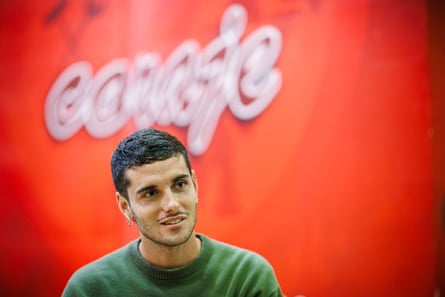
“Otherwise you could go into a very dark place where you feel you have to escape this [football]. Even then the world wouldn’t end. And fortunately, the positive in football has always weighed much more heavily. And that’s been shown to be right. Those conversations give me perspective, make me conscious of how fortunate I am.”
Although Camello says doubts about the game itself are rarely shared in such depth in the dressing room – “football might be the most important thing in the entire world to your teammate” – something about this place helps. The club’s problems are significant, debilitating and should not be romanticised, he insists, and yet somehow they have made a success of it, built through solidarity. Besides, he says, “we’re also here because we want to be” and there is something about Rayo, something about breaking out of the bubble, that has been good for him, for all of them, as people as well as players. There’s a moment when he talks about everything that comes with being a footballer and says “it’s easy to be a dickhead”, but that’s diminished at a club not just in the barrio but of the barrio, one that’s “totally different” to anywhere else he knows, where “your feet are that bit more on the ground and you realise you’re not stars”.
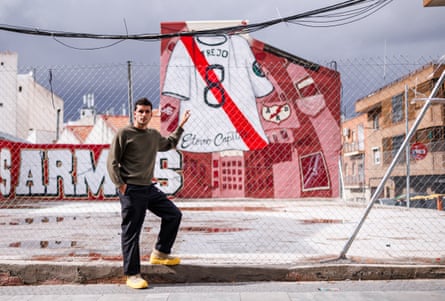
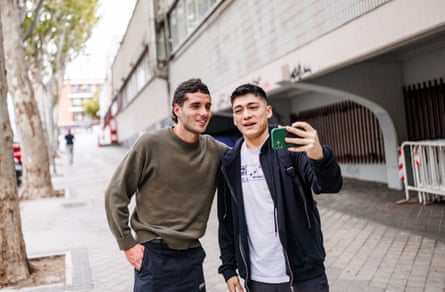
“Rayo is the last team standing from football from another time, that’s what I like,” Camello says. “Even just parking here on the street right in front changes things. The same faces, every time. The least important thing about the football here is the football; it’s what they stand for every weekend, what the believe in, the connection. It’s Isi in the bar on the corner. Unai and his mates in the one down the bottom there. The bar we’ve taken over. That doesn’t exist anywhere else. To have those guys you were watching half an hour ago in the same bars, doesn’t happen. I’ve built relationships that are very sincere that I never expected. I’m a normal bloke who fulfilled mine and many kids’ dream. Like a superhero when they pull on the mask; I come here, I put on the kit, I’m the most competitive, most professional person you can be. But when I leave I take it off and forget about it.”
There is a release, refuge in something else. In the camera. In the drum lessons Camello admits have been slow and the guitar he’s abandoned, the ability God gave his feet denied to his fingers. In the films, in the indie rock music first heard in the family car, and the musician mates he has made. The music discouraged by reggaeton-loving teammates who control the stereo blaring out each morning. They wonder, he says laughing, why he’s not so keen on the gym.
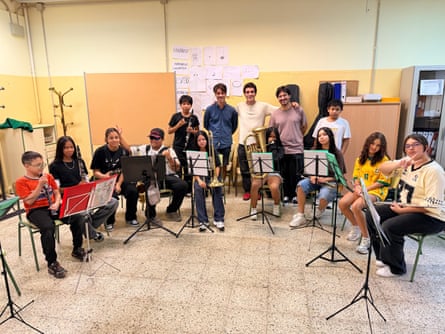
The music that can make a difference, too; if there is anything that moves people, reaches them like football, it may only be that. “There’s something I’ve wanted to do for a long time and it’s really fun,” Camello says. “I joined a charity, Action for Music, which gives opportunities to kids to play music in humble neighbourhoods. They go to four hours of classes a week: percussion, strings, wind. The kids don’t pay a euro, everything’s free: the space, the teachers, the instruments. They have schools in Tetuán and Carabanchel. I’m getting involved, learning, and I want to set up a school in Vallecas next year.” He stops, grins. “Only I’m going to do it my way … with rock.
“I did a session with them the other day, me trying to play the drums after six months. There was a kid on sax: wow, what a vibe he had, he was just loving it. When you don’t know where to go, there’s a place, someone who believes in you, gives you an opportunity. Forty kids: put some drum sticks in their hand, a guitar, a sax, something that will give them so much. Tell them they can be good at something, feel good about themselves. Have fun, maybe find something inside they didn’t know was there. It’s a way of giving back to Vallecas everything it gives me. I’m so excited.”
Imagine them playing the Wizink. “I can be their manager,” Camello laughs. “The idea is to do concerts at the end of each year. Imagine those kids, coming into their first class … then going on stage. It’s good to see yourself up there, with an instrument. Their family there, people who have bought tickets to see them play, the applause. That feeling: ‘I’m worth it.’”
Sounds like scoring a goal. Camello’s eyes light up. “Yes, it is,” he says. “I’m still the same guy as I was when I didn’t score, eh. But at that moment when you’re standing there, there’s nothing else in your head, just a feeling that all this makes sense. When the ball hits the net, when you get a ground on its feet, all together, when they’re celebrating, it’s like it’s all worth it. You feel important, you’re good at something.”
KioskNews shows a cleaned-up reading view extracted from the publisher’s page — the original always lives on their site, not ours.