Taiwan trade surplus to hit US$205.4bn on back of AI
SHIFT: The cumulative direct investment ratio for China fell from 58.3% in 2017 to 18.8% from 2018 to last year, while the ratio for the US increased to 18.7% over the same period
By Kao Chia-ho and Jonathan Chin / Staff reporter, with staff writer


The central bank forecasts Taiwan’s overall trade surplus to hit US$205.4 billion this year as it emerges as a global artificial intelligence (AI) hardware manufacturing hub.
The nation’s projected trade surplus this year is 4.2 times the US$49.2 billion surplus in 2018, when the US-China spat over tariffs started, it said in a report on structural changes to Taiwanese trade and investment since that year.
The growth of Taiwan’s AI hardware manufacturing sector was spurred by a US effort to build without Chinese supply chains, the report said.
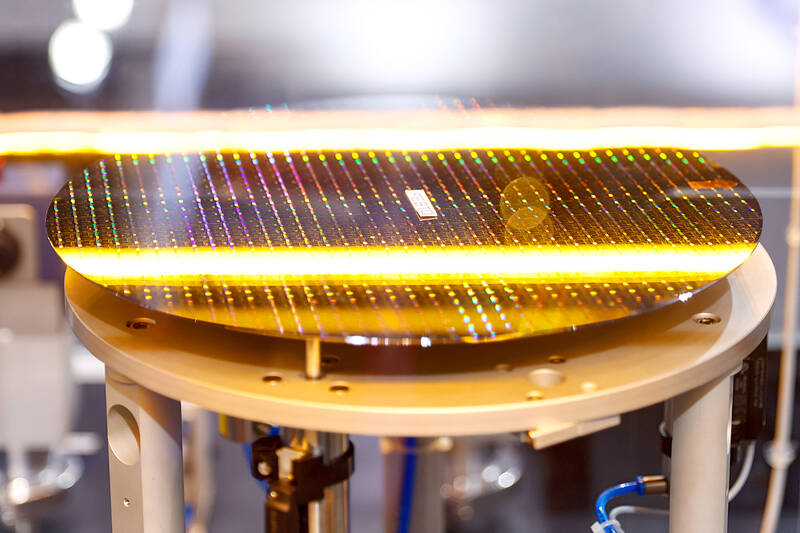
A silicon wafer on display during SEMICON Taiwan 2026 in Taipei on Sept. 26.
Photo: Ritchie B. Tongo, EPA
The US’ trade deficit is anticipated to exceed US$1.1 trillion, with Taiwan as its third-largest source at US$219.2 billion, following Vietnam at US$238 billion and Mexico at US$221 billion, it said.
China would be the fourth-largest at US$156.4 billion, the central bank said.
Taiwan is becoming a crucial manufacturing node in the global division of labor, with US-bound server exports boosting the nation’s development of semiconductor-making and advanced chip packaging technology, it said.
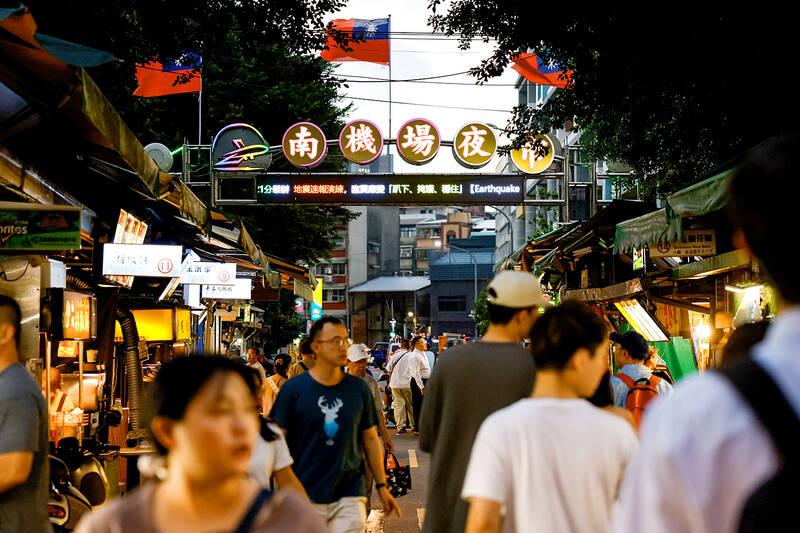
People walk through Nanjichang Night Market in Taipei on Thursday.
Photo: Ann Wang, Reuters
The nation imports South Korean memory chips and Japanese wafer fabrication equipment and materials, while outsourcing medium and low-technology manufacturing to ASEAN member states, the report said.
These industrial relationships put Taiwan at the center of global AI supply chains, it said.
The electronics industry has also moved away from the trade model of making products in China and selling them in the US market, the report said.
High-value added, tariffed, technologically advanced or cybersecurity-sensitive goods are now predominantly made in Taiwan, while medium and low-tech products are assembled in the US or ASEAN countries, it said.
The local production share in exports reached a record high of 52.9 percent last year, up 5.3 percentage points from 2018, the report said, adding that the share of orders produced in China dropped to 26.2 percent, a steep decline of 20.7 percentage points over the same period.
Production shares in ASEAN and the US rose to 11.3 percent and 5 percent respectively, a growth of 9.7 and 4.1 percentage points compared with 2018, it said.
Taiwanese investments in China this year are expected to drop further, a departure from Taiwanese enterprises’ long-standing strategy of investing in China, which had prevailed for much of the past 30 years, the report said.
The companies used to outsource manufacturing to China to keep costs down and increase efficiency, facilitating the latter’s rise as the world’s leading producer of consumer electronics, it added.
The rise in production costs and geopolitical risks in China has changed the equation, driving businesses to reorient their trade ties toward Japan, the US and Southeast Asia, it said.
Developed countries are also changing their policy stance, choosing to establish domestic chip manufacturing capabilities and strategically valuable materials, the report said.
Taiwan’s cumulative direct investment ratio in China in 2017 was 58.3 percent, but has plummeted to 18.8 percent between 2018 and last year, it said.
The US has supplanted China as Taiwan’s most important investment destination, the report said.
The nation’s cumulative direct investment ratio in the US from 2018 to last year increased to 18.7 percent, while the proportion of total outward investment directed at the US in 2023 and 2024 was 36.4 percent and 29.1 percent respectively, it added.
KioskNews shows a cleaned-up reading view extracted from the publisher’s page — the original always lives on their site, not ours.