Winter action plan: Delhi to get 30 smaller road sweeping machines for narrow streets
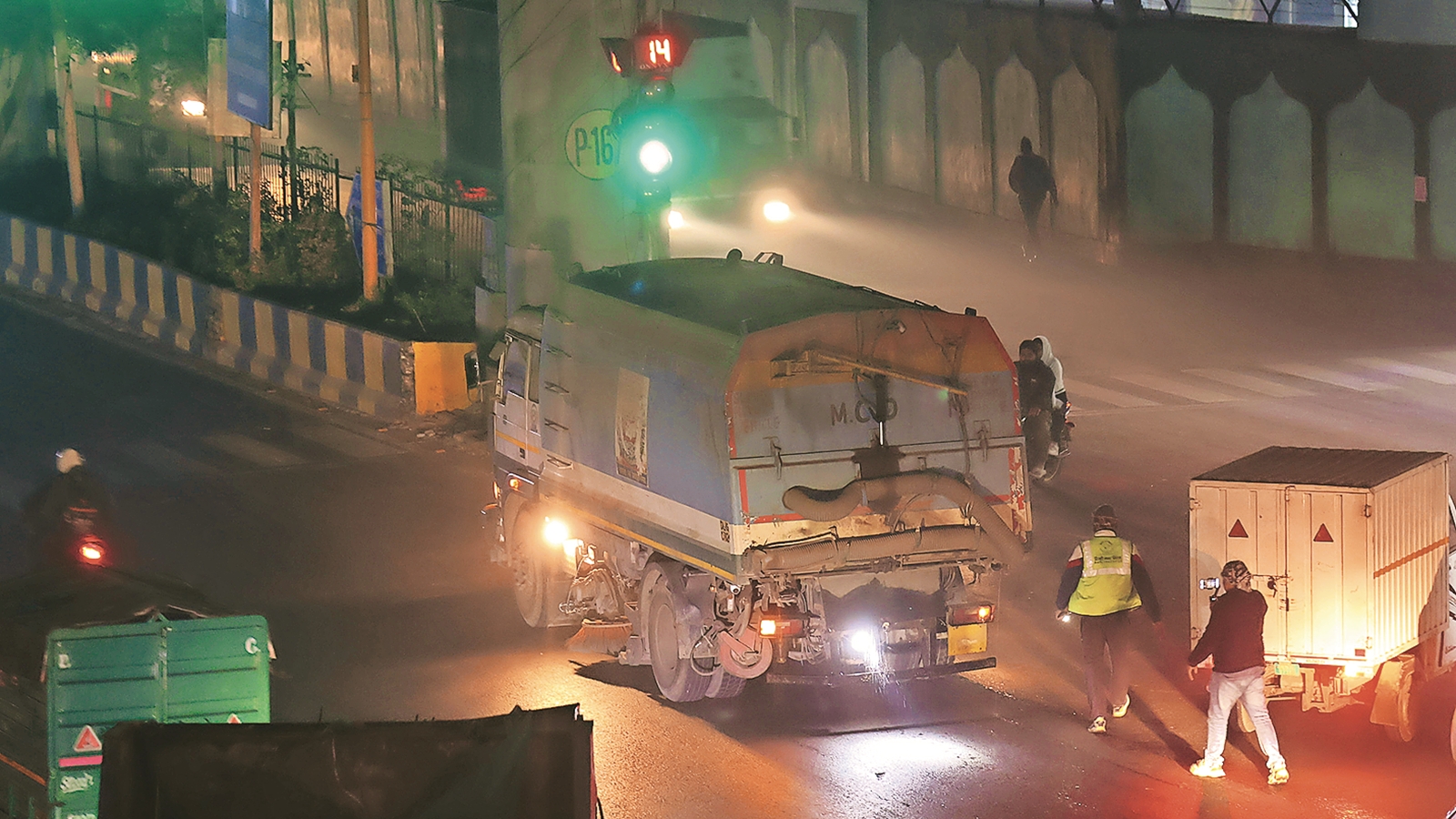
In a key measure to fight winter pollution, the Delhi government has approved the procurement of 30 smaller EV (electric vehicle)-based mechanised road sweeping machines (MRSMs) to clean narrower roads. This is significant as the existing fleet of MRSMs has limited reach, covering only a fraction of the Capital’s total road network.
According to the Cabinet decision announced Tuesday, the initiative is expected to cover about 609 kilometres of roads with a right of way (RoW) — road width open for traffic — of less than 10 metres (32.81 feet), comprising 854 roads across 250 wards. The Municipal Corporation of Delhi (MCD) will receive a grant to procure the 30 machines and will deploy and operate them, officials said.
Sources said the Union Ministry of Environment, Forest and Climate Change has urged the Delhi government to deploy the machines by November.
The Delhi Cabinet on Tuesday also gave its approval for real-time monitoring of PM2.5 and PM10 sources in collaboration with IIT-Delhi.
In May, The Indian Express reported that while the Centre had flagged a total requirement for 505 MRSMs in Delhi, there was a shortfall of over 80%. Currently, the total fleet strength is 98. Records investigated by The Indian Express showed how the Centre arrived at its 505-machine figure: 246 small machines for 9,855 km of roads with RoW of under 20 feet; 91 medium machines for 7,277 km of roads with RoW of 20-60 feet; and, 168 large machines for 13,409 km of major roads with RoW over 60 feet.
The initial rollout will be limited in scale, in order to assess the performance on the ground before wider deployment, a senior ministry official said. “It is like a pilot mode. A smaller number would first be deployed to see if it works out and to understand the on-ground challenges,” the official said.
The Centre is drawing on mechanised cleaning models from South Korea, Japan, Saudi Arabia and the United Arab Emirates (UAE), while also studying the experience of cities like Indore, The Indian Express has learnt.
Story continues below this ad
The pilot project is expected to address gaps in the existing road-cleaning system. The existing MRSMs cover only 20-30% of the Capital’s roads, a senior ministry official pointed out. “The move will help address dust pollution on some of these narrow roads, which have been difficult to cover with the existing fleet,” the official said.
Public participation will be important, particularly on narrow roads where parked vehicles, pedestrians and other activity could obstruct the machines, officials said. “Announcements will have to be made a day before road cleaning so that people are informed and can park their vehicles accordingly,” said an official.
Officials said state-level agencies found it difficult to deploy a large number of small machines simultaneously, prompting the decision to begin with a smaller fleet, before scaling it up.
The proposed deployment of 30 additional MRSMs is estimated to cost about Rs 393.73 crore over 10 years, according to the Delhi government.
Story continues below this ad
An IIT-Kanpur study in 2016 had found that road dust accounts for about 56% of Delhi’s annual PM10 emissions and 38% of its annual PM2.5 emissions.
In February, the Commission for Air Quality Management (CAQM) had issued technical and operational norms for deployment of different categories of MRSMs based on road width. Small machines with a hopper capacity of less than 1 cubic metre and an operating width of less than 2 metres are meant for roads with RoW of less than 10 metres.
The CAQM norms require small MRSMs to operate for at least eight hours per shift and cover a minimum of 20 running kilometres. They also require an integrated water-spraying system and particulate matter filtration to suppress dust and prevent its re-entrainment. New MRSMs are to be electric or CNG-powered.
In 2025, the Prime Minister’s Office (PMO) had directed agencies to expedite procurement of MRSMs. At a meeting in April last year, officials had estimated that at least 1,000 additional machines would be needed across the National Capital Region for comprehensive coverage.
Story continues below this ad
Meanwhile, the government has said the current fleet of MRSMs is being deployed in two shifts, with deep cleaning of all major roads targeted for completion by October 31.
KioskNews shows a cleaned-up reading view extracted from the publisher’s page — the original always lives on their site, not ours.