Doctor cautions on poor bone health nationwide
‘SILENT KILLER’: Osteoporosis can often go undetected, and, if left untreated, can increase the risk of fractures, which can lead to other complications, a doctor said
By Lee I-chia / Staff reporter


Height loss, slouching and back pain can be signs of osteoporosis, which is frequently referred to as a “silent killer” as it often goes undetected, but can significantly increase risks of fracture and mortality, a doctor said at a news conference yesterday.
As Taiwan’s rapidly aging population has triggered a public health challenge regarding osteoporosis, the Food and Drug Administration (FDA) yesterday invited Wu Meng-huang (吳孟晃), director of Taipei Medical University Hospital’s Department of Orthopedics, to help raise awareness of the disease.
Osteoporosis is a systemic skeletal condition, characterized by decreased bone density, causing the bones to lose support from the internal structure and become like a thinning sponge, he said.
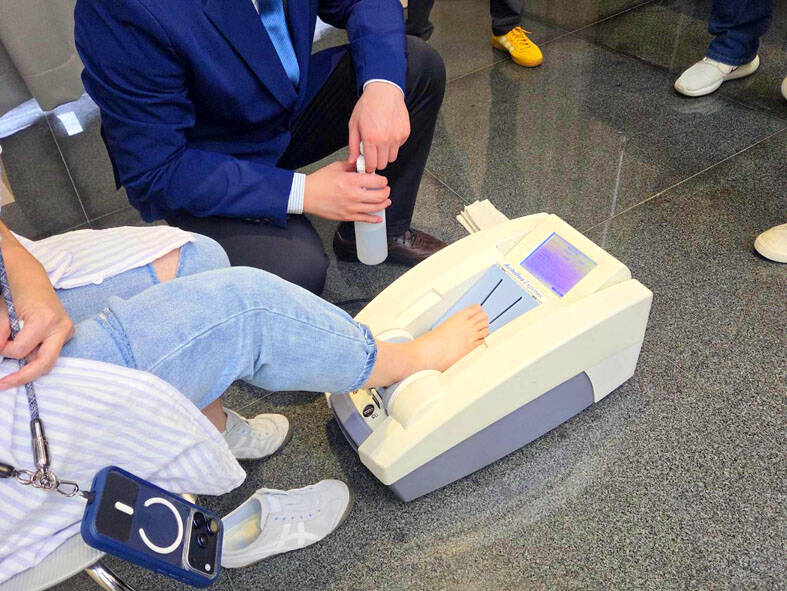
A woman puts her foot in a bone mass density testing machine during a news conference in Taipei yesterday.
Photo: CNA
Taiwan has a relatively high prevalence of osteoporosis, especially among people aged 50 or older, with about one in three to four women, and about one in five men in the age group diagnosed with the disease, Wu said.
If untreated, osteoporosis can increase the risk of fractures from a fall or even routine movement, he said, adding that Taiwan has the highest hip fracture rate in Asia.
Hip or vertebral fractures can cause movement disabilities, and people who are bedridden for long periods are more susceptible to complications such as aspiration pneumonia or urinary tract infection, significantly increasing the risk of mortality, Wu said.
High-risk groups for osteoporosis include women aged 65 or older, men aged 70 or older and people who take certain medications over long periods, such as anti-hormone drugs for treating breast cancer and prostate cancer, he said.
People with chronic lung disease or rheumatic and autoimmune diseases might also experience bone loss, he added.
Wu suggested that women with a family history of osteoporosis should consider getting a bone density test between 40 to 45 years old, and getting a follow-up test every two years after menopause, while those who have been diagnosed or are among the high-risk groups can consult a doctor to get tested every year.
He also suggested that men receive a test at about age 50, as some might already have osteoporosis without knowing.
Dual-energy X-ray absorptiometry (DXA) of the lumbar spine and hip is the standard clinical test for measuring bone mineral density, and the T-score from the test is used to diagnose osteoporosis, the FDA said, adding that people can consult a doctor about getting tested.
Quantitative ultrasound (QUS) of the heel is a radiation-free and convenient alternative to test bone density, but it cannot directly replace DXA, and those who have an abnormal QUS result would require a follow-up DXA scan for osteoporosis diagnosis, the agency said.
Wu said osteoporosis prevention should start early, by doing weight-bearing exercises, running and brisk walking, and getting moderate sun exposure to help the body produce vitamin D and preserve bone health.
KioskNews shows a cleaned-up reading view extracted from the publisher’s page — the original always lives on their site, not ours.