‘It is ours’: The far-right Israeli settlers who want to build homes in Gaza

The Simhoni Forest: While many Palestinians dream of escaping the ruins of Gaza, Israeli Tchiya Chaim cannot wait for the chance to move there – and take her 11 children with her.
For the past week, the settler activist and hundreds of comrades have been living in an outpost in southern Israel, just a few hundred metres from the Gaza border. Working quickly overnight to avoid detection, they established what looks like a squatter campsite with rows of tents, tarpaulins, demountables and caravans. There is also a jumping castle for young children and a classroom lined with religious texts. They have called the encampment Halutzei Aza – “the Pioneers of Gaza”.
“God willing, we will stay here until the government will take this settlement and put it into Gaza,” says Chaim, a senior member of the controversial Nachala settler movement led by Daniella Weiss, known as the godmother of the Israeli settler movement.
“It’s part of Israel, and we are going back there. On a basic level, it is ours.”
And what should happen to the two million Palestinians who live there? “They have so many places they can go,” she responds with a grin. “For example, Australia. Such a big place. Don’t you have room for them?” As we speak, children run around wearing T-shirts saying “Gaza’s Jews”.
Chaim speaks glowingly of Gaza as a place of tranquillity and natural beauty, not mentioning the fact that most of its buildings have been destroyed or damaged during Israel’s war against Hamas, which killed more than 74,000 people, according to Gaza’s Health Ministry. Locals there speak of rodent infestations and infectious diseases running rampant amid the rubble.
The Pioneers of Gaza have nestled themselves between Kfar Aza and Nahal Oz, two of the kibbutz communities that came under brutal attack by Hamas on October 7, 2023. It’s a vivid display of the competing ideologies at the far ends of Israel’s political spectrum. The kibbutzim are famously left-leaning, pro-peace and secular; the Pioneers of Gaza and its supporters are right-wing, mostly religious, and committed to establishing a Jewish presence across all of what they call Greater Israel.
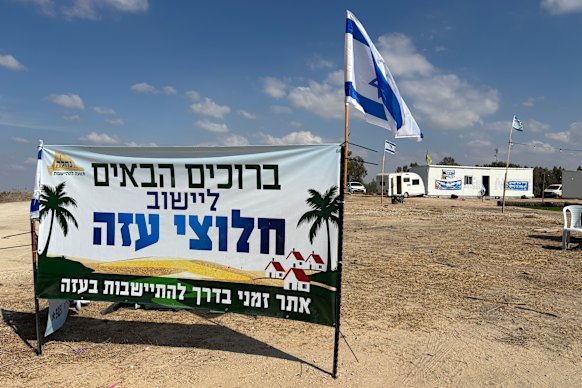
In the West Bank, settlers commonly use hastily built outposts to establish a foothold that later becomes a more developed and permanent community – despite the settlements being regarded as illegal under international law. This one, inside Israel’s 1948 borders, is designed as a way station to the Gaza Strip. Its arrival just days before Israelis vote in their first election since 2022 sends a message from the settlers that they want this to be a priority for the next government.
‘[The Palestinians] lost the war and when you lose you have to face the consequences. Relocating is the least they could do.’
Rabbi Duv Fendel
The Nachala settlers had no permission to set up their camp in the forest, which is controlled by the Jewish National Fund, a major charity. But authorities are showing no haste in moving them on. When we visit, there are a handful of police at the scene watching passively. Eventually, the officers politely ask someone from the camp to join them for questioning at the station. When the settlers decline, they quickly give up.
“We’re working together,” Chaim says, evincing no concern at being evicted. Israel’s police force is controlled by the ultra-national National Security Minister, Itamar Ben-Gvir, himself a radical right-wing settler.
The mayor of the nearby town of Sderot, a stronghold of Benjamin Netanyahu’s Likud party, has visited to express solidarity and support for the settlers’ cause.
Twenty-one Jewish settlements were built in Gaza between 1967 and 2005, before Israel dismantled them under a policy known as the unilateral disengagement. Israel evacuated 8000 settlers from Gaza and relocated a cemetery containing 48 graves. The Israeli military continued to retain control of the strip’s sea and airspace. The policy was deeply polarising at the time, and Israeli critics saying it would expose Israel to more terror attacks.
Soon after the disengagement, the Iran-backed Islamist militant group Hamas gained power and began smuggling in rockets and building an elaborate underground tunnel network. Two decades later came the October 7 attacks, which killed an estimated 1200 Israelis.
Rabbi Duv Fendel, who has travelled from Sderot to teach Torah classes to the would-be Gaza settlers, says: “It’s outrageous that the only place in the world that by law a Jew is forbidden to live is in the Gaza Strip. Uprooting the settlements was one of the most hideous crimes in Zionism, and they need to be restored immediately.”
As for the Palestinians living there, he peppers his speech with comparisons between Hamas and the Nazis and a desire for vengeance. “They lost the war and when you lose you have to face the consequences. Relocating is the least they could do,” he says.

The settlers at the camp say they speak for a large part of Israeli society, and they are correct. While not commanding majority support, resettling Gaza is not a fringe position either. A poll by the Israel Democracy Institute last year found 40 per cent of Jewish Israelis support Israeli settlement of the Gaza Strip.
Two of Prime Minister Benjamin Netanyahu’s most senior ministers, Ben-Gvir and Finance Minister Bezalel Smotrich, are campaigning for re-election on a platform of returning Jewish settlers to Gaza. Both have been sanctioned by Australia and other Western nations for inciting violence against Palestinians.
“I want all of Gaza. I want Gaza to be ours, I want it Zionist, I want it secure,” Smotrich told a campaign event this month. Ben-Gvir told Time magazine in a recent interview: “If Israel wants to continue to live and not be destroyed, we have to capture all of Gaza ... Israel is a tiny country. We have to be wider, broader.”
Defence Minister Israel Katz, a member of Netanyahu’s Likud party, said in July that he intended to set up three military outposts in northern Gaza, a move that has traditionally been a prelude to civilian settlements.
When Eliyahu Aton saw a story about the Pioneers of Gaza encampment on Channel 14 – Israel’s equivalent of Fox News – he drove from his home 45 minutes away to offer his solidarity. Resettling Gaza, he argues, will improve Israel’s security and ensure an attack like the October 7 massacre can never happen again.He believes the kibbutzniks living nearby who still believe in the possibility of peace with the Palestinians are dangerously naive.
Danny Rahamim, a leader of the Nahal Oz kibbutz, counters that the settlers are “crazy” for wanting to resettle Gaza. “That would be like poking two fingers in their eye,” he says.
Critics argue resettlement would stretch the Israel Defence Forces to breaking point, drain the budget and expose Israel to international opprobrium. Netanyahu has repeatedly insisted that Israel has no intention of permanently occupying Gaza or displacing its civilian population. US President Donald Trump’s peace plan states that “Israel will not occupy or annex Gaza”.
This is why Aton, who served with the Israeli military in Lebanon in the 1980s, says Netanyahu needs ideologically committed coalition partners who will push him further to the right. The 63-year-old used to vote for the left-wing Labor Party until the early 2000s but is now backing Ben-Gvir’s Otza Yehudid (Jewish Power) party. “He knows how to treat the terrorists. He speaks our language,” he says.
Aton’s shift reflects a broader ideological trend in Israeli society accelerated by the October 7 attacks. Nearly two-thirds of Jewish Israelis identify now with the political right and a quarter identify as strongly right-wing, according to a study released this month by the Jewish People Policy Institute. Just 22 per cent of Israelis now identify with the left.
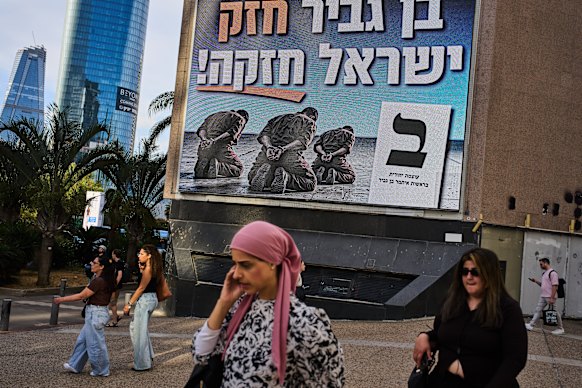
Ben-Gvir is expected to win about eight seats on Tuesday (Israel time), up from the previous election and a massive turnaround from 2020, when his party failed to win a single seat. Younger voters, in particular, have been rushing to his campaign events, and conservative towns like Sderot are plastered with posters of him in front of handcuffed prisoners. Ben-Gvir drew international condemnation, including from Australia, earlier this year when he was filmed taunting pro-Palestinian detained after trying to enter Gaza on a flotilla carrying humanitarian aid.
Many at the Pioneers of Gaza camp say they back Smotrich, who is more calculating and less bombastic than Ben-Gvir but equally hardline. The problem for the far-right parties is that while they are holding and even gaining ground, support for Netanyahu’s less extreme Likud has plummeted.
The latest polls show the pro-Netanyahu bloc hovering around 50 seats, significantly down on its haul at the last election and below the 61 required to form a government. Rabbi Duv Fendel is praying for a miracle on election day so his dream of resettling Gaza can be fulfilled. “I hope it will be a landslide for the right-wing,” he says.
Get a note directly from our foreign correspondents on what’s making headlines around the world. Sign up for our weekly What in the World newsletter.
KioskNews shows a cleaned-up reading view extracted from the publisher’s page — the original always lives on their site, not ours.