Need a smile? This livestream features 6 puppies all day long
Every wiggle and wobble, every snuffle and squeak of six newborn puppies snuggling together in Finland is captured by cameras monitoring their development in the first weeks of their lives. For science, of course.
Even though the puppies mostly nap and nurse — no fetching yet — they’ve entranced millions of Finnish viewers and others around the world through Pentulive, a 24/7 slow TV livestream from Finland’s national public broadcaster, Yle. “Pentu” means puppy in Finnish.
The puppies’ mother, a 5-year-old Lagotto Romagnolo dog named Hilkka, gave birth to four males and two females on Oct. 10. The puppies have brown and white fur and weighed roughly 1 kilogram each Thursday.
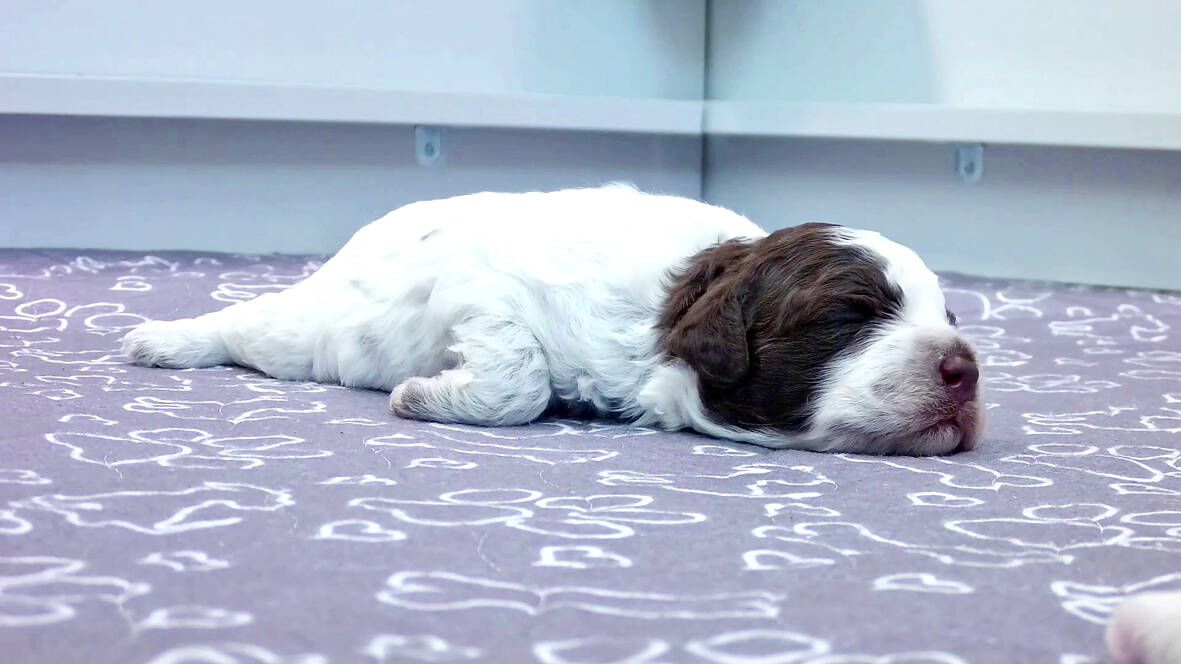
A puppy of the Lagotto Romagnolo dog Hilkka sleeps on Oct. 15 in Finland.
Photo: AP
“They are just opening their eyes and their ears,” Pirjo Koskinen, a Yle science journalist who came up with the idea for Pentulive, said on Thursday. “They are taking their first clumsy steps.”
The slow TV show is in its sixth season and expected to break viewership records again. In less than two weeks, the livestream had more than 6 million views on social media alone in the country of 5.7 million people. A naming ceremony is set for Saturday.
The programming incorporates science through chat sessions with viewers three times a week, as well as a podcast and online articles detailing the dogs’ development. The audience can watch the puppies grow day by day and track their milestones alongside Yle’s science journalists and the breeder.
The scientific benefits extend to humans, too.
Seeing the puppies attempt to make a mad dash to their mother for milk, for example, can trigger an increase in levels of a hormone called oxytocin in a human brain, Koskinen said. Also known as the love hormone, it can help create social bonding as well as reduce anxiety.
The show is also an escape from the stresses of the rest of the world for viewers and Yle’s journalists alike. One look at those wagging tails and little pink noses and it’s hard not to smile, said Jyri Loikkanen, Yle’s producer of Pentulive.
Loikkanen, who often watches the livestream to decompress from his workday, said a commenter wrote on social media comparing the US considering livestreaming the firing squad execution of Fort Hood shooter Nidal Malik Hasan to Finland streaming puppies.
“I think it’s pretty much a sign of the times that people crave for this kind of small escape,” Loikkanen said, from the “doom and gloomy news what we are experiencing at the moment: The politics, the economics, war and strife et cetera.”
The puppies will be adopted mid-December by people chosen by the breeder. Yle keeps the breeder’s name and location anonymous for their privacy and so that they can focus on the dogs’ well-being. The puppies’ new families are selected before the livestream begins each year.
The slow TV style of programming began in 2009 with Norwegian public broadcaster NRK’s minute-by-minute airing of a seven-hour train trip across the southern part of the country. It has since spread with productions in the United Kingdom, China and elsewhere.
In Sweden, for example, remote cameras for “The Great Moose Migration” capture dozens of moose as they swim across the Angerman River, some 300 kilometers northwest of Stockholm, in the annual spring migration toward summer grazing pastures.
KioskNews shows a cleaned-up reading view extracted from the publisher’s page — the original always lives on their site, not ours.