14 times in 10 months, two Election Commissioners objected on record to poll panel steps
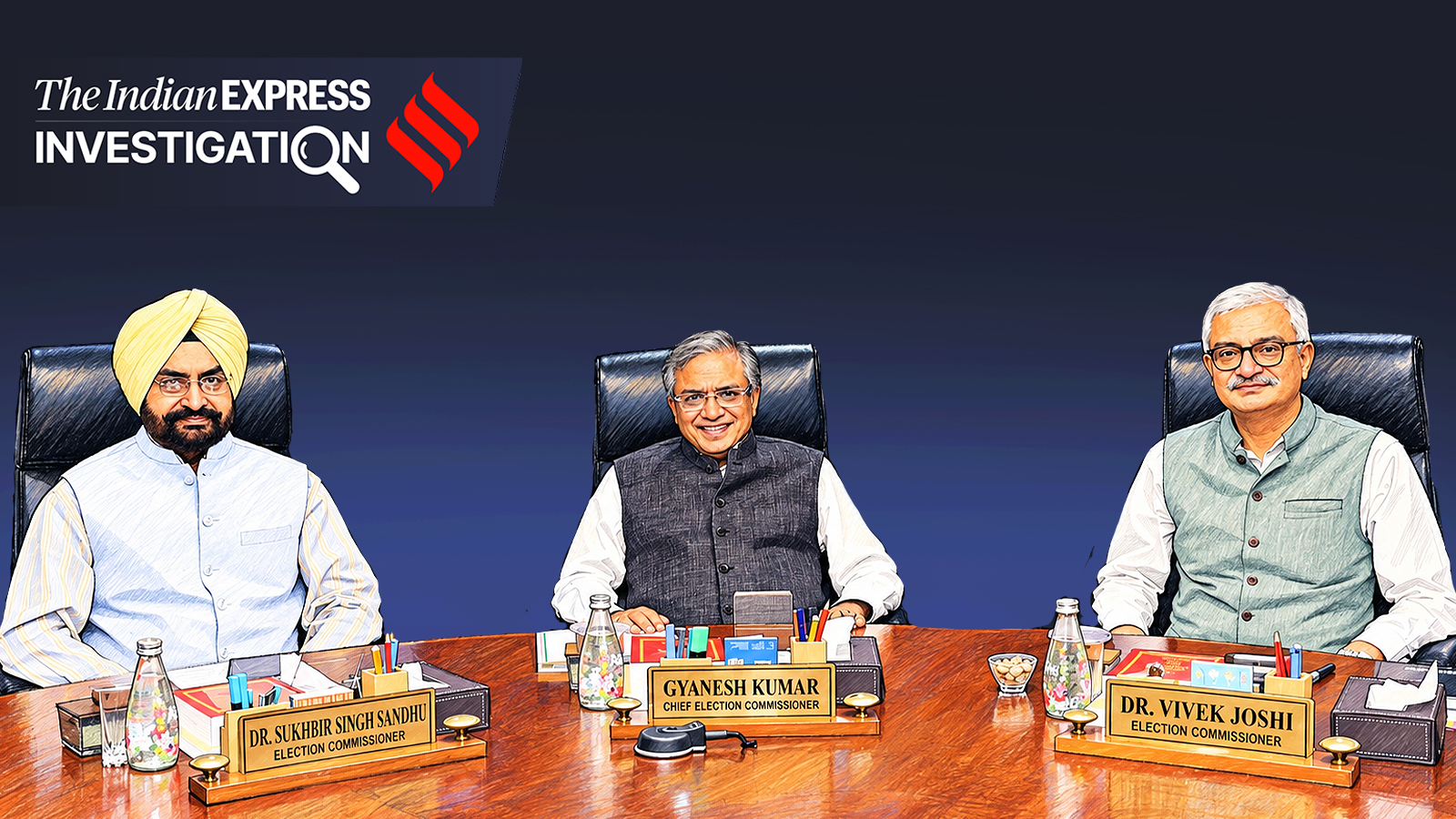
The Election Commission of India’s (ECI) Special Intensive Revision (SIR), which began in Bihar in June 2025, an otherwise routine clean-up of the rolls, has struck more than 13 crore names off the draft voter rolls in 30 States and Union Territories. This has put the Election Commission at the centre of intense public debate over its role in deciding who gets to vote — and who doesn’t.
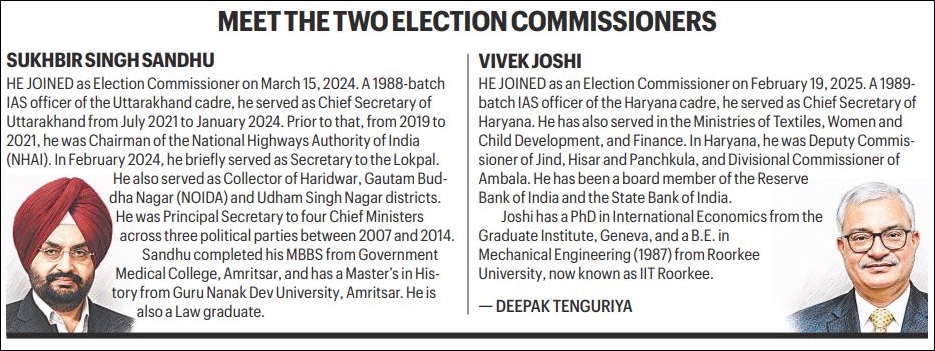
An investigation by The Indian Express reveals that questions were raised on these very issues within the three-member Election Commission (EC) itself, time and again through much of this same period. By two of the three Election Commissioners, Sukhbir Singh Sandhu and Vivek Joshi, no less.
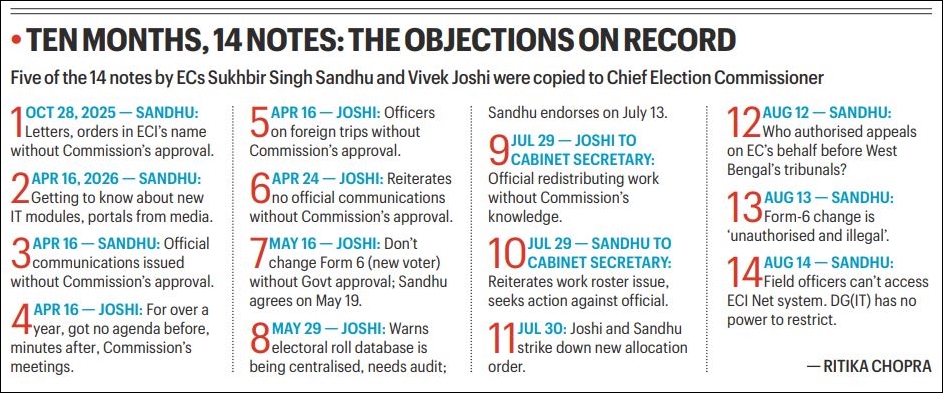
The national rollout of the SIR has been under the supervision of all three Commissioners. But Sandhu and Joshi have formally objected, on record, at least 14 times over the last 10 months — four times on a single day — to decisions taken and orders issued, they say, without their knowledge.
The stakes couldn’t be higher.
◆ 2 out of 3 Election Commissioners complained about being kept in the dark, adding new voters, and deleting names.
◆ They called steps on new voters 'unauthorised, illegal'; warned against voter database access being 'centralised' in Delhi, bypassing state officials.
◆ On concerns over integrity of voter software, dissenting Commissioners even knocked on the Cabinet Secretary's door.
◆ This marks an unprecedented rupture inside the Election Commission and reveals a cloud over its conduct.
Read more on this story →
For, the objections relate to the core of the Election Commission’s mandate: new voter registration, deletion and restoration of voters in the rolls; filing of appeals against orders restoring voters in the SIR process; and the custody, and security, of the entire electoral roll itself. All objections related to these were copied to Chief Election Commissioner Gyanesh Kumar, too. Some were sent to Deputy Election Commissioners under their watch.
In one such written objection, Sandhu complains that the EC acted against the written advice of two Commissioners and claim its action was “unauthorised and illegal.” Most recently, in a radical departure from the norm, Joshi and Sandhu wrote separately to the Cabinet Secretary complaining about changes in work allocation that, in effect, removed a layer of oversight of the IT backbone for the electoral rolls. They made it clear: these changes had been done without their knowledge and they struck them down.
It was after this, on September 9, that the CEC and the two ECs met, their first full meeting in four months.
The Indian Express has seen each of these exchanges, and interviewed a range of officials in New Delhi, Kolkata, Goa and Mumbai, to reconstruct the extent of the disquiet within, unprecedented in scale and significance within the constitutional authority that is entrusted with the free and fair conduct of the nation’s elections.
Story continues below this ad
More so, because all three were handpicked by the NDA government and appointed under the 2023 Act by a selection panel of the Prime Minister, Union Home Minister and the Leader of Opposition. The Opposition member, Congress’s Adhir Ranjan Chowdhury, recorded a dissent over the appointment process when Sandhu and Gyanesh Kumar were named Election Commissioners in March 2024. LoP Rahul Gandhi, too, recorded his dissent when Kumar was elevated to CEC and Joshi appointed in February 2025.
On September 21, The Indian Express sent a questionnaire to the Commission on the issues flagged by the two Election Commissioners asking what was done to address their concerns. There was no response. Both the ECs were also sent emails on September 21, asking them whether their concerns were addressed. Both the emails also sought responses on whether these issues were flagged during the September 9 meeting. Both emails were followed up by phone calls on Monday and Tuesday. There was no response.
Taken together, these objections represent the sharpest and most sustained ruptures recorded inside a Constitutional authority — and touch four key issues:
1. Who’s a “new voter”, why was Form-6 changed?
In July this year, as first reported by The Indian Express, a form that every adult citizen has to fill to become a voter started asking a question it never did earlier. Linking the application to the SIR, it asked if the new voter or their parents/ grandparents “exist” in the “electoral roll of last SIR.” Applicants could not proceed without answering it.
Story continues below this ad
This despite the fact that in May, Joshi had warned on file that Form 6 could not be changed in this manner without the government amending the rules, and Sandhu had agreed. The change was made anyway.
After The Indian Express first reported this change in July, Sandhu put on record on August 13 that it was “unauthorised and illegal” and “must be removed immediately”.
Until Monday morning, that question was still there.
2. Who should have access to the electoral roll?
The Commission’s strongest defence against every political allegation on electoral roll rigging has been that the roll preparation is decentralised. Each constituency’s voters’ list is prepared and controlled by its Electoral Registration Officer, a statutory authority on the ground. Usually, the ERO is the Sub-Divisional Magistrate. This list sits on a software, ERONet, and its successor ECINet. Over the past year, the two Commissioners have repeatedly questioned whether EROs’ access to this list is now being restricted.
This was what Joshi red-flagged in May this year — the SIR was gathering pace across states — as “gradual centralisation of the electoral roll database” and proposed an audit to certify that “no one, except the concerned statutory authorities, has credentials to make any change in the (voter) database.”
Story continues below this ad
In August, Sandhu reiterated this. He recorded that state-level election officials were reporting they “don’t have proper and complete access” to the ERONet portal, the digital system through which they maintain the electoral roll. He flagged that the Electon Commission’s Director General of IT Seema Khanna “doesn’t have any legal authority to restrict proper and complete access and freedom to operate, as given by law, to the statutory authorities.”
The defence the Election Commission has relied on for decades, the two ECs were saying, is being dismantled from inside its own IT division.
3. West Bengal: who authorised the appeals?
The SIR was the most deeply contested in West Bengal. There was no evidence of its role in the election outcome. Of the 294 seats that went to polls, in 49, the SIR deletions exceeded the victory margin. But in these, the spoils were almost evenly shared — 26 were won by BJP and 21 by TMC.
But the manner in which names were struck off prompted the Supreme Court, in February 2026, to take the last leg of the SIR out of the Commission’s hands and get judicial officers to decide on the plight of 60 lakh voters flagged for “logical discrepancies.”
Story continues below this ad
Of these, 27 lakh electors were subsequently deleted by the Commission. The court then ordered tribunals of retired High Court judges to hear appeals against those decisions.
Last week, the Commission told the court that there were 38 lakh appeals pending before the tribunals: 22.21 lakh filed by deleted voters seeking to be restored. The other 16.10 lakh were filed against voters the judicial officers had included, seeking their deletion. The Commission did not say who filed those.
This was the issue flagged by Sandhu — about the Commission appealing against voters whom judicial officers had included.
In August, he wrote to Commission officials asking, “Who was authorised to file these appeals on behalf of ECI, and by whom?” and “Who actually filed these appeals on behalf of ECI?” He recorded that neither he nor Joshi nor the current Chief Electoral Officer of West Bengal had been informed about the basis or process of filing the appeals.
Story continues below this ad
4. Goa: why did the software reject eligible voters?
The same centralisation, which Joshi and Sandhu had flagged repeatedly, ended up disenfranchising potential voters in Goa. On January 29, the Supreme Court ordered that voters flagged for “logical discrepancies” during the SIR be allowed to submit documents and be heard before the final roll was published. A “logical discrepancy” is a mismatch the software throws up when it tries to link a voter to a parent or relative on an older roll: a name that doesn’t match, an age gap that doesn’t add up.
Goa’s EROs heard these cases. On the documents produced, they found 97 voters eligible for the final roll. The software had no way to record that decision.
Between February 11 and 17, the office of Goa’s Chief Electoral Officer wrote eight times to Gyanesh Bharti, the Senior Deputy Election Commissioner in charge of the state, copying Director General of IT Seema Khanna every time, asking for the rollback option that would let EROs reverse the earlier deletions as the Supreme Court had directed. The requests went unanswered as the deadline for publication of the final electoral roll approached.
The provision was not enabled in time. The 97 were left off the final voters’ roll in Goa. Ninety seven voters is a small number, however this goes far beyond 97 — it is the Election Commission of India’s job to ensure that every valid vote gets counted.
Story continues below this ad
Objections within: what the law requires
The Commission is a constitutional body under Article 324, made up of the Chief Election Commissioner and two Election Commissioners who are equal in rank. The CEC is first among equals. He does not have the power to decide alone.
Under the Chief Election Commissioner and Other Election Commissioners (Appointment, Conditions of Service and Term of Office) Act, 2023, all business of the Commission, says Section 18, “shall, as far as possible, be transacted unanimously”.
If the CEC and the Election Commissioners “differ in opinion on any matter”, the matter “shall be decided according to the opinion of the majority.” The same section allows the Commission to settle its own procedure and the division of its work, but only “by unanimous decision”.
-
01
Two out of three Election Commissioners have lodged 14 formal objections against poll panel decisions, led by chief Gyanesh Kumar in 10 months.
-
02
Commissioners Sukhbir Singh Sandhu and Vivek Joshi allege key decisions were made without their knowledge or approval.
-
03
The internal rift focuses on the Special Intensive Revision (SIR) affecting 13 crore voter names.
-
04
ECs challenged "unauthorised, illegal" changes to Form 6 for new voter registration.
-
05
Concerns raised over the "gradual centralisation" of the electoral roll database via IT divisions.
-
06
Centralised software now overrides ground-level Electoral Registration Officer (ERO) decisions, blocking eligible voters.
-
07
Centralising digital systems erodes the EC's traditional decentralised safeguard against rigging.
-
08
Officials questioned the legal authority of the IT Director General to restrict access for statutory officers.
-
09
Software issues in Goa led to the disenfranchisement of 97 eligible voters despite Supreme Court orders.
-
10
The rift highlights tensions over the 2023 Act mandate that EC business be transacted unanimously.
-
11
Objections were copied to CEC Gyanesh Kumar, signalling an unprecedented constitutional authority rift.
-
12
Unlike past individual dissents, this rift sees the Commission majority sidelined from decisions.
Indeed, both Commissioners invoked these provisions in their notes to remind the Commission’s officers how it is meant to work. On April 16, Sandhu told the Commission’s senior officers that “many communications go out in the name of the ECI but they do not have the approval of the Commission”, and that from then on every communication must have it, “as per the provisions of 2023 Act”.
Story continues below this ad
Eight days later, Joshi told the same officers that “several communications are disseminated in the name of the ECI without the requisite approval of ‘the Commission’,” and that all future communications must have that approval, “in accordance with the provisions of Article 324 of the Constitution” and the Act.
KioskNews shows a cleaned-up reading view extracted from the publisher’s page — the original always lives on their site, not ours.