NUS researchers develop clothing that can monitor health round the clock and act as ‘stethoscope’
SINGAPORE – Researchers at the National University of Singapore have developed a system where hair-thin sensor fibres are woven directly into clothing, allowing for the wearer’s heart and lungs to be monitored wirelessly.
This could help clinicians track patients’ health over longer periods, including after they are discharged from hospital, by incorporating the capabilities of a stethoscope into everyday clothing, the university said.
Dubbed the all-fibre wireless auscultation system (FiWAS), the technology allows for auscultation – the practice of listening to sounds inside the body – by combining fibre microphones with flexible, fibre-shaped electronics that process the signals and transmit them wirelessly.
The researchers note that while common wearable devices such as smart watches and smart rings can track vital signs, they are unable to capture sounds coming from the heart and lungs – which can provide doctors with crucial information about a patient’s health, such as changes in blood flow or fluid build-up in the lungs.
The fibre microphone they developed – measuring just 0.15mm, about the width of a human hair – is able to sense tiny vibrations via contact, allowing it to pick up sounds within the body while reducing interference from external noise.
The microphones connect to a flexible “fibre computer” containing miniature electronic components, which amplify and digitise the signals before transmitting them via Bluetooth to a mobile phone or computer.
The microphones and fibre computer can be sewn together into clothing, with a prototype able to operate for about 40 hours while powered by a small coin-cell battery.
The researchers also noted that FiWAS is washable, and is able to withstand washing machine and dryer cycles.
In collaboration with the National Heart Centre Singapore (NHCS), the system was tested on 10 patients hospitalised with heart failure – a clinical syndrome that can cause fluid to accumulate in the lungs, with patients remaining at risk of deterioration after discharge.
FiWAS was able to record heart murmurs, sounds associated with turbulent blood flow and S3 gallop – a faint, additional heart sound associated with heart failure.
The system was also able to capture lung crackles – which can indicate fluid accumulation in the organ – as well as an episode of atrial fibrillation in one patient.
A type of irregular heartbeat that can increase the risk of stroke or heart disease, atrial fibrillation is typically detected using an electrocardiogram (ECG).
However, routine ECGs can miss signs of atrial fibrillation as they typically record for up to 30 seconds.
The continuous monitoring provided by FiWAS, though, was able to capture the brief irregular rhythm, said Tural Khudiyev, who led the research.
The assistant professor at NUS’ College of Design and Engineering said the sound quality of FiWAS was comparable with that of current digital stethoscopes, which outperform conventional acoustic stethoscopes in picking up faint noises.
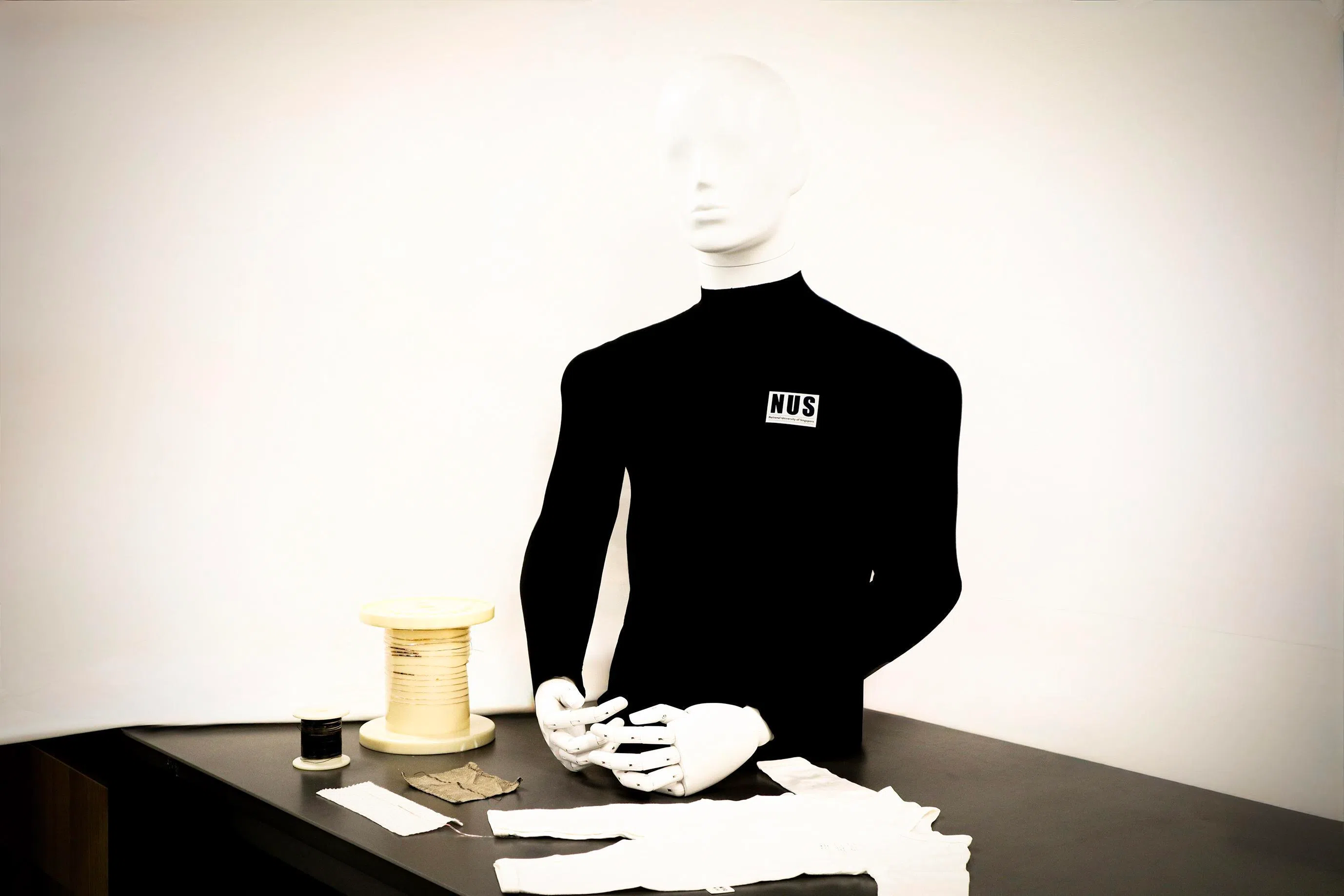
The all-fibre wireless auscultation system (FiWAS) developed by NUS researchers weaves fibre contact microphones and a flexible, fibre-shaped computer into soft, breathable textiles – turning clothing into a wireless stethoscope that listens to the body from within the fabric.
PHOTO: NUS
Derek Hausenloy, director of the National Heart Research Institute Singapore at NHCS, said FiWAS could allow for heart failure patients to be continuously monitored at home for issues such as fluid build-up in the lungs, even after discharge.
Such issues can be easy to miss without continuous monitoring, he said.
“Usually, by the time it’s been detected and a patient’s short of breath, that means they’re nearly going to end up in hospital,” said the cardiologist.
At KK Women’s and Children’s Hospital, the system was incorporated into infant onesies and bedding to monitor 20 newborns, including extremely preterm infants born before 28 weeks of pregnancy.
The system was able to capture one episode in which a premature infant’s heart rate slowed, the researchers said.
Yeo Kee Thai, a senior consultant at KKH’s neonatology department, said: “Continuous monitoring is critical to keeping newborns safe, but frequent use of traditional sticky pads and wires may hurt their fragile skin and make it harder for parents to hold and bond with their baby.”
“FiWAS allows us to obtain the continuous clinical data we need while letting the baby rest completely undisturbed,” he added.
Larger clinical trials with both NHCS and KKH, involving more diverse patients and a broader range of heart and lung conditions, are in the works.
The team’s findings were published in the peer-reviewed journal Nature Cardiovascular Research in October.
Khudiyev noted that one issue FiWAS still faces is movement, which can reduce the sound quality recorded. He suggested this could be addressed by improving the fit of the garment.
The system could eventually be used to track other conditions, he added.
In addition to monitoring patients, the technology could also be used to develop fitness trackers in the form of clothing, he said, adding that the team is working towards establishing a spin-off firm to commercialise the tech.
“We envision everyday clothing becoming an intelligent, large-area interface to the human body – continuously listening, mapping and interpreting cardiovascular and pulmonary physiology, while AI helps transform these signals into actionable information about health,” Khudiyev added.
KioskNews shows a cleaned-up reading view extracted from the publisher’s page — the original always lives on their site, not ours.