Nvidia’s Asian partners and suppliers prepare for life after Jensen Huang
By Wen-yee Lee, Hyunjoo Jin and Heekyong Yang / Reuters, TAIPEI and SEOUL


US chip giant Nvidia Corp’s partners and suppliers across Asia, from memory chip powerhouse South Korea to advanced chipmaking hub Taiwan, are redrawing plans in case chief executive Jensen Huang (黃仁勳) is ousted over reports of two extramarital affairs.
Nvidia’s board was meeting late on Wednesday to decide on Huang’s future, a source familiar with the matter told Reuters, in a sharp shift of tactics from Sunday, when the board expressed confidence in Huang and his leadership team.
“We will support whatever capacity Nvidia needs, but the new CEO may not be as aggressive as Jensen,” said an executive at a Taiwanese supplier who feared his company’s expansion could slow if a successor was not as quick to tie up manufacturing capacity.
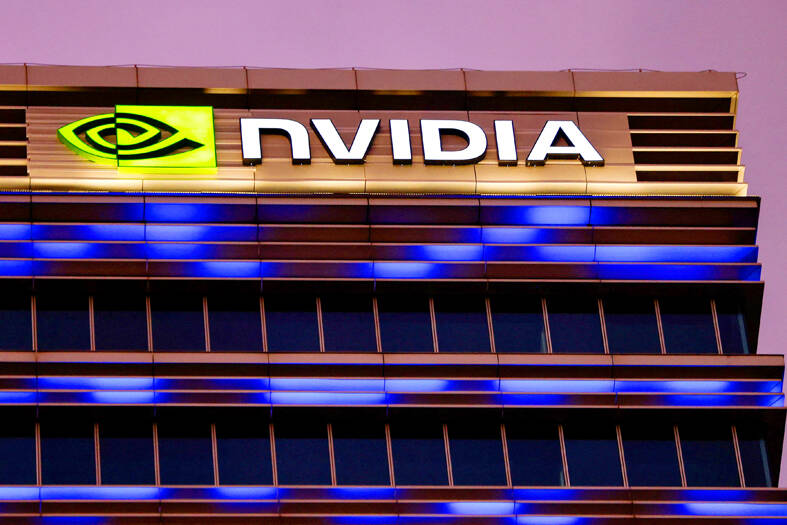
The Nvidia logo at the company’s Taipei office is pictured yesterday.
Photo: Ann Wang, Reuters
The executive sought anonymity because the subject is a sensitive one.
Huang has never anointed a successor, but analysts and investors see two candidates as particularly likely, at least for the short term: Nvidia’s uber-engineer Ian Buck and chief financial officer Colette Kress.
Any setback for Huang could deprive the artificial intelligence (AI) industry of one of its most vocal champions.
The longtime Nvidia leader has built a strong supplier network in Taiwan during frequent visits to strengthen ties with key manufacturing partners such as Taiwan Semiconductor Manufacturing Co (TSMC, 台積電), Hon Hai Precision Industry Co (鴻海精密) and Wistron Corp (緯創).
In May, he said Nvidia planned to invest about US$150 billion a year in Taiwan.
“He can take technologies his engineers believe are possible and turn them into products the whole company commits resources to, takes risks on, and has to deliver,” TF International Securities Group Co (天風國際證券) analyst Kuo Ming-chi (郭明錤) said.
“That’s why the supply chain gets such strong order visibility and is willing to keep up with aggressive spec upgrades, Kuo said.
“It also forces competitors to follow, which drives technology upgrades and supply chain investment across the entire AI industry,” he added.
In China, AI companies are seeking to secure overseas access to Nvidia chips, concerned that the scandal could spur Washington to tighten curbs on remote access to advanced processors, Reuters reported yesterday.
Companies in South Korea, home to key suppliers of the high-bandwidth memory used in Nvidia’s AI chips — Samsung Electronics Co and SK Hynix Inc — were assessing what a leadership change could mean for their expanding ties with the US firm.
Nvidia and SK Group, parent of memory chipmaker SK Hynix, are pursuing an AI initiative encompassing large-scale data centers and next-generation chips valued at about US$500 billion.
In forging and deepening Nvidia’s ties with South Korean business leaders, Huang has extended partnerships beyond semiconductors into robotics and AI factories.
He personally sketched a roadmap for collaboration on a whiteboard when Lee Hae-jin, founder of South Korean Internet firm Naver Corp, visited the US, the latter said.
“We’ve built strong ties with Huang over the years,” said an official at a South Korean chip company with business ties to Nvidia, citing Huang’s accessibility whenever business matters needed to be discussed.
“Our biggest question is whether a potential successor would maintain the same favorable relationship with us,” the official said.
Omdia chief analyst Lian Jye Su (蘇連傑) said Huang’s exit might shift Nvidia’s long-term direction and any slowdown in its execution or loss of clarity over its product road map could give rivals more room to catch up.
Still, some investors and analysts expect limited immediate impact from any change of leadership.
“The chips Nvidia will ship over the next year or two are already designed and in production, and its customers’ 2027 spending plans don’t depend on who runs the company,” said Armina Rosenberg, portfolio manager and cofounder of Minotaur Capital, which holds Nvidia shares.
KioskNews shows a cleaned-up reading view extracted from the publisher’s page — the original always lives on their site, not ours.