Paul Whitehouse urges PM to act over ‘imminent extinction’ of Windermere’s ice-age fish

An ancient fish species that has survived in Windermere for more than 11,000 years is at risk of “imminent” extinction due to widespread pollution in England’s biggest lake, experts have warned.
New research reveals the arctic char (or charr) appears to have disappeared from large parts of the 11-mile long lake where its habitats have been eroded by sewage and other substances.
Andy Burnham was urged to act to prevent the loss of this “unique” species as conservationists erected an ice sculpture of the prime minister outside No 10 North in Manchester on Thursday.
The 1.2-metre high structure, featuring a serious-looking Burnham between two blocks of sculpted arctic char, was unveiled by the comedian Paul Whitehouse, who co-stars with Bob Mortimer in the BBC’s Mortimer and Whitehouse: Gone Fishing.
Whitehouse said the “imminent extinction” of arctic char in Windermere was “absolutely symbolic” of the pollution in England’s waterways.
He said: “We need something to really highlight exactly what is happening, you know Windermere, the jewel in the crown of England’s freshwater resources – and it’s free, it’s available for everyone but it’s a basket case at the moment or it will be soon.”
Whitehouse said Burnham had made “some positive noises about taking back control of our water companies” but that stopping sewage discharges could be his legacy: “This government and Andy Burnham could say, look, we cleaned up the water companies. What a legacy that would be.”
Windermere, in the Lake District, has suffered from widespread raw sewage and bacterial pollution driven by discharges from United Utilities as well as 1,800 private septic tanks and private sewage treatment works.
In March this year, the mother of a seven-year-old boy who kayaked on the lake described how he nearly died after contracting a dangerous strain of E coli from contaminated water.
Experts say the arctic char in Windermere exists nowhere else on Earth because it has formed into four distinct populations since the last ice age more than 11,000 years ago.
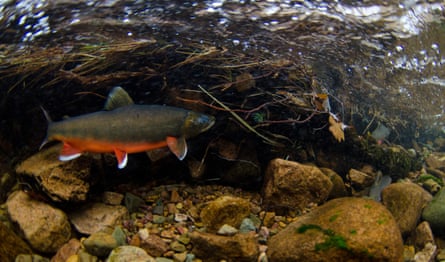
Its habit of lurking in the coldest depths of the 67-metre deep lake has led some to describe the orange-bellied species as like a “mythical creature” or a “ghost”.
New research by the Freshwater Biological Association (FBA), published on Thursday, reveals that the arctic char appears to have disappeared from Windermere’s southern basin and was not detected in its historic spawning sites on the lake.
The study, funded by Natural England, found that the char’s spawning habitats had degraded significantly since the last observations in 2017 because of an increase in sediment and algal accumulation linked to sewage.
The first known written record of people on Windermere catching arctic char dates back to 1223, when Henry III was king of England.
For thousands of years it was a prized delicacy and a key part of the Lake District’s economy, known to have been served to the royal courts of Tudor kings as well as local restaurants.
A documentary about the demise of the char, called The Hunt for an Ice Age Survivor, was released by the campaign group Save Windermere on Wednesday.
Matt Staniek, a zoologist who founded Save Windermere, described the char as the “canary in the coalmine” that warned of the rapidly deteriorating health of the historic lake.
He urged Burnham to step in and halt all sewage discharges into Windermere, adding: “It is the epitome of the failure of government to protect our waterways from sewage pollution. If it’s happening to England’s largest natural freshwater lake in a Unesco world heritage site at a national park, then no river is safe from this level of pollution.”
Simon Johnson, executive director of the Freshwater Biological Association, said Windermere without arctic char would be “like a classic Lakeland woodland without red squirrels in it”. But the elusive fish, he added, were less able to capture the public imagination because they were so hidden: “If we lose arctic char, what’s next?”
Whitehouse, also co-star of the BBC’s The Fast Show, described the char as “elusive and ephemeral and extraordinarily beautiful”, adding that he had only ever seen one in Iceland where “the waters are still pristine and they don’t have water companies polluting their beautiful waterways”.
In a nod to his fishing partner on Mortimer and Whitehouse: Gone Fishing, he added: “Bob Mortimer, with all his angling skills, will never catch one – certainly not with the rate we’re going.”
Year-end fundraiser
$0 of $2,000,000 goal
A moment full of possibility – and risk
We hope you appreciated this article. Before you close this tab, can we ask you to support the Guardian at this crucial time for democracy in the US? With Black Friday approaching, our most impactful monthly support option is just $7.50 a month for six months.
In the last two years alone, Donald Trump has eroded many of the pillars of US democracy – slashing funds for universities, undermining science, shutting down arts institutions, and attacking the free press as an “enemy of the American people” and “a threat to our national security”. While he and his allies have enriched themselves and spread lies, federal forces have harassed and imprisoned innocent people and violated the constitutional rights of many Americans.
Now, in a sweeping change election, the American people have spoken: Donald Trump, Pete Hegseth, RFK Jr, Elon Musk and the tech oligarchs may finally be held to account. A majority of American voters have demanded an end to the costly and immoral wars, the flagrant profiteering, and the corrosive attacks on communities and democratic institutions.
It’s a moment full of possibility, with more stories than we can possibly cover. New leaders are emerging from Texas and Michigan to Iowa and South Carolina – and heading to Washington to fight for affordability, against wealth inequality, and for human survival in the face of AI and the climate crisis.
These new leaders will be facing a cornered Trump and his hardline chief of staff, Stephen Miller, who have nothing left to lose. The next few years are critical for the future of the country. Journalism that covers the epic clash between these forces has a vital role to play right now.
Investigative journalism provides a fact-based paper trail for an emboldened Congress to follow. Members of Congress – and the American public – often rely on our in-depth reporting to inform the tough questions, to connect the dots and to pursue accountability for wrongdoing.
At the Guardian, our newsroom is devoted to uncovering the truth and conveying it to as many people as possible. We’re not alone in this mission, but this kind of journalism faces unprecedented hurdles: big tech threatening our financial stability and stealing our work for AI, billionaire owners telling journalists what to publish, and a hostile executive branch intent on suppressing our reporting.
The Guardian is free to dig deep without fear because we’re funded by our readers. Our readers hold us to account, and we hold the powerful to account.
However, this only works when enough of our readers contribute. Against the advice of most industry analysts, we’ve refused to put up a paywall – we believe good journalism should be freely available to all people, regardless of ability to pay. If you’re counting on our reporting, and you can’t afford to pay, please stop reading this message and go back to our articles.
If you can afford to contribute, please know that your support is not only helping yourself – from voters in Kansas to immigrants in Minnesota and families in Gaza, your generosity is bringing factual news to people around the globe.
Today is among our most important fundraising days of the year. To sustain our unique financial model, our goal is to raise $2,000,000 before the new Congress is seated on 3 January. More than 19,000 people have contributed already. All gifts are gratefully received, but for the next several days only, our most impactful monthly support option is $7.50 a month for the first six months. If you can afford 37 seconds, please join our ranks – and show your support for the rekindling of democracy in the US and around the world.
KioskNews shows a cleaned-up reading view extracted from the publisher’s page — the original always lives on their site, not ours.