Supreme Court split over sentencing when the offender and the victim are both Indigenous
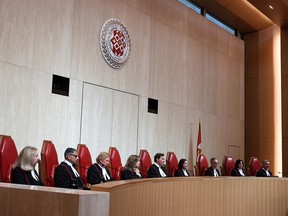
The Supreme Court of Canada has tried to resolve competing judicial imperatives of addressing Indigenous overincarceration and high rates of violence against Indigenous women in cases when a male offender and a female victim are both Indigenous.
Sign In or Create an Account
The complexity and importance of this tension was highlighted by 22 groups being granted intervenor status to offer input in the case, including the attorneys general of three provinces, First Nations and Indigenous organizations, law groups, and numerous human rights, civil liberties and constitutional advocacy organizations.
The fact the nine Supreme Court justices were split five to four in their decision, released Friday, reflects divergent views on how best to protect Indigenous victims while ensuring rehabilitation for Indigenous offenders.

Get a dash of perspective along with the trending news of the day in a very readable format.
By signing up you consent to receive the above newsletter from Postmedia Network Inc.
A welcome email is on its way. If you don't see it, please check your junk folder.
The next issue of NP Posted will soon be in your inbox.
We encountered an issue signing you up. Please try again
In a bid to reconcile what the court called Canada’s “twin crises,” the majority opinion laid out a framework for sentencing judges to follow when confronted by situations like the case of a vicious beating in Halifax.
In 2021, Harry Arthur Cope, a Nova Scotia man, attacked a woman who was his common-law partner on a sidewalk in Halifax. The victim was repeatedly punched and thrown to the ground. When police found her, her face was swollen and covered in blood. Doctors said she suffered severe injuries to her face and upper torso.
It wasn’t the brutality of the intimate partner violence that pushed the case to Canada’s highest court, it was the demographic complications arising in Canada’s courts when the offender is an Indigenous man and the victim is an Indigenous woman.
The personal narratives of the offender and the victim require balancing of two special judicial imperatives.
“Indigenous people find themselves disproportionately and excessively imprisoned, while Indigenous women and girls suffer from unacceptably high levels of violence and abuse,” the Supreme Court says in its decision.
“Both of these pressing issues have been shaped by the experiences of colonization and addressing them together is central to the ongoing process of reconciliation. Parliament has sought to address both concerns through the criminal sentencing process.”
The tension between the issues arose at Cope’s 2023 sentencing after his guilty plea to aggravated assault. At his original trial, court heard that Cope had severe mental health challenges and stopped taking his medications and began consuming illicit drugs a year before the attack. He had a significant criminal record.
For his sentencing, Provincial Court of Nova Scotia Judge Christine Driscoll ordered an Indigenous Background Report. A First Nations’ sentencing circle said community members did not feel more incarceration would help Cope and recommended in-patient treatment.
Driscoll considered Cope’s background, as Canadian courts must do when sentencing an Indigenous offender, known as Gladue factors. She also weighed special factors from the perspective of the victim — that the assault was violence against a vulnerable Indigenous woman.
Driscoll rejected the proposal for a conditional sentence by the sentencing circle and sentenced Cope to five years’ imprisonment. Nova Scotia’s Court of Appeal then reduced his sentence to three years.
It was the Crown’s appeal of that appeal that took Cope’s case to the Supreme Court, where its contentiousness remained over two days of hearings last December, after which the justices reserved their decision.
A slim majority of Supreme Court judges — Andromache Karakatsanis, Nicholas Kasirer, Michelle O’Bonsawin, Mary T. Moreau, and the now-retired Sheilah Martin — upheld the appeal decision of a reduced sentence for Cope. Dissenting justices Chief Justice Richard Wagner, Suzanne Côté, Malcolm Rowe and Mahmud Jamal would have restored the trial judge’s five-year sentence.
In the Supreme Court, majority rules.
The majority presented a workflow for judges to keep paying special attention to Indigenous offenders in the Gladue process while incorporating newer provisions to account for vulnerable victims and Indigenous females that followed recommendations by the Missing and Murdered Indigenous Women and Girls inquiry.
“In cases where an Indigenous offender commits an offence against his intimate partner who is an Indigenous woman, a sentencing judge must apply the principles related to both Indigenous offenders and victims of crime, and do so harmoniously to arrive at a just and proportionate sentence,” the majority opinion says.
The court understands the importance of protecting victims, but there is disagreement on the best ways to achieve protection
The court found the sentencing judge should have more keenly linked mental-health factors to the offender’s moral blameworthiness and more meaningfully engaged with the sentencing circle’s input.
“The lessons of the sentencing circle are more than just a source of factual information relevant to a fit sentence, but are key to understanding the Indigenous perspective on sentencing…. What is required is that a sentencing judge reasonably engage with the perspectives expressed in the sentencing circle in crafting a fit and appropriate sentence.”
The majority opinion said the sentencing circle process “will be relevant both to understand the availability of alternative sentencing options that may exist in the community, as well as the community perspective on the sentence that will best achieve the relevant sentencing objectives.”
The minority of justices said the original five-year sentence should be restored, writing that the sentencing judge appropriately considered the nature of the crime and the victim’s particular vulnerabilities. She also properly considered the circumstances of the offender, the Gladue factors, and his mental illness.
“The majority’s proposed sentencing framework fails to reflect Parliament’s direction to sentencing judges… to prioritize denunciation and deterrence, and to generally impose harsher sentences for the abuse of vulnerable victims, including Indigenous women and girls,” the minority opinion says.
Philippe Boucher, a PhD student in Legal Studies at Carleton University and criminology lecturer at Université de Montréal, has been studying the Cope case and said the division on the court shows an evolution in opinion.
When the court ruled on the original Gladue process in 1999, the decision was unanimous, he said.
“We can see how the issues at stake were more sensitive and controversial this time. Especially, 10 years after the launch of the National Inquiry into Missing and Murdered Indigenous Women and Girls, the court understands the importance of protecting victims, but there is disagreement on the best ways to achieve protection.”
After watching the hearings on the case, he said he was not surprised by how tight the split was.
“This shows how complex it is for judges to establish a sentence when both the accused and the victim are Indigenous,” Boucher said.
Our website is the place for the latest breaking news, exclusive scoops, longreads and provocative commentary. Please bookmark nationalpost.com and sign up for our newsletters here.
Join the Conversation
This website uses cookies to personalize your content (including ads), and allows us to analyze our traffic. Read more about cookies here. By continuing to use our site, you agree to our Terms of Use and Privacy Policy.
KioskNews shows a cleaned-up reading view extracted from the publisher’s page — the original always lives on their site, not ours.