The Premier League is back: welcome to the new era of post-verdict unreality | Barney Ronay

The internet: an apology. It turns out you were right. It was actually a simulation all along. Now, talk to me about chemtrails again. And yes, maybe Vinícius Júnior has been replaced by a handsome, baffled-looking waxwork.
Welcome to the weirdest weekend of them all. We are now post-judgment, post-statement, postlapsarian. As the Premier League prepares to snap back into what must be described, out of habit, as reality, armed with the knowledge its serial champions have been the authors of a 10-year sham supremacy, the first question is fairly simple. How is it going to feel?
There is no precedent for this. Even the state of total confusion feels brittle given City maintain their complete state of innocence and deny all charges. We await the release of Irrefutable Body of Evidence, the great lost Madonna erotic thriller sequel, presumably recast around a steamy three-year regulatory tribunal scenario.
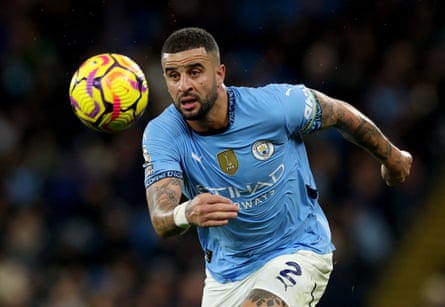
City’s appeal defence appears to be based around the government giving them money. This may or may not be related to how you control what the high court considers admissible. But it is also implied confirmation that the club is the propaganda tool of an overseas state, that Kyle Walker, for example, has basically been a civil servant all these years. Maybe the United Arab Emirates should have six stars on the national team jersey, one for each title. They even look like asterisks.
Beyond this there is the more basic issue of how to present this spectacle as entertainment. How do you structure a Match of the Day now? What’s the balance in the edit of bus-rage, taunting banner clips, managerial evasiveness content, versus the trivial stuff on the pitch with the balls and goals and men in shorts?
Mainly the Manchester City affair has created an existential problem. The key questions in English football are no longer things such as who will win the league, or will Tottenham get relegated (although this is still an excellent question). They are instead: what is real now? What was real then? What will be real in the future? Will something that seems real now become unreal later?
The whole experience brings to mind visiting the Yas Marina Formula One track in Abu Dhabi a few years back, a pristine place, all sweeping curves, perfect surfaces, dreamy floral boulevards. At that stage exploring its far reaches, following the curve around the final corner, led to: nothing. Out of sight the hanging baskets stopped dead. The sprinklers cut out. The pavement ended. The next step took you straight into sand and dead space.
Beyond the main stage the Yas track was a set, an imitation of life. And it turns out this is basically what Abu Dhabi was doing to the Premier League in the years 2009 to 2018: creating a product, a simulacrum, a pop-up.
At the end of which we have a blurring of edges, different versions of what could be real eliding into one another, a place where an AI video of Uncle Phil from the Fresh Prince scoring the Özil goal against Ludogorets seems just as real, just as plausible as City’s 6-0 thrashing of Watford in the FA Cup final. Seen through that lens this can feel like an extinction-level problem. Being real is, in the end, all sport actually has.
It feels fitting City’s first date in the new unreality is Liverpool at Anfield on Sunday, one of the great Premier League fixtures recast as a kind of ceremonial shame-event, a requiem for a dream. Liverpool have a clearer sense of grievance than most, having been deprived of league titles three times on the final day by a club that was colouring outside the lines.
In many ways the game at Anfield is a perfect snapshot of what we have lost. This should be an entirely pure and gripping sporting contest. Instead the biggest story in top-tier English football is the meaninglessness of top-tier English football. The headline product is gossip, side-eye, legal backstory.
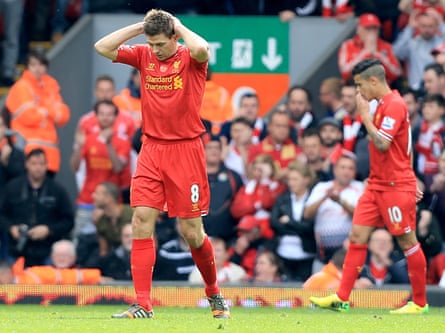
In their next 14 league games City will play three teams who have reserved the right to sue them. How can these occasions be seen as credible acts of sport? Even the banter-culture is out of date. For the past 12 years City at Anfield has been soundtracked by the Steve Gerrard/He slipped on his arse incident, a source of public pain that has defined the late-stage career of Liverpool’s most beloved modern captain. Except, we now know the actual story is the club that finished above them were cheating.
It turns out this is the first stage of football grief. Poring over the endless counterfactuals. Some are pretty stark. The five league titles won on the last day of the season. The 1-0 FA Cup final victory against Stoke, coached by a man with two contracts, the winning goal scored by a player linked, by close association, with the book-cooking regime.
There is a butterfly effect here of endless interference. What do Inter make of all this? Imagine losing a Champions League final that could have transformed your modern history, by the narrowest margin, to a club that appear to have built their own era out of cheating on their income. Two years later Inter were thrashed by another nation-state team and Simone Inzaghi was shunted off the set. He’s in Saudi now. Just get on the train.
Then there’s the wider structural stuff. City spent nine years flooding the zone with government-backed transfer funds (€1.2bn in those nine years: miles out in front), skewing the money supply in every league in Europe. The extra £20m disbursed at the last moment to drag Kevin De Bruyne out of the Bundesliga. What happens if that doesn’t happen?
At home, Spurs missed the Champions League by one spot four times, always in City’s slipstream. Would Manchester United have signed Rasmus Højlund without that steamrollering model of Erling Haaland-era success?
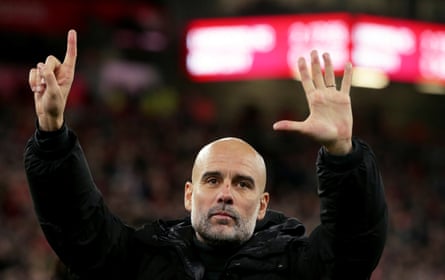
How to reprocess the deep cultural influence of Pep Guardiola? This was based on Guardiola’s genius as a coach, which is still real, irrespective of the gradient of the playing field. But nothing succeeds like success. Winners get to rewrite history. How does it feel now that Guardiola’s style affected so profoundly the way kids play park football, the way young coaches work, all of it based on sustained blockbusting example?
Even the Football Association’s England DNA pathway was basically a Pep document, predicated on the undeniable evidence of his winning way. The method is still good, the detail unarguable, the tactical blueprint pure. But that 10-year spell in England was also supercharged by cheating.
after newsletter promotion
We mourn too the legend of the Catalan brain trust, the hours spent studying this pure and monk-like dynamic. Yeah, fine. But also chuck vast amounts of hidden cash at it. Not to mention the hundreds of articles, podcasts, academic studies, fan tributes and personal tomes about purity, legacy, style, the glory that sailed above all other questions.
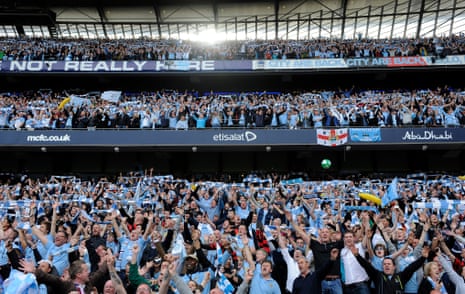
City’s fans are entitled to some space here, a chance to effect their own reckoning up. Elements of that support may have responded over the years with bizarre levels of aggression to any questioning of the process. But it is also normal to believe what you’re told, not least when it includes the profound transformation of the thing you love. How to process a total narrative U-turn?
The City documentary series A Beautiful Obsession is a far more interesting watch now, like The Sixth Sense when you know the ending. The project is cast by its editors as a pure passion play, Pep portrayed as a tunnel-vision obsessive, pictured most often staring at a whiteboard covered in magnets while the world turns beyond his line of vision.
It is impossible now not to see some kind of willed seclusion, Prospero on his island, rough magic starting to fray as reality crashes on to the shores. Episodes one to four are portrayed as a Viking funeral for the age of Pep. But they are now an unwitting farewell to something else too. In his final appearance Pep is shown quoting Kipling, saying triumph and disaster are both impostors. And he’s right. It turns out they were. Most notably the triumph bits.
Just before the end credits we see one of City’s club channel celebrations, with boards plastered in the usual phrases the club seems to feel drawn to. This is how it felt. We see things they’ll never see. Looking back this was always part of the dynamic, the insistence, which is usually just taken as read, that this is all real, that the feelings were feelings, that nobody can fake this away.
It is still the mantra for some. And maybe that’s true. But if so, what did it add up to in the first place? An episode of a TV show? An induced high, a snort of disposable pleasure?
But then, this is also not the end. There is always disasterism in football, the sense the thing happening now is the thing that will always happen. But football’s enduring strength, the one thing that marks it out as indestructible, is its relentlessness. We are in the period of rupture and parallax error. But how long will it last?
Plenty of good can still come from this. The idea that English football is profoundly damaged by this may prove wide of the mark. What is happening here, and this includes the outcome of the appeal, is that rules are being enforced. Andy Burnham may have confused the process with his tone-deaf and weirdly partial comments. But for all the delay and indecision this is still the rule of law in action.
And maybe English football gets to learn something. Maybe the unregulated nature of the league can reset a little. At the very least it seems axiomatic the new regulatory powers should ensure no nation state, or state fund, however you want to semanticise it, gets to own a club again.
There are still 33 rounds of Premier League games to run in the age of whiplash. The current interlude may feel like a football version of those bits in the Terminator films where Sarah Connor drives around in a Jeep looking glazed and distant, prepping for the time of skulls and robot death-rays, disengaged from the meaningless lives of blind and foolish humans.
Football always moves on. Throw flares at a bus, taunt the deceived souls in the away end. But the future is still wide open. Perhaps we can even face it with a little hope in the time of conflict.
KioskNews shows a cleaned-up reading view extracted from the publisher’s page — the original always lives on their site, not ours.