MOA unveils blast disease-resistant rice variety
By Yang Yuan-ting and Esme Yeh / Staff reporters


The Ministry of Agriculture (MOA) has unveiled a new rice variety called Hualien No. 27, which it said is resistant to rice blast disease and has a premium texture comparable to Japan’s Tsuyahime rice.
The cultivar was developed by the ministry’s Hualien District Agricultural Research and Extension Station over many years of research by crossbreeding Hualien County’s Taiken No. 16 and Japan’s Koshihikari, the station said.
Field tests in Yilan, Hualien and Taitung counties showed that Hualien No. 27 is highly resistant to heat and rice blast, and has good production potential, station director Yang Ta-chi (楊大吉) said.
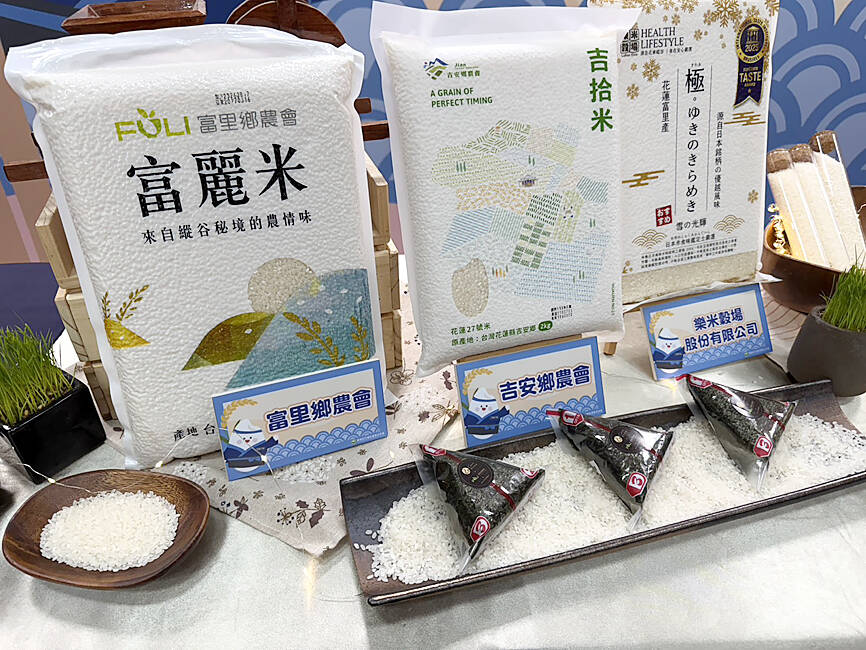
Samples of Hualien No. 27 rice are displayed in Taipei on Oct. 28.
Photo: Yang Yuan-ting, Taipei Times
The cultivar also has bigger grains and low chalkiness and has been adapted to conventional and organic farming methods, he said.
It can more easily meet CNS Grade 2 rice quality standards, as it is resistant to breakage during milling, Yang said.
Hualien No. 27 is considered to have great market potential, he said, adding that it is suited for making staple foods, and dishes such as sushi, seasoned rice or mixed rice.
The cultivar is outstanding in terms of grain appearance and taste performance, Yang said.
Hualien No. 27 rice’s 1,000-grain milled weight is 21.3g, significantly higher than Taiken No. 16 (19.4g) and Koshihikari rice (19g), he said, adding each of the new cultivar’s grains is plump.
Hualien No. 27 rice looks shiny and has a smooth texture, with a taste value of 85.5 immediately after it is cooked, higher than Taiken No. 16’s 84 points and Koshihikari rice’s 82.8 points, Yang said.
It maintains a high taste value even after being kept in a thermal pot for 12 hours, at 83.5 points, while Taiken No. 16 drops to 82 and Koshihikari to 79.8, he said.
Such thermal insulation performance has great practical value for modern people, such as those who use preset cooking or dine at different times, Yang said.
It is also convenient for the catering industry, he said.
Data from the station showed that Hualien No. 27’s production averages 6,368kg per hectare, 13.5 percent higher than Taiken No. 16’s 5,612kg per hectare under the same growth conditions.
Hualien No. 27 has a total planting area of 40 hectares nationwide, Yang said.
The station has been transferring its cultivation techniques to Hualien County’s Fuli Township Farmers’ Association and Jian Township Farmers’ Association, as well as Lohas Rice Co, he said.
Fuli Township’s rice production mainly adopts organic farming, Yang said, adding that the township’s organic rice varieties are expected to be gradually replaced with Hualien No. 27.
KioskNews shows a cleaned-up reading view extracted from the publisher’s page — the original always lives on their site, not ours.