Still have a tummy bulge after pregnancy despite exercising? It could be diastasis recti

Scroll through social media long enough, and you are bound to encounter fitness mum-fluencers ready to share postpartum exercises that “snatch” the waist and flatten tummy bulges.
Targeted exercises and physiotherapy can help build core strength and improve abdominal function. But for some women experiencing diastasis recti, there may be a limit to what exercise alone can achieve, said experts.
Diastasis recti occurs when there is a separation between the left and right sides of the rectus abdominis muscle – the muscles that form the “six pack” – along the midline of the abdomen.
Doctors say the condition is not simply due to weak abdominal muscles after pregnancy, or a lack of effort or willpower to exercise.
“Once the abdominal wall has been significantly overstretched, exercise can strengthen the muscles around it but cannot necessarily tighten the stretched tissue itself,” explained Dr Andrew Cheah, consultant plastic surgeon at Artisan Plastic Surgery.
WHAT CAUSES ABDOMINAL SEPARATION?
Pregnancy is the most common cause, as the abdomen expands because of the growing baby, stretching the connective tissue between the abdominal wall muscles. Women who have had multiple pregnancies, twins or larger babies may be at higher risk, said Dr Cheah.
Some studies suggest that diastasis recti affects over one in three (35 to 39 per cent) women six months after childbirth, and up to 30 per cent after a year, said Dr Yap Yan Lin, senior consultant and head of Division of Plastic, Reconstructive and Aesthetic Surgery, Department of Surgery at National University Hospital (NUH).
However, women who have never been pregnant, and men, can also develop the condition.
Heavy lifting or straining, particularly using improper technique, can place excessive stress on the fascia (connective tissue), said Dr Yap.
Increased pressure inside the abdomen, such as from chronic coughing, straining or constipation, can place additional stress on the abdominal wall, she added.

Ageing and genetics may also play a role. Fascia naturally weakens over time, and some people may be genetically predisposed to lax connective tissue.
MORE THAN A COSMETIC CONCERN
A significant separation can affect how the abdominal wall functions.
Senior principal physiotherapist Cammy Tsai from the department of rehabilitation at NUH explained that diastasis recti can change how the muscles along the sides of the abdomen are attached, which affects core strength.
This can make everyday movements more difficult and may contribute to pelvic or lower back pain.
Dr Melvin Look, consultant surgeon and director of PanAsia Surgery, said some patients may also experience abdominal discomfort, bloating, constipation, urinary incontinence or painful sex.
Diastasis recti may also increase the risk of developing a hernia, Tsai added. A hernia occurs when an internal organ or tissue pushes through a weak spot in the surrounding muscle or tissue wall.
HOW TO TELL IF YOU HAVE DIASTASIS RECTI
A visible “sausage-shaped” vertical bulge along the middle of the abdomen, particularly when coughing or straining while standing, is one of the tell-tale signs of diastasis recti, said Dr Look.
Another way to check is to lie flat on the ground and make a crunch with the abdominal muscles while simultaneously doing a leg raise (see the photo below).
“If you can dip your fingers in the midline between the rectus muscles, you may have diastasis recti. The wider the gap you can feel, the further apart the muscles are likely to be,” said Dr Look.

However, a self-check cannot determine the severity. Imaging like ultrasound or a computed tomography (CT) scan of the abdomen may be used to confirm the diagnosis, assess the extent of the separation and plan treatment.
A gap of 2-3cm is “mild”, one that’s 3-5cm is “moderate” and a gap 5cm and above is “severe”, said Dr Yap.
Besides the width of the muscle separation, Dr Cheah said he also considers how much the condition is affecting the patient.
“A large separation with obvious bulging of the abdomen and symptoms such as core weakness, poor posture, or back discomfort would generally concern me more than a small separation with no functional symptoms,” he said.
WHERE EXERCISE AND PHYSIOTHERAPY CAN HELP
In mild cases, targeted exercise is part of the treatment plan but complete closure of the abdominal gap is not guaranteed, said Tsai, the physiotherapist.
“Postpartum women do not generally return to what they were like before pregnancy, as there is an expected ‘new normal’ postpartum,” she added.

The goal of physiotherapy, Tsai said, is not necessarily to close the gap completely, but to improve abdominal wall tension and core strength, and help women return to the activities and functions they want to perform.
A qualified physiotherapist can guide patients through exercises targeting the deep abdominal and trunk-stabilising muscles.
Other conservative approaches include wearing supportive garments or an abdominal binder and maintaining good posture, said Dr Yap.
The important point, said Dr Cheah, is that women should not feel that they somehow “failed” because exercise has not completely corrected the condition.
WHEN TO CONSIDER SURGERY
Dr Look said surgery may be considered when there has been no improvement after about six months of supervised training, including exercise and physiotherapy, or when the gap is too large to respond adequately to conservative treatment.
A sizeable umbilical hernia (a hernia that occurs near the belly button) may also make surgery necessary, particularly because of the risk of bowel becoming trapped in it, he added.
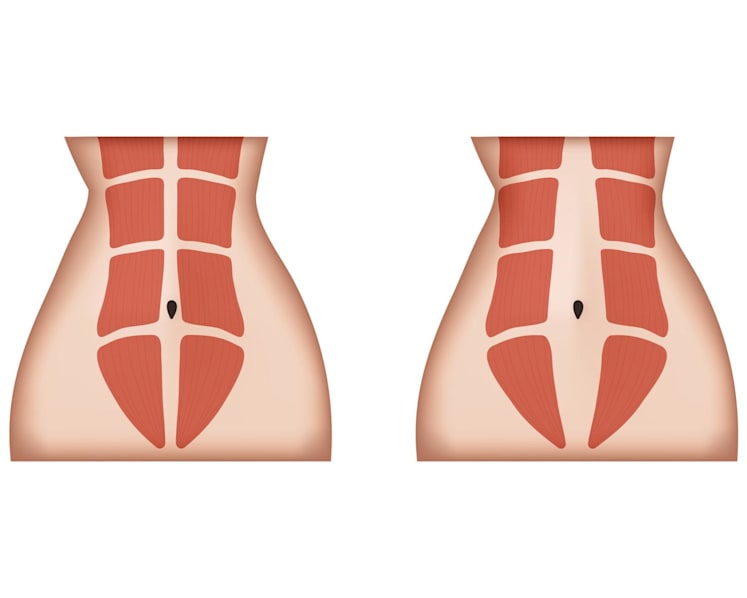
Surgery can be considered if the diastasis recti gap is more than 3cm, said Dr Yap.
However, the decision to undergo surgery is not solely based on the width of the gap, but also on how much it affects the patient’s quality of life, said Dr Cheah.
“If it is purely an appearance issue and it does not bother you, there is absolutely no need to treat it. But if you have a persistent central bulge together with a feeling of core weakness, difficulty with certain exercises, poor posture, or back discomfort, it is reasonable to get assessed,” he said.
WHAT SURGERY INVOLVES
The aim of surgery is to restore the abdominal wall and bring the separated muscles closer to the midline.
“The muscles themselves are not cut and sewn together,” explained Dr Cheah. Rather, the stretched tissue between and over the muscles is tightened to bring the muscles towards the middle of the abdomen.
In a conventional repair, the surgeon brings the separated muscles together towards the midline using a stitching technique called plication, said Dr Cheah and Dr Look.
As the surgeon has to work his way from the top to the bottom of the abdomen, a long vertical incision down the midline is usually required, said Dr Look.

In women who have a large amount of excess or loose abdominal skin, the repair may be combined with an abdominoplasty, commonly known as a tummy tuck, both doctors added.
In recent years, minimally invasive surgery has become possible in selected patients. Dr Look said one of his patients, a 42-year-old mother of three with a 6cm separation, underwent minimally invasive surgery with three keyhole incisions made along the bikini line.
RECOVERY AND RISKS AFTER SURGERY
For patients considering surgery, Dr Look said it is important to choose an experienced surgeon and to be prepared for recovery and rehabilitation to take up to six months.
As with any operation, there are risks, such as bleeding, infection, wound-healing problems, scarring, numbness and contour irregularities, said Dr Cheah.
Diastasis recti can also recur. Dr Look placed the recurrence rate at 10 to 15 per cent, with factors including surgical technique, improper rehabilitation, and other risk factors such as obesity and smoking.
Becoming pregnant after surgery can also place considerable strain on the abdominal wall and potentially affect the results. “We advise women to consider surgery only after completing their family,” said Dr Look.
“The most immediate physical change is that the abdominal wall feels firmer and more supported. Over time, many patients report that their core feels stronger and that they are able to exercise more comfortably,” said Dr Cheah.
However, surgery is not a substitute for fitness, he added.
“We repair the structural problem, but patients still need to rebuild their core strength gradually after recovery. I usually think of surgery as restoring the foundation, after which exercise and rehabilitation can build upon it,” said Dr Cheah.
CNA Women is a section on CNA Lifestyle that seeks to inform, empower and inspire the modern woman. If you have women-related news, issues and ideas to share with us, email CNAWomen [at] mediacorp.com.sg.
KioskNews shows a cleaned-up reading view extracted from the publisher’s page — the original always lives on their site, not ours.