PINE PAIN: Lower Tokai fynbos ‘can recover’, but scientists divided over what comes next
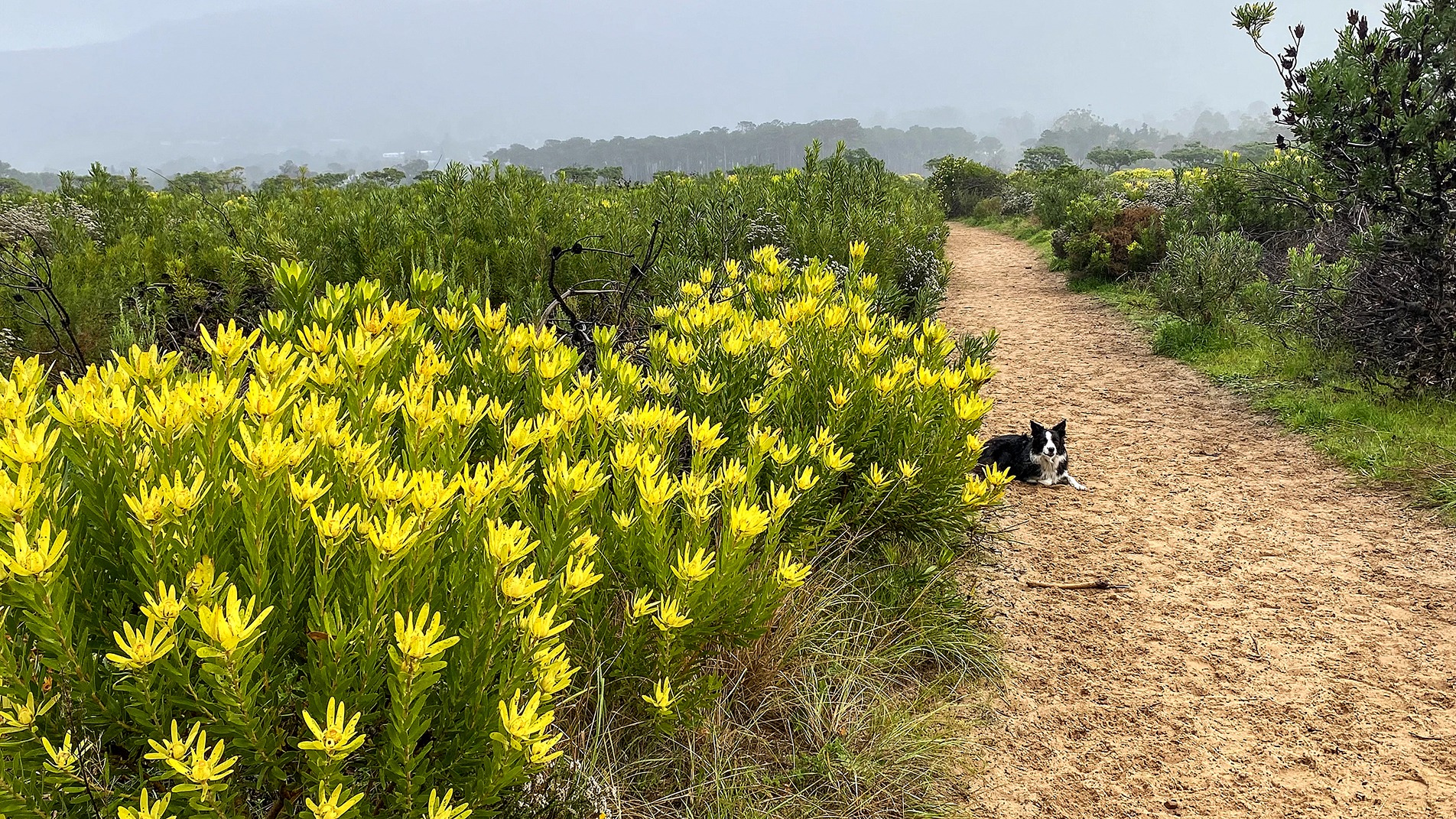
Fynbos can be restored to its original state even after 130 years of lying dormant in seed form in the soil under pine plantations, two of South Africa’s most eminent fynbos ecology and invasion biology specialists have confirmed.
And one of these researchers – Professor Dave Richardson – says this applies specifically to Lower Tokai, where a pine plantation was established in about 1885 on what is now recognised as critically endangered Cape Flats Sand Fynbos, and where some felled sections are already being successfully rehabilitated.
This vegetation type (previously referred to as Cape Flats Sand Plain Fynbos) is the most threatened vegetation type within the City of Cape Town, with just 10% remaining and less than 1% formally conserved. SA has signed an international commitment to protect and restore at least 30% of this fynbos type, if possible.
Richardson, an A-rated researcher by the National Research Foundation, was Director of Stellenbosch University’s Centre for Invasion Biology from 2012-2022 and is currently a Distinguished Professor in the university’s Department of Botany and Zoology.
He has now publicly added his views to the Lower Tokai Park debate that has raged intermittently for at least two decades over differences of opinion about the future management of this part of the Table Mountain National Park (TMNP).
/file/attachments/orphans/YeldLowerTokaiPark3_161593.jpg "The barren soil surface of the Dennedal pine plantation demonstrates how successfully alien pine trees suppress natural fynbos vegetation. (Photo: John Yeld)
<br>")
/file/attachments/orphans/YeldLowerTokaiPark2_912060.jpg "The Dennedal compartment is the only remaining section of the Tokai pine plantation established in the late 19th century. (Photo: John Yeld)")
Arguably, the most highly contested issues in this debate are whether the remaining 26-odd hectares of standing pines and other listed invasive plants in Lower Tokai should be felled; whether this former planation section can and should be rehabilitated and restored as closely as possible to its original Cape Flats Sand Fynbos vegetation; and whether non-invasive tree species should be planted in place of the pines to create shaded walkways in what is a highly popular recreational area.
In July, the national Department of Forestry, Fisheries and the Environment directed SANParks to clear all invasive alien plants like pine trees and gums from the former Tokai and Cecilia plantations.
In response, Richardson and his fellow A-rated colleague Professor Richard Cowling, who is also a fynbos ecology and invasion biology specialist, provided a statement to the Friends of Tokai Park conservation group that supports the Department of Forestry, Fisheries and the Environment’s directive. The statement summarised their view of the crucial overall question: “Can Fynbos be restored after decades of pine afforestation?”
Their response reads: “The short answer is ‘Yes’... There are many published papers and much anecdotal evidence showing that fynbos plant species can persist as living plants decades after pine afforestation and as dormant seed 130 years after afforestation.”
But this conclusion, as it relates to Lower Tokai Park, remains highly contested by Parkscape, a community organisation established in 2016. Its vision is “To create community-focused safe, biodiverse, open and shaded parkscape in the buffer zones of Table Mountain National Park where Park meets urban edge”.
Parkscape’s attitude to restoration is set out in an undated statement on its Facebook page headed “Biodiversity Challenge”, which states inter alia: “SANParks aims to restore the Lower Tokai area, previously under pines for approximately 130 years, and return it to its previous state. The intent is admirable, but it is, unfortunately, ecologically impossible... The world has moved on from 130 years ago.”
Parkscape acknowledges “significant” rehabilitation efforts at Lower Tokai that have been made by the Friends of Tokai Park conservation group, SANParks and the South African National Botanical Institute (Sanbi – Kirstenbosch), but states this has been achieved at “tremendous cost”.
/file/attachments/orphans/YeldLowerTokaiPark7_313852.jpg "The lovely Erica verticillata – extinct in the wild but miraculously rediscovered, propagated and planted out in its original habitat in Lower Tokai Park where it’s flourishing.
<br>(Photo: Supplied / Friends of Tokai Park)
<br>")
/file/attachments/orphans/YeldLowerTokaiPark5_755858.jpg "Fynbos dominated by ‘geelbos’ Leucadendron conebushes and Metalasia ‘blombos’ species in a previously cleared part of the former Tokai pine plantation.
<br>(Photo: John Yeld)
<br>")
“The reality is significant aspects of the site have changed over many years... Despite the valour of the efforts, the entire regeneration effort, one might say, is not unlike ‘trying to bring back the dodo’.”
Much of Parkscape’s controversial stance that is both widely supported and strongly opposed, has been co-formulated and promoted by Emeritus Professor Eugene Moll, a retired plant ecologist who holds an honorary appointment with the University of the Western Cape’s Department of Biodiversity and Conservation Biology. When the statement by Richardson and Cowling was published, Moll wrote to them, challenging their view and querying whether they had been accurately reported.
Richardson fired back with an unequivocally worded response: “Yes, my professional opinion on the feasibility of restoring Cape Flats Sand Fynbos in Lower Tokai has been correctly interpreted and applied. My position is not merely a generalised ecological stance; it is site-specific, evidence-based, and is firmly applicable to the Sandplain Fynbos of Tokai.”
Richardson said he “strongly disgreed” with Moll’s assertion that restoring fynbos in the Lower Tokai area was impossible because of compromised soil (too many nutrients) or depleted seed banks.
“Years of empirical research, historical evidence, and direct observations show that Sand Plain Fynbos is highly resilient and can successfully recover after pine stands are cleared,” he wrote.
Noting that fynbos seeds can persist in a dormant state in the soil for up to 130 years after afforestation, Richardson pointed to peer-reviewed studies demonstrating that lowland sand fynbos – and specifically the Tokai-type – had a “remarkable capacity” for self-generated recovery, and that there was empirical proof of this in Lower Tokai Park.
“The success of restoring Cape Flats Sand Fynbos at Lower Tokai is not a theoretical debate; it is a visible, documented reality,” he told Moll.
Citizen scientists on the iNaturalist platform had recorded 575 observed indigenous plant species in the currently restored area of Lower Tokai, including 43 confirmed Red Data List [threatened] species, he pointed out.
“The historical belief that seed banks would be restricted to a few species was disproved as early as the 1978 fire, which brought back a rich fynbos community and several highly threatened species.”
Also, a 2024 peer-reviewed study had confirmed that not only were viable seed banks present, but that vital ecosystem processes, including pollination and seed dispersal, had returned to replenish those seed banks. Two Erica species that were extinct in the wild (E. turgida and E verticillata) had been successfully replanted and were growing in the area, he noted.
Richardson challenged Moll by asking: “Given this extensive, peer-reviewed, and publicly available data, on what scientific evidence are you basing your counter-views?”
Saying it was not possible both to restore fynbos and retain invasive trees which were “clearly” the biggest threat to the Lower Tokai ecosystem, he continued: “Because Lower Tokai is public land owned by SANParks, we have a legal and moral obligation to restore it!”
If Moll’s primary concern was the creation of shaded recreational spaces, he should direct his efforts and energy to supporting on-oing Department of Forestry, Fisheries and the Environment and SANParks initiatives, Richardson suggested.
“They are actively advocating for the creation of shaded corridors on the periphery of Tokai and Cecilia using indigenous or non-invasive, less fire-prone species that can be watered during their initial years of establishment. This would be a highly valuable contribution to the community.”
Richardson also told Moll said he was convinced that the debate over the future of Tokai Park would not be resolved “via email exchanges, Facebook threads, or media postings”, and he suggested a facilitated workshop and field trip to the area for all parties.
In 1976 when he was still a lecturer in UCT’s Botany Department, Moll and one of his students, Bruce Campbell, published a report, The Ecological Status of Table Mountain (which was a proclaimed national monument at the time) and made recommendations for its future management. The report was highly influential and attracted widespread interest and support.
The introduction to the report states under the heading Ecology: “The ecological status of Table Mountain today is generally fairly poor, though there are recent signs of improvement in some areas. However, with the implementation of scientifically planned corrective management, the natural vegetation could be restored to what it was in c.1600.”
The first in the report’s table of major management objectives for the mountain is “the conservation of the unique flora and fauna as a whole”. The third objective reads: “the provision of high-quality, nature-oriented recreation”.
In a 2011 article in the Constantiaberg Bulletin, Moll pointed to years of research that had led to his 1976 report, and announced that he had changed his view since then.
“At that time I was all for fynbos, but as the years passed I have realised there is more to life than being a purist FF [Fynbos Fanatic]... Modern conservationists have moved away from the old model of fence-the-people-out to a more inclusive policy where people are fully consulted – so FFs, please wake up and come into the 21st century.”
Moll, who subsequently became a founder member and one-time Exco member of Parkscape, acknowledges that fynbos has recovered – at least significantly, if not to a fully “pristine” state – in some areas of Table Mountain after pine plantations were felled, including parts of Silvermine and the Back Table area. And he describes SANParks’ aim to restore the Tokai Park area to its pre-1885 status before pines were planted as “a most noble objective”.
/file/attachments/orphans/YeldLowerTokaiPark4_664338.jpg "The northern edge of the Dennedal pine plantation in Lower Tokai Park with restored fynbos in a previously cleared area in the background. (Photo: John Yeld)
<br>")
However, he insists this is “ecologically impossible”, and doubles down on his argument that the land and soil in Lower Tokai have been severely compromised by forestry, farming and the introduction of additional nutrients since the 18th century.
“The future of Lower Tokai is challenging, for this very small area is of critical importance to many, some with diametrically opposed ideas. Right now, the remaining pine plantation is a haven for many Capetonians from many diverse backgrounds and interests from recreation to religion and more,” he told GroundUp.
Moll said he would “happily” agree to a joint site inspection by all the players.
“My view, for as long as I am able to remember, [is that] I, and Parkscape, are not pro-pine, but pro-shaded safe recreation spaces.
“As a plant community plant ecologist, I am not against any attempt to get Sand Plain Fynbos back on Lower Tokai. I am simply of the opinion that this is impossible – well, at least for the next few hundreds of years – because of how the soils in the area have been treated since about 1700 when they were first farmed.
“The issues we are trying to address are extremely complex and open to interpretation that depends on one’s own worldview and experiences. I am not apologising for trying to give context to a vexed situation.” DM
KioskNews shows a cleaned-up reading view extracted from the publisher’s page — the original always lives on their site, not ours.