Hegseth saw the future of war, but cannot lead the way
The US military is out of step with modern warfare, and must shift from expensive high-end weaponry toward ‘precise mass’ before a rival, such as China, does
By Andreas Kluth / Bloomberg Opinion


US Secretary of Defense Pete Hegseth got one big thing almost right when he addressed junior leaders of the joint force the other day. Too bad he keeps getting so many other things so badly wrong.
What he got right, and also captured elegantly in a historical analogy, was the direction in which warfare is developing, and in which the Pentagon must go as well, even though it is not set up to do so.
Hegseth labeled the effort Project Agincourt. The name comes from a famous battle in 1415, when the English were badly outnumbered by a French force composed largely of men-at-arms in heavy armor. However, the English showed up with archers carrying longbows and supplied with vast numbers of arrows made by fletchers working near the front lines.
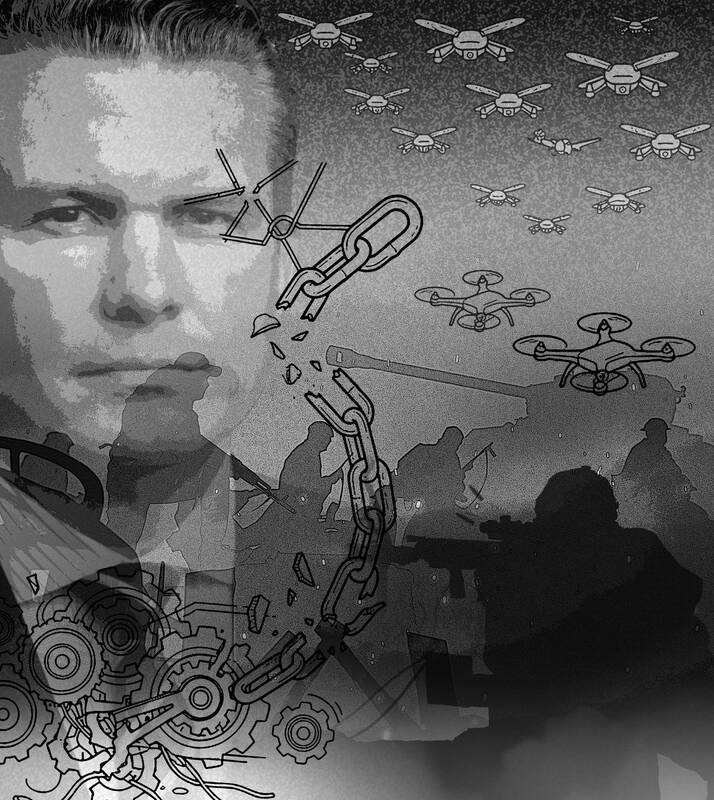
Illustration:Tania Chou
The English won.
Hegseth chose the analogy because it shows the strategic importance of so-called cost-exchange asymmetries. They become a factor when one side — the French in 1415, the US or Russia today — comes to the battlefield with weapons that are sophisticated, but also expensive (“exquisite,” in today’s jargon), such as plated armor and steeds, or F-35s and Patriot interceptors.
The other side — the English then, the Iranians or Ukrainians today — can then counter with weapons that are just barely good enough individually, but devastating in vast numbers, and above all inexpensive and expendable (ie, “attritable”).
The English had their arrows, the Iranians and Ukrainians (and many others) use drones. Those become especially lethal in swarms, and then downright diabolical when networked and guided by artificial intelligence to kill autonomously.
OUT OF STEP
The US’ problem is that its military is out of step with this development. It might still have the world’s most powerful forces, but in the words of Dan Driscoll, who last month quit as secretary of the army, “the US Army in 2025 looked shockingly similar to that of 1975.”
That is, it relies far too much on exquisite weapons that are great for, say, bombing Iranian nuclear facilities out of the blue, as in last year, but are uneconomic against seemingly limitless barrages of attritable Iranian ordnance, as in this year.
As Council on Foreign Relations defense and national security program director Michael Horowitz said, “militaries cannot endlessly block salvos of US$35,000 Shahed-136 attack drones with US$4 million Patriot missiles.”
So the US military needs to shift its procurement and its tactical and strategic models away from exquisite weaponry and toward what Horowitz calls “precise mass.”
That, in a nutshell, is the objective of Project Agincourt. It takes existing initiatives in the Pentagon, reorganizes and turbocharges them, in the hope that the joint force can bring precise mass to the battlefield before, say, the Chinese do the same.
One nuance is that the goal is not to replace the equivalents of plated armor with longbows.
“I am often asked whether the US military should prioritize high-volume, low-cost equipment or exquisite programs,” Driscoll writes; “unfortunately, the answer is both.”
Hegseth calls that a “high-low mix.”
So far, so good — and so intellectually harmonious between Hegseth and Driscoll. To see the Pentagon’s problem, you have to look beyond Hegseth’s speech.
Driscoll published his essay in Foreign Affairs just before Hegseth announced Project Agincourt, which grew out of efforts Driscoll had been coleading, along with other top brass such as General Randy George.
However, George was dismissed by Hegseth in April, and Driscoll resigned just weeks before Hegseth’s address.
GENERAL EXIT
Moreover, Driscoll and George are among a procession of senior leaders whom Hegseth has shoved or nudged out. (In his speech, the secretary boasted that he had reduced the number of generals and admirals by 10 percent and has another 10 percent to go.)
Driscoll met with US President Donald Trump before resigning and told him that Hegseth was damaging the military with all the firings and constant turmoil. Specifically, Driscoll reportedly said that Hegseth was undermining the innovation campaign that Driscoll was pushing — the one now labeled Agincourt — by purging so many of its leaders.
The clashes extend beyond personalities and include substantive differences. Driscoll makes clear that the precise-mass revolution cannot happen without breaking open the oligopoly of defense contractors who today make all those exquisite weapons, each in a deliberate information silo so that it cannot interoperate with any others used by US or allied forces.
He also assigns a huge role to US’ allies, with whom the Pentagon must coordinate.
INDUSTRIAL CAPACITY
“The United States’ greatest deterrent, the foundation of its diplomatic clout and the primary factor in its ability to win on the modern battlefield will be its collective allied industrial capacity and military interoperability,” Driscoll wrote.
His vision is to modernize the military readiness of the entire, united West. That point is lost on Hegseth and Trump, who in word and deed keep antagonizing the US’ allies, in effect pushing partner nations such as Canada toward weaning themselves from the US rather than doubling down on interoperability.
The best that can be said about Hegseth’s announcements is that he has put into catchy words what deeper thinkers such as Driscoll have been saying for a long time. If it takes a bit of plagiarism to prepare the US military for the rest of the century, so be it.
SHOCK AND AWE
What is worse is that Hegseth also proved once again why he is incompetent. At heart, he is still the TV personality and culture warrior who prefers to shock, polarize and divide rather than the leader who unites, rallies and builds.
“We’re no longer the woke department,” Hegseth boasted on that stage. “No fatties, no trannies, no beardos, no weirdos, no wimps, no radicals.”
No secretary of defense before or (presumably) ever again could sound so buffoonish in a role of such responsibility.
Hegseth has grasped where warfare is going because thoughtful people like Driscoll explained it to him. Yet Hegseth keeps ousting every Driscoll in sight. If the US one day loses to tomorrow’s longbow archers, the blame would belong to mediocrities like this secretary of war.
Andreas Kluth is a Bloomberg Opinion columnist covering US diplomacy, national security and geopolitics. Previously, he was editor-in-chief of Handelsblatt Global and a writer for The Economist. This column reflects the personal views of the author and does not necessarily reflect the opinion of the editorial board or Bloomberg LP and its owners.
KioskNews shows a cleaned-up reading view extracted from the publisher’s page — the original always lives on their site, not ours.