How one city in China became the fireworks factory of the world
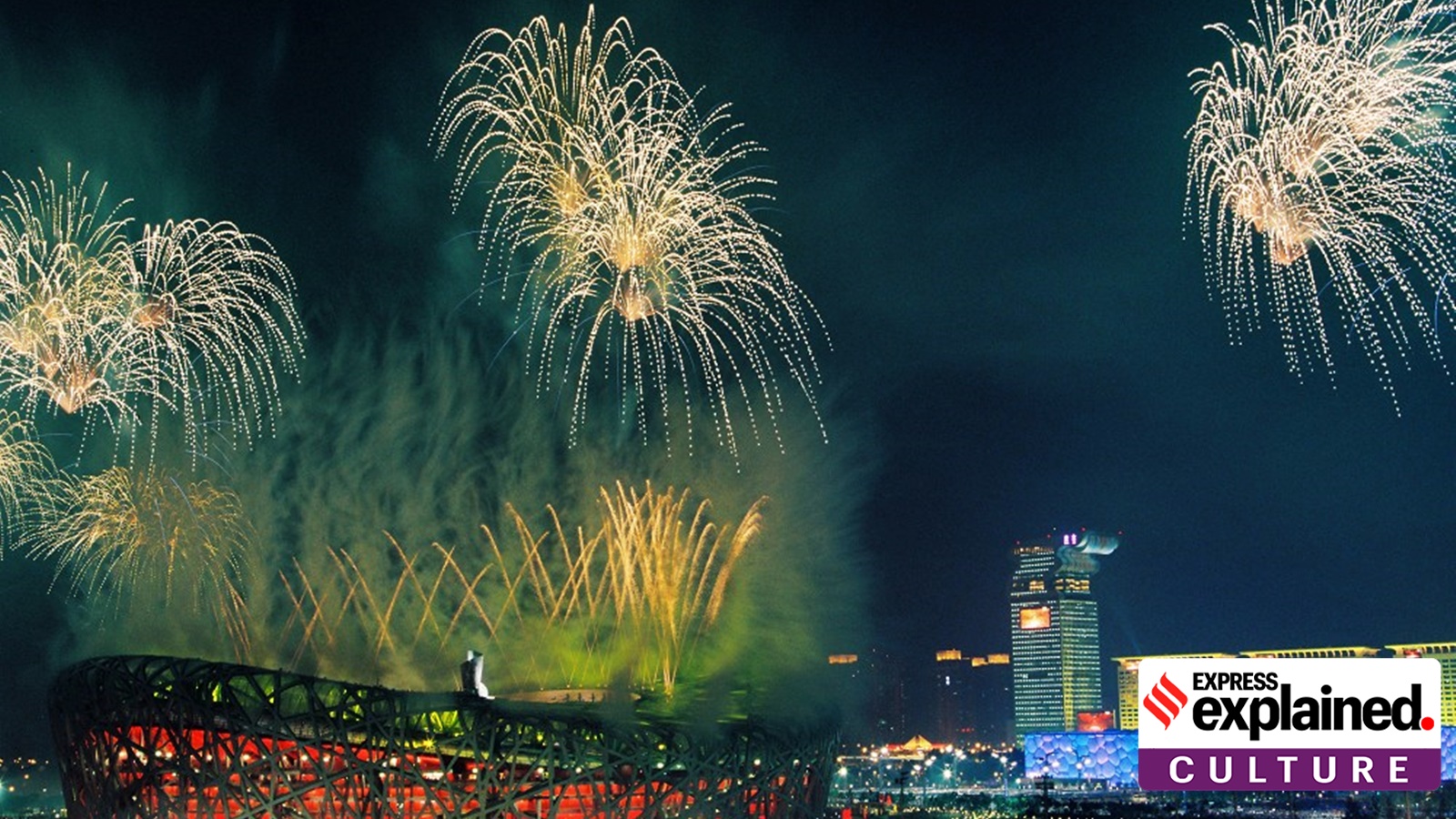
Diwali fireworks will light up the night sky across India tonight, with most crackers likely having some link to the dominant production hub of Sivakasi in Tamil Nadu. Globally, though, it is one country — and one city within it — that holds the pole position in selling fireworks to the world.
Liuyang, in southern China’s Hunan province, is said to have been associated with fireworks for centuries, going all the way back to the invention of fireworks during the Tang Dynasty (618 to 907 CE). Today, the city accounts for about 60% of China’s domestic fireworks market and roughly 70% of its exports, according to a report in the State media. As a whole, China accounts for a whopping 90% of global fireworks production.
How did Chinese fireworks come to occupy this position in the modern age? The story has to do with their origins, common factors that have propelled other sectors of China into becoming manufacturing powerhouses of their own, and rising concerns about safety and pollution in the modern age.
 Fireworks production in Liuyang, China. (Wikimedia Commons)
How fireworks shot off from Liuyang
Several legends are associated with the origin of fireworks, including the quest for immortality and the need to drive away evil spirits.
Chinese alchemists were said to be attempting to mix several powders, including saltpetre (which supplies the necessary oxygen) and sulphur (the fuel), when they accidentally created the early fireworks. The powders were packed inside bamboo, initially. These lacked the spectacle and light associated with modern versions, but still produced sound and spark. The prime constituent of fireworks is gunpowder (also invented in China), formed of saltpetre, sulphur, and charcoal.
Stories of their invention are often traced to Liuyang. “For centuries, fireworks production in Liuyang was a precarious cottage industry. Families mixed black powder by hand and filled shells manually — a system that combined artisanal skill with serious safety risks and heavy pollution,” said one State media report.
A CNN report stated that the modern communist state, established in 1949, did not exactly inherit the advantages of this legacy. The upheaval of several wars and policies like the Cultural Revolution negatively affected domestic industries. It was, in fact, the 1972 visit of US President Richard Nixon to China, before US-China ties were formalised, that “The Chinese fireworks industry would see a serious revival and a transfer of accumulated Western know-how back to China,” the report said.
Story continues below this ad
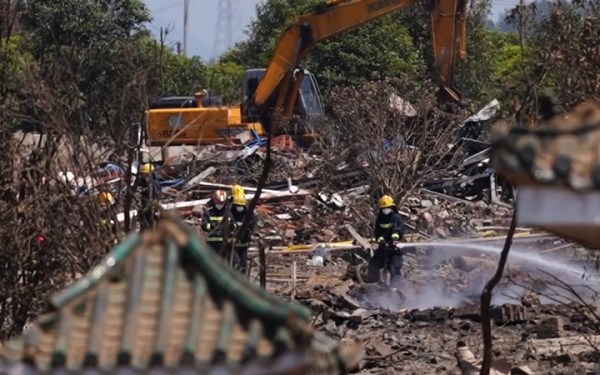 Aftermath of the 2026 Liuyang fireworks factory explosion. (Wikimedia Commons)
Initially, it was “Guangdong province’s Dongguan, not Liuyang, that began to dominate China’s export industry due to its proximity to the Pearl River and the trade center of Hong Kong. It wasn’t until the 1990s that pressures from urban development and a spate of deadly accidents encouraged a return to the birthplace of pyrotechnics.”
The large labour base required for the industry was readily available, reducing the input costs for labour. Other factors that likely helped the region were the relatively lax regulations around the dangerous work of producing fireworks (compared to similar centres in the West), and the fact that it did not require sophisticated or expensive machinery, the report added.
Domestic demand also plays an important role in sustaining the region’s industries. Events and holidays such as the Lunar New Year and National Day have become associated with grand firework displays, helping generate sales across multiple cycles annually.
One State media outlet described the growth as part of China’s “emotional” economy: “According to iiMedia Research, the emotional economy market in China — consumption driven by entertainment, experiences and emotional connection — reached 2.7 trillion yuan ($380 billion) in 2025 and is projected to exceed 4.5 trillion yuan by 2029.”
Story continues below this ad
“Fireworks, once viewed merely as holiday consumables, have been repositioned as a year-round cultural attraction. Anchored by the city’s Sky Theater, Liuyang has turned weekend fireworks shows into a regular tourism draw. Since 2023, the city has hosted 142 major displays, attracting more than 7 million visitors,” it said.
Shift owing to safety, pollution concerns
Safety has increasingly become a part of China’s fireworks story. Over the decades, several factory incidents have led to new regulations and temporary bans.
Just this May, a factory accident in Liuyang caused an explosion that killed 26 people. Months before, local governments were said to be loosening restrictions on fireworks to ring in the Lunar New Year, Nikkei Asia reported.
“A set of national regulations on fireworks safety was put in place in 2006 (following years of a ban). The regulations allow local governments to prohibit or restrict the use of fireworks by time, location and type… but local governments in China tend to interpret central policy conservatively and come down on the side of strict enforcement,” it said.
Story continues below this ad
The government has argued that steps have been taken to modernise the industry and improve working conditions. This has included “AI-enabled cameras feeding into a centralized risk-warning system” and separating “dangerous chemical-handling procedures” from human handling.
Pollution is also now a part of the equation, bringing fireworks to the centre of debate about worsening air quality, much like in India. A 2015 report in the Chinese Communist Party’s tabloid Global Times said, “Setting off fireworks during the Lunar New Year is an age-old tradition in China, with ancient superstitions believing the light and sound would scare away evil spirits… However, fireworks have been increasingly blamed for contributing to the country’s smog problem, pushing local governments to implement measures forbidding or limiting firework displays.”
New, less-polluting formulas have been introduced, but not without criticism and resistance. After wide-reaching bans in Beijing in 2018, one State media report cited citizens complaining about the lack of firework displays during festivals. It quoted author Feng Jicai as stating, “The fireworks were originally intended to scare away the ‘nian’, a mythical beast that preyed on people and livestock at the turn of the year, but was afraid of loud noises… For centuries, Chinese people embraced the new year with the sound of fireworks.”
In 2017, due to “strong opposition from rural people,” a fireworks ban was lifted just two days after it was issued in central Henan province, where air pollution was very serious, the report added.
KioskNews shows a cleaned-up reading view extracted from the publisher’s page — the original always lives on their site, not ours.