Afghanistan’s olive groves give farmers hope
By Isabelle Wesselingh and Barez Atef / AFP, JALALABAD, Afghanistan


Olives tumble with a gentle “plop” onto a tarpaulin in eastern Afghanistan, an unusual, drought-resistant harvest offering hope to farmers who have struggled as climate change worsens water shortages.
Drought and water scarcity affect more than half of the country’s population, according to the UN. Some farmers are seeking alternatives to corn, rice or wheat.
Abdullah Orzala’s olive grove, first planted 15 years ago on his family’s land in Saidan Arabi village in eastern Nangarhar province, is one such success story.
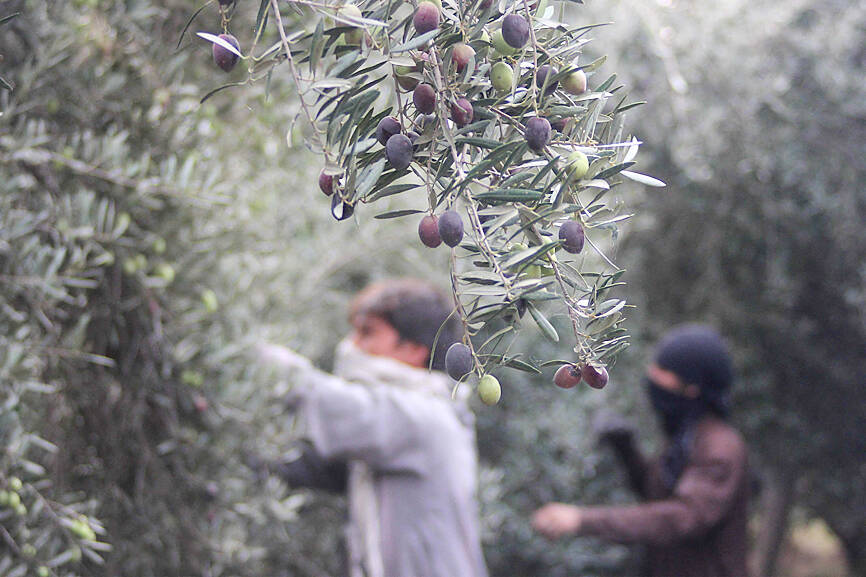
Afghan workers harvest olives in Saidan Arabi, Afghanistan, on Nov. 3.
Photo: AFP
“I said to myself, ‘let’s try something,’ because the important thing for me in agriculture is that we have to think about water resources and how to adapt to climate change,” he said. “And the olive tree is one of the best drought-resistant trees in the world.”
The gnarled evergreens also enhance human resilience to climate change by improving soil health and reducing erosion, UN Food and Agriculture Organization (FAO) said.
That is useful in Nangarhar, where farmers have been facing crop failures and competition over shrinking water resources, a UN news release said in June.
“Other things like wheat, like rice, like onions, you have to give them more water, but olive trees don’t need a lot of water,” said production supervisor Sadiqullah Afghan, 29. “So, people like these trees for the future.”
Olives are not a traditional ingredient in Afghan cuisine, and the country’s yields are tiny compared with major European producers.
However, they can be a valuable cash crop for rural communities, who sell them to traders or stores in cities, where there is a nascent market for the health-giving fruits and their oil.
This month, the 500 villagers of Saidan Arabi hand-pick olives from their organic orchards and cold-press them at an experimental mill in a lush, mud-walled garden.
“We press the olives immediately to ensure better quality,” Afghan said.
The oil is sold for up to US$17 per kilogram in Kabul’s organic-product shops.
Orzala has planted thousands more olive trees in another village in Nangarhar, creating 16 permanent jobs across the two areas.
The plant specialist, who fled Afghanistan as a child, studied in the US and returned in 2003, hopes to establish a permanent mill and expand sales across Afghanistan and beyond.
Along the road from provincial capital Jalalabad to the Pakistani border, vast olive groves stretch across the landscape, giving it an almost Mediterranean character.
They date to the 1960s, and a Soviet-built mill began making oil in 1985. However, successive wars later destroyed about half of Afghanistan’s total area for olive cultivation.
The industry is recovering. Italy provided new equipment to the mill in 2019, and the Taliban authorities have expanded operations since returning to power in 2021.
Output from the state-owned company is increasing, with about 70 people working at the mill, which produces extra-virgin oil and table olives.
While national production is negligible compared with world leader Spain, director Akhtar Muhammad Hashimi said the mill churned out 135,000 liters of oil last year, about 124 tonnes.
“This year, we expect between 143,000 and 165,000 liters,” all of it sold in Afghanistan, Hashimi said. “We hope one day to gain access to the international market.”
However, therein lies a problem.
Global olive oil consumption has almost doubled in the past 30 years, according to the International Olive Council, but Afghanistan’s banking isolation and diplomatic exclusion pose major obstacles to reaching international markets.
Only Russia recognizes the Taliban government, which bars girls from education beyond primary school and imposes sweeping restrictions on women.
Still, olive cultivation is expanding in eastern and southern Afghanistan. The FAO has planted 381 hectares, citing their use in “creating long-term income opportunities for rural families.”
In eastern Laghman Province, businessman Mohammad Nazir Ahmadzai, who made his fortune in Kuwait, said he had planted 15,000 young trees on land “leased from the state.”
In Saidan Arabi, 20-year-old Orzala estate worker Sani Khan laughed as he recalled locals’ initial skepticism about the initially unfamiliar tree with its bitter fruit.
Over time, people realized olives were “resistant to water shortage” and better than poppies, whose sap fuels the illicit opium trade, “because of the higher income,” he said.
KioskNews shows a cleaned-up reading view extracted from the publisher’s page — the original always lives on their site, not ours.