New discovery unearths statues of King Ramses II in Nile Delta
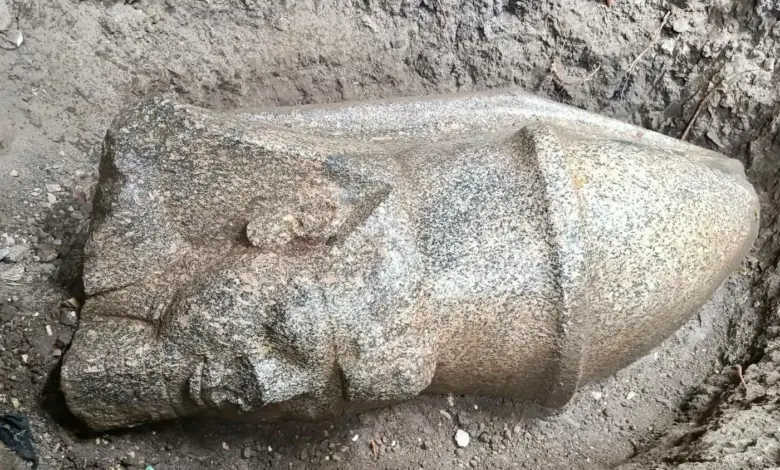
A new archaeological discovery in the village of Behbeit al-Hagar, Gharbiya Governorate has brought to light major royal artifacts from the reign of King Ramses II, offering new insight into the New Kingdom’s presence in the Nile Delta.
The find, announced following excavations at the site, includes the remains of two colossal royal statues alongside a pink granite block bearing hieroglyphic inscriptions.
An Egyptian antiquities researcher, Tamer al-Menshawy, confirmed that the discovery highlights the historical importance of Behbeit al-Hagar—a site best known for its massive ancient temple dedicated to the goddess Isis.
The primary artifact is a massive 1.6-meter-tall statue head depicting Ramses II wearing the Double Crown (Pschent), which symbolized the unification of Upper and Lower Egypt.
Scholars estimate that the complete statue originally stood at approximately 8.5 meters in height.
The rear pillar of the head contains inscriptions of the king’s Horus name, “Hor-Ka-Nakht Mery-Maat.”
Excavators also uncovered a 2.4-meter-tall torso and head of a second royal statue wearing the traditional Nemes headcloth.
Despite missing its base and lower limbs, the facial features remain well-preserved and closely resemble the first colossal piece.
Additionally, a 1.3-meter pink granite block was recovered, inscribed with royal titles including “Nesu-Bity” (King of Upper and Lower Egypt) and “Sa-Re” (Son of Ra).
The discovery showcases how Ramses II utilized grand architecture and monumental statuary to assert political and religious authority throughout the Delta, beyond well-known southern centers like Luxor and Abu Simbel.
Officials credited a local citizen who initially reported finding the granite block to the Ministry of Tourism and Antiquities, allowing archaeological teams to launch prompt documentation and rescue excavations.
Continued excavations work at Behbeit al-Hagar is expected to reveal the architectural context regarding how these royal monuments were integrated into the Delta’s temple complexes.
KioskNews shows a cleaned-up reading view extracted from the publisher’s page — the original always lives on their site, not ours.