Lamine Yamal: ‘Football is mechanised but players like me have that special spark’

Like the kid he is, Lamine Yamal just wanted to keep playing. This wasn’t Plaça Joan XXIII, wasn’t El Parque de Rocafonda either; it wasn’t the Mataró neighbourhood where it all began, but it might have been. “We’re in a World Cup final and I wanted to carry on,” he says, and there’s the smile again, the braces. Really? “Yes”. No nerves? “No. I never thought: ‘Just blow the whistle’. I was enjoying it.” No fear, just fun: 19 July, New Jersey and he knew: this 19-year-old who had happily been asleep on the bus to the biggest match of his life.
And now he sits in a first-floor office in Las Rozas, surrounded by tactics boards and stats sheets. There’s a Spain keyring hanging from the door and a second star on his shirt. In the corridor, crates loaded for London. Son of Mounir and Sheila, named after the family friends who helped them, “touched by God’s wand” in the words of the coach whose office is next door, there’s something about Lamine Yamal. He turned 17 the day before the final of Euro 2024, a schoolboy sitting exams, and 19 the day before the semi-final of the World Cup. Asked what he wanted, he said a trip to New York, so there he was, about to be a champion again.
The way Lamine Yamal tells it, Spain knew they were world champions before they had scored, in the moment Enzo Fernández was sent off. It was the third minute of second-half stoppage time, still 0-0, but now, he says: “We knew it was impossible they would score, and with the ball against 10, very difficult for us not to.” The surprise was that they hadn’t already, but on 106 minutes the ball came to his feet. He had been thinking about this moment for some time.
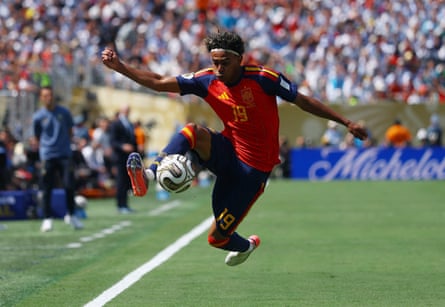
The battle with the one, two, three players facing you is “very psychological”, Lamine Yamal says. “A full-back will have a coach who says: ‘OK, Lamine: what he does is …’ I think of him as a robot, trying to stop me. Robots can be almost perfect but a human will have something a robot doesn’t. Football is mechanised but there are players like me, Pedri, many others, who have that special spark. There’s a typical Neymar move when he stops, fakes, goes the other way: I watched so many videos of him. I try to play with opponents, ensure they can’t mechanise me, don’t know where I’m going.”
“I remember three plays in minutes 60, 70, 80 or thereabouts, when I took on the full-back. Every time, [Alexis] Mac Allister came over. If I had really wanted to go at the full-back, I would have gone at him fast; instead this time I went slower, carrying the ball, so that Mac Allister had time to get to me, Pedro [Porro] could arrive behind me and I could play it back.” A little space made, from Porro’s cross Nico Williams headed back and Ferran Torres, who had struggled throughout the tournament, scored the goal.
“We knew Ferran needed it,” Lamine Yamal says, then laughs: “Well, everyone needs a goal in a World Cup final. If Unai Simón had scored, great. When it goes in, it’s spectacular, you feel you’re champions. You can’t explain the emotion. All I wanted was to keep playing. I never thought: ‘They might equalise’. There was a small push, a chance [Pau] Cubarsí cleared, but I was enjoying it.”
The mini trophy is at Lamine Yamal’s mum’s house; he gave the Lego trophy to his dad but his little brother, Keyne, broke it. At the final whistle, he embraced Lionel Messi. “I said thank you for everything you gave football. I don’t do things to look nice for the photo; that came from inside,” Lamine Yamal says, but the symbolism was powerful, like a rite of passage, a passing of the torch. Lamine, 19, hugging Messi, 39, who had bathed him when he was a baby, as if it was a baptism, the creation. As if he had made this happen.
Almost absurd in its perfection, utterly implausible, the bathtub origin story poses so many questions, but here’s one that baffles: why on earth did your dad not produce that picture for 17 years? “Because I told him not to,” Lamine Yamal says. “He put it on Facebook once and I told him to take it down. Comparisons were too easy, that was all people would talk about. I wanted to be Lamine; I didn’t want to be Messi. I just wanted to get where I could get. I asked him to wait. When I’m Lamine, do what you want.”
Oh, he’s Lamine all right, and where he has got to no one has. A global social phenomenon, his image was everywhere at the World Cup, whole stadiums waiting on him, the comparisons he tried to avoid inevitable. And, amazingly, in his favour. No one had ever won a Euros and a World Cup younger, at 19 years and six days. Messi was 35 when he won the World Cup; Diego Maradona was 25; Cristiano Ronaldo never has. Who knows what he could achieve? Spain’s candidate for the Ballon d’Or (even if Kylian Mbappé has support in Madrid), he would be the youngest winner, ever.
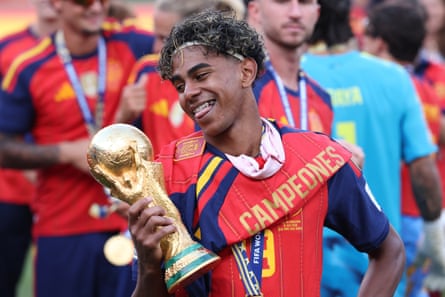
Nor is it just about the titles. It is about the play and the personality, something different, an appeal, apparent even in this office. And something deeper, too. Luis de la Fuente likened Lamine Yamal to Salvador Dalí and Michelangelo, a genius. He knows that himself and doesn’t mind saying so. Doesn’t mind saying that, yes, he should be named the world’s best footballer. Because, well, he is. Even at 19, which may in fact be what goes against him.
“Being completely honest, it’s not just this year I’ve been at a Ballon d’Or [winning] level, but longer. Everyone knows that; they know I am differential,” he says. “I think people think: ‘Lamine is 19, he’ll win it at some point, so let’s say someone else …’ I just have to win, win, win, and there will be a time when there’s no debate. There will be people who love me, people who say: ‘What a pain in the arse he is’, and that’s fine.”
“After the final, my family were so happy,” Lamine Yamal continues, laughing once again. “The problem with that is they don’t know what it is to lose. I go to the Euros, I win it. I go to the World Cup, I win it. It seems easy. There was a moment I thought: ‘When I don’t win they’re going to think I’m terrible.’ I told them: ‘Calm down, there will be plenty more World Cups.’ I have to play more and win more.
“At the Euros I didn’t even know who I was, where I was, the significance of it all. I could sit an exam and the next day play France because I wasn’t really conscious of the difference. I won it and said: ‘Well, that’s good, but a World Cup is better, no?’ Now I know what a Euros means. I know what a World Cup is, although I think you truly realise when you go to the next one and lose. There’s a lot still to do. Why not be the best national team in history? The best Barcelona? And if there’s anyone in the world who doesn’t ‘rest’ on success, who doesn’t have normal standards, it’s me.” No pressure, kid.
Lamine Yamal has lived that from the start. He was 13 the first time he felt some sort of fame. One day we will stop talking about his age but stop for a minute and it is still absurd: he went to the Euros at 16, a literal child, and the World Cup at 18 and won both. He has three league titles. The money, the fame, the exposure. It’s remarkable really that, to put it bluntly, he’s not a dickhead. “Well,” he laughs, “it depends how you’re brought up. I will never say: ‘Who are you? I won the World Cup.’ Only stupid people would do that. I know that football is 0.000001% of life.”
And there it is again; the maturity. Here’s a teenager supporting a family, who in his own words was handed “too much responsibility” too soon, who talks eloquently about the demands, exposure and about embracing them. At times he can seem to actually enjoy the attention and the pressure, wilfully adding to it, all a game. He can be accused of talking too much, and can reply: “Well, as long as I am winning … sport is serious but I want a show, some fun.” Remember Adrien Rabiot? He does. “That day you all saw how much I like it,” he says, grinning. At the World Cup his headband read: “Ego Yamal”. There’s a cheek, a mischief; he’s “playing” with us, he admits, with the silliness of it all.

At times, but not all times. He says “a bad game from Lamine equals 400 bad games for anyone else”, that “I’ll produce a nine out of 10 and people will say seven out of 10”. At the World Cup, he visited Nashville: there’s a smile as he recalls the “cowboys, the atmosphere” … and the anonymity. A photo appeared of him at Walmart, a silly thing that mattered. “If we stopped in a gas station, I could get out and grab something,” he says. What he posts, what he says, he controls – which doesn’t mean always getting it right, or being happy. One post last season was entitled “my inner abyss”.
Do we know Lamine Yamal? “No. Not at all. No one,” he insists. “Only my inner circle know what I think, the way I am. People don’t have a clue – not a clue, Not. A. Clue.” Why? “I grew up in a barrio where the less people know about you, the happier you are, the quieter your life. Obviously I like a footballer’s life, but I would also like to live in peace, a normal life. The nearest I can get is for people to know as little as possible. If I post something, I need to know I can handle what comes. At first it annoyed me to read things because I didn’t understand it. My mum would read something, call me and say: ‘Son, what’s this?!’ That affected me but it doesn’t affect me now.
“There are times I enjoy the pressure. I enjoy going on to the pitch, when a lot is expected. Then there’s a different kind of pressure which is nothing to do with what people say, nothing to do with football; it’s life. I don’t feel pressure in football. I will never lie at home thinking: ‘I played really badly, I didn’t win the Ballon d’Or, we didn’t win the league.’ It’s responsibility: I have my family. I’ve suffered, struggled with them, we’ve been through bad times and now that we’re enjoying life, I have to continue. If I have played football all these years, it’s because I love football but also for them. I know life is much longer. I have to look after my family, my little brother.”
“In football there’s no fear,” he adds. “I saw my mum struggle so that I could play football. I’ve seen my dad go round the streets collecting scrap metal so I could eat. That’s fear. Now if I had a son, I could look after him. If my mum or my dad need anything, I can help. I don’t have that fear now and that’s the only fear I could have in life.”
So, play the game. Your way, as always, made in Rocafonda, the hard barrio whose postcode Lamine Yamal signals with every goal. Besides, he insists, fun is underrated in football. “Barcelona give you good things but you also need something of your own, your roots,” he says. “Barcelona gave me control, understanding, IQ. In the park there’s no IQ: you go at your opponent, then go back again. I have that. If I hadn’t come from where I came from and been at La Masia, I wouldn’t have come out like this.
“The thing is, I love football. I don’t play for money, I play because I love it. Players who obsess over goals or assists don’t enjoy it. I play for the fun: to dribble, to play one touch, two touches, to make a teammate who hasn’t scored score. For the fans’ happiness. To hear the olés. I play for that. I enjoy it. I get home and I say: ‘I’ve had a great time.’ If every player did that, we would enjoy it much more.
“At the World Cup, you heard it, felt it: when I got the ball, they would stand up, one after the other, all along the row. Like they were saying: ‘Let’s see if this guy is what they say he is.’ At the Camp Nou, people know I’m going to go at someone. That feeling, that expectation, is something you can only experience in sport, being a player like me. It’s like there’s something inside that makes you feel more powerful than anyone and I hope it’s there until the day I retire. There’s a surge around you and you feel like Superman. You feel spectacular.”
KioskNews shows a cleaned-up reading view extracted from the publisher’s page — the original always lives on their site, not ours.