Russia surpasses France in African youth appeal, still trails China: survey
Russia’s influence has surged among young people across Africa in recent years, leaping over former colonial power France while still trailing China, a survey of African youths has found.
Many young Africans now perceive Russia to be an ally, observers said, warning its rivals to take the shift seriously as the continent becomes increasingly critical to both Moscow and Beijing.
According to the African Youth Survey commissioned by the South Africa-based Ichikowitz Family Foundation, 54 per cent of young Africans aged 18 to 24 viewed Russia as influential, up from 44 per cent two years earlier. The survey interviewed 4,901 respondents across 16 African countries in March.
This means that Russia’s perceived influence ranks higher than that of former colonial power France, which tallied 47 per cent in the survey.
“The findings put Russia among the foreign powers viewed warmly by many young Africans, although China remains more highly rated,” the report said.
China’s Xi hails ‘fruitful’ talks with Russia’s Putin #xitrumpsummit
Relative to other continents, Africa has the world’s youngest population, with the median age of its 1.5 billion people at 19 years, according to the Pew Research Centre, a US-based think tank.
Among those young Africans who cited Russia’s influence, 83 per cent saw it as something positive, with an even higher number – 86 per cent – seeing “Russia as strong or somewhat of an ally”, according to the report.
Yet, the perception of Russian influence varied across Africa, reaching 95 per cent in Burkina Faso, 69 per cent in Congo-Brazzaville and 65 per cent in Chad among the 16 surveyed countries. All three countries were former French colonies.
The three, alongside Mali, Niger and the Central African Republic, were countries where Russia gained influence as France either lost ground, held steady or retreated over the last decade.
Between 2022 and 2023, French troops were expelled from several of France’s former colonies in the Sahel. Following the French departure, the military junta in Niger, led by Abdourahamane Tchiani, ordered the US in 2024 to shut down its military bases after choosing to boost ties with Russia.
“Russia has achieved something that would have been difficult to imagine a few years ago,” said Ivor Ichikowitz, founder of the foundation that commissioned the study.
“It has overtaken France in perceived influence, and large numbers of young Africans now see it as an ally.”
Ichikowitz said that the development was something Russia’s rivals needed to take “seriously” and could only ignore “at their peril”.
Separately, 80 per cent of respondents said they were concerned about foreign influence in their countries, up from 72 per cent two years earlier.
A substantial number, 39 per cent, would want their country’s natural resources protected in dealings with foreign partners.
16:09
How China is reshaping its economic ties with Africa
Another 34 per cent said respect for sovereignty was important in choosing a foreign partner.
And for 43 per cent of the respondents, securing economic value through a partnership was important, particularly investments in infrastructure.
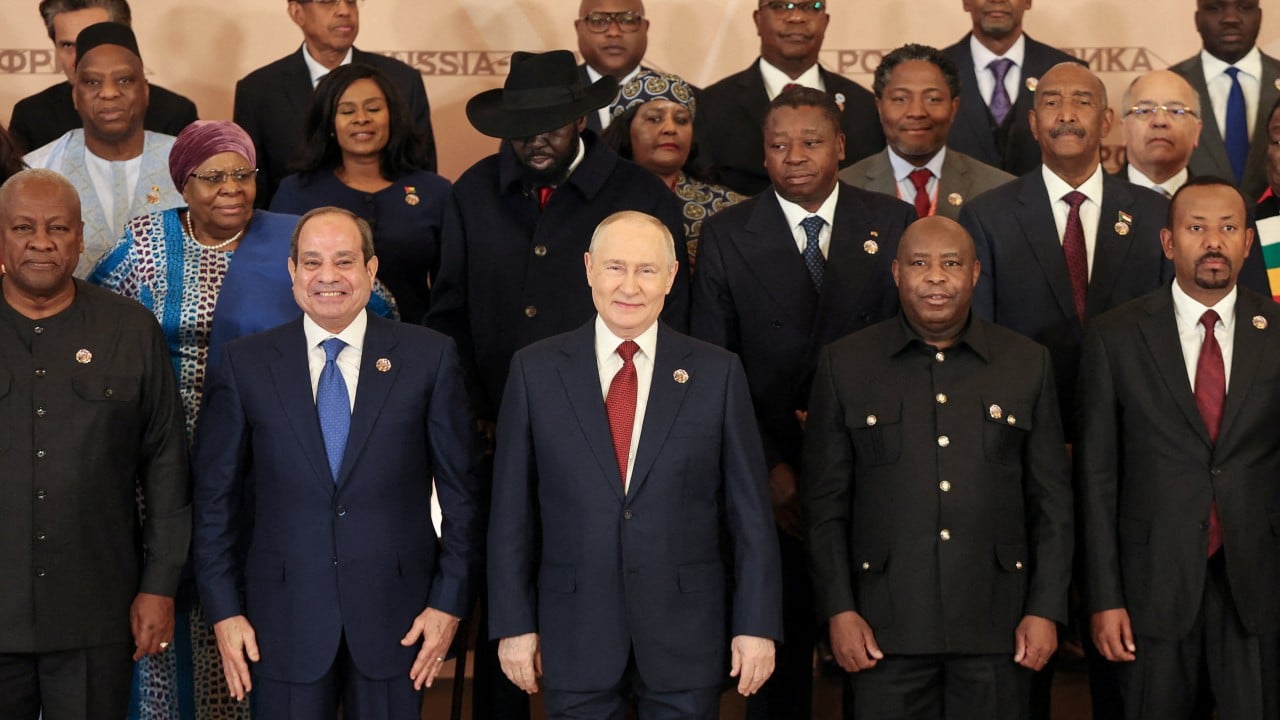
The release of the survey findings coincided with the third edition of the Russia-Africa Summit in Moscow, held over Wednesday and Thursday. Meant to advance partnership between the Kremlin and the continent, the event drew 22 African heads of state as Russian President Vladimir Putin hosted delegations from 48 countries.
Amid fierce US-China competition over access to Africa’s critical minerals and other strategic economic needs, Russia has been more focused on military and defence cooperation, according to Tighisti Amare, director of the Africa programme at Chatham House, a Britain-based think tank.
However, the recent summit revealed that securing access to important minerals found in Africa, reducing the effects of Western sanctions through the promotion of alternative global payment systems, as well as food and energy security, had become equally important focal points of cooperation, Amare said.
With the summit, Russia appeared to be borrowing from China’s playbook, analysts said.
Like the Forum on China-African Cooperation – Beijing’s multilateral platform for engaging countries on the continent – the Russia-Africa Summit could be taken as a rejection of the dominance of the Western world view and an alternative tack.
“Africa matters to both Russia and China now more than at any time in recent decades,” said Robert Hamilton, senior fellow at the US-based Delphi Global Research Centre.
Moscow sought to “blunt isolation and profit from insecurity”, Hamilton argued, while Beijing aimed to “consolidate an alternative global order and protect long-term investments”.
The 2026 edition of the African Youth Survey said the perceived influence of foreign countries like China and India had grown since 2024, with Beijing now viewed as a more favourable partner by young Africans than before.
Still, the study found that African youth harboured lingering concerns about foreign influence, “reflecting an enduring tension between the perceived benefits of international engagement and anxieties about sovereignty and self-determination”.
KioskNews shows a cleaned-up reading view extracted from the publisher’s page — the original always lives on their site, not ours.