Beijing approves giant Long March 9 rocket for deep-space and lunar base runs
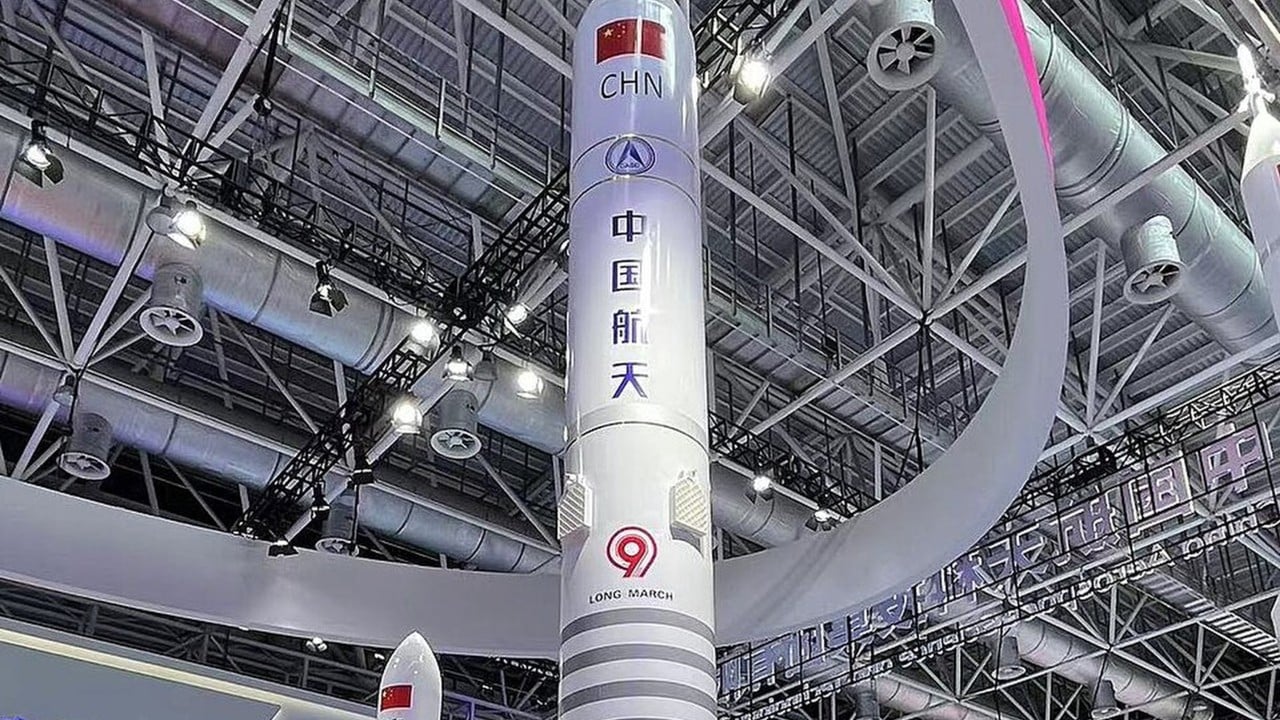
Beijing has given the go-ahead for the Long March 9, a super heavy rocket often seen as China’s answer to SpaceX’s Starship, weeks after the American megarocket first reached orbit, according to a lecture slide circulating online.
The stainless-steel giant received official approval last month, according to the slide. At 110 metres (361 feet) tall and 10.6 metres wide, it will be the most powerful and expensive launcher China has ever built.
The slide, presented in the northwestern city of Xian by a researcher from the country’s main state-owned rocket maker, shows the Long March 9 is set to make its maiden flight in 2030. It will haul big loads to the moon and Mars, and help build solar power stations in space.
01:02
Pallas-1 sees China’s Galactic Energy join reusable launch push, closing in on SpaceX
Its first stage will be powered by 30 methane-burning engines, producing about 6,000 tonnes of thrust at lift-off. On lunar missions, the rocket will be able to carry 50 tonnes – about the weight of eight elephants.
However, unlike Starship, which is designed to be fully reusable, the Long March 9 will recover only its first stage. A slimmed-down variant, the Long March 9B, is expected to be fully reusable when it debuts in 2032 and could lift 150 tonnes into low Earth orbit.
News of the approval set Chinese social media buzzing. “Finally, it’s not just a PowerPoint rocket any more,” one user quipped.
Others were more cautious, since the Long March 10 – the rocket China is building to land astronauts on the moon before 2030 – comes from the same state developer, the China Academy of Launch Vehicle Technology.
“Resources will definitely be squeezed between the two,” another wrote. “Securing the Long March 10 for the moon landing comes first. The Long March 9 is necessary, but clearly not the top priority right now.”
For years, the Long March 9 existed mostly on paper. Veteran rocket scientist Long Lehao, one of its biggest champions, promoted it so often in talks and interviews it had become a running joke among Chinese space watchers.
“We are only waiting for formal state approval,” Long told Chinese media in 2018, adding that it was “entirely possible” to finish development within 10 years of a green light.
The design has changed sharply since then, after the first version resembled Nasa’s Space Launch System, a throwaway rocket with solid boosters strapped to its sides.
Engineers later added a reusable first stage. By 2024, the plan looked “almost exactly like a clone of SpaceX’s Starship rocket”, Eric Berger, senior space editor at Ars Technica, wrote at the time.
03:54
The race for the moon’s south pole: can China beat Nasa’s 2028 deadline?
The Long March 9 is expected to play a key role in the International Lunar Research Station, carrying heavy equipment and supplies to the base China plans to build near the moon’s south pole with Russia and other partners by 2035.
Groundwork is already under way. Photos posted online show construction began in April on a huge assembly complex in Wenchang, on the southern island of Hainan, likely meant for the rocket and expected to be finished in 2028.
KioskNews shows a cleaned-up reading view extracted from the publisher’s page — the original always lives on their site, not ours.