Trump touts AI boss pledge to self-regulate
US President Donald Trump on Tuesday said the tech executives gathered at the White House to discuss regulating artificial intelligence (AI) had signed a “morally binding” commitment to build adequate safeguards on the fast-moving technology.
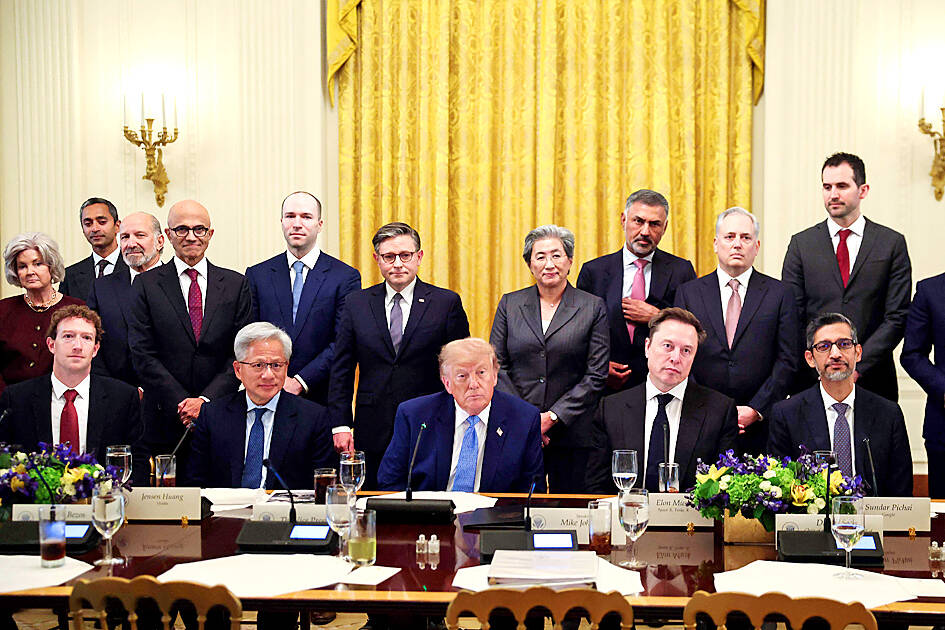
“They’re going to police themselves,” Trump said after the meeting that gathered the top leaders in AI, including Nvidia Corp’s Jensen Huang (黃仁勳), OpenAI’s Greg Brockman and Anthropic PBC’s Dario Amodei.
Trump said the tech bosses had signed a deal that would put on paper their commitment to self-regulate in a morally binding agreement that would not be legally enforceable.
US President Donald Trump, center, speaks during the America.gov launch event at Andrew W. Mellon Auditorium on Tuesday.
Photo: AFP
However, the final document, dubbed the White House Accord, left the door open “to codify these steps into laws or regulations” if it made sense over time.
Speaking to reporters outside the Oval Office surrounded by the world’s tech titans, Trump also confirmed he would officially rename the technology “super intelligence” instead of artificial intelligence, “because it’s not artificial.”
Hours later he released an executive order in which he says the terms “super intelligence” and “SI” shall be used by the federal government whenever possible, because “’Super Intelligence’ more appropriately captures the promise, potential and rapidly advancing capabilities of these technologies.”
Meta Platforms Inc boss Mark Zuckerberg said the White House accord aims to assure customers that AI technology “works in the way that we intend.”
The commitment includes “robust internal controls” and multiple layers of auditing — from internal risk reviews to external auditors and oversight from the companies’ boards of directors, he said.
Zuckerberg called it a starting point for industry wide standards.
Elon Musk, the world’s richest person, said the executives essentially agreed to “grading each other’s homework, which is a lot better than if people just grade their own homework for obvious reasons.”
The lunch meeting also included Amazon.com Inc founder Jeff Bezos, Satya Nadella of Microsoft Corp and Sundar Pichai of Google.
Of the 31 guests, two were women: Susie Wiles, Trump’s chief of staff, and Advanced Micro Devices Inc chief executive Lisa Su (蘇姿丰).
The gathering occurred as attitudes toward AI sour in Washington, with lawmakers increasingly under pressure from voters to curb or slow its development over fears it could displace workers and upend society.
Trump, advised by Huang and his former AI czar David Sacks, has urged unfettered AI development to outpace China and fuel a US economy increasingly dependent on AI-driven growth.
The issue of data centers, the vast computing facilities the technology requires, has emerged as a flashpoint in midterm election races in both parties, with more and more communities worried about rising electricity bills and strains on water and land.
Trump has dismissed opponents of these data centers and after the meeting insisted that AI companies “will be very generous” with communities who open their doors to them.
“They’ll help with their schools, they’ll help with their teachers,” he said.
KioskNews shows a cleaned-up reading view extracted from the publisher’s page — the original always lives on their site, not ours.