UPSC Ethics Simplified: What Rs 700 crore Delhi medical scam teaches about probity, bioethics
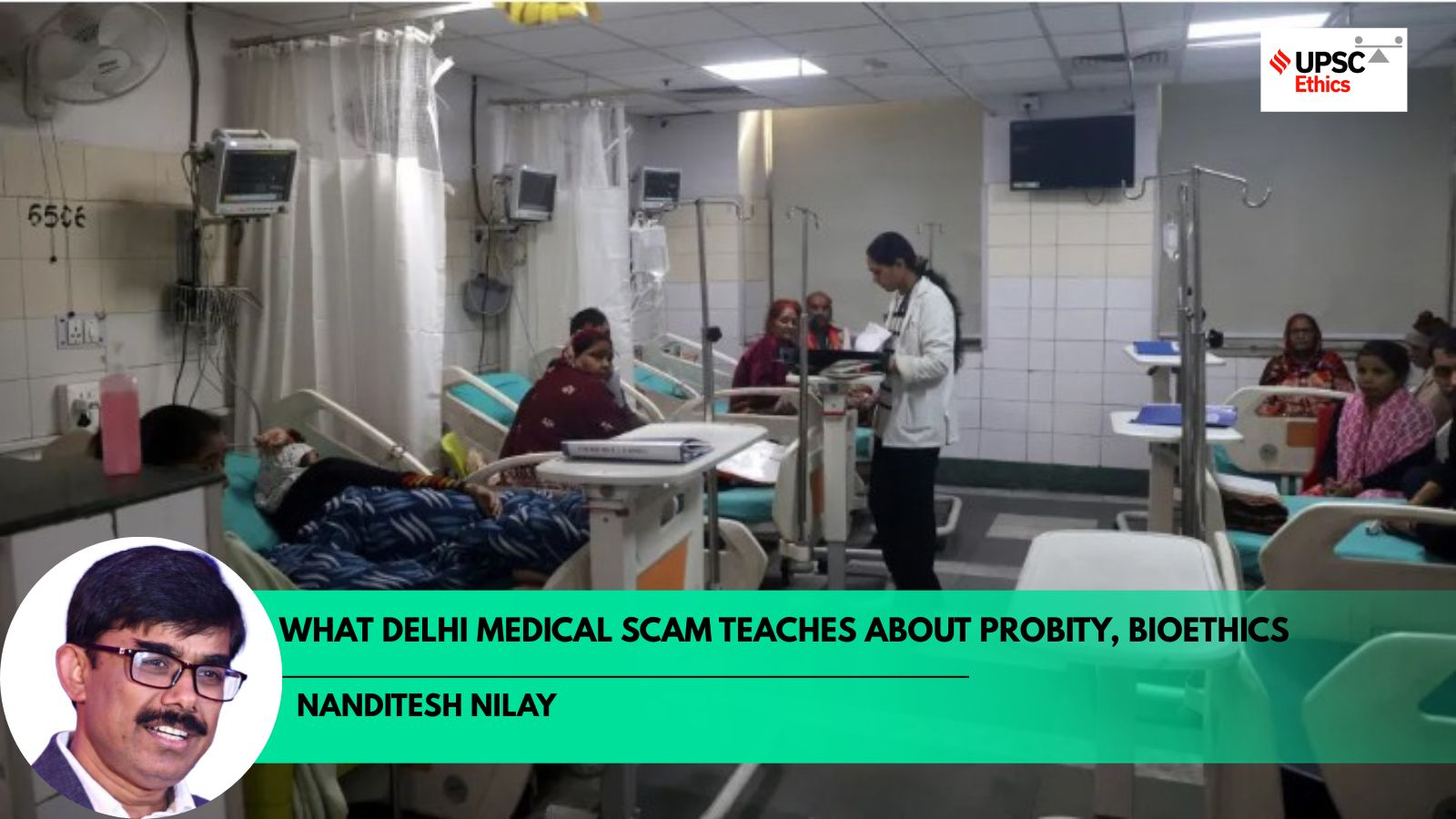
(UPSC Ethics Simplified, a special series under UPSC Essentials by The Indian Express, explores ethical concepts relevant to the Civil Services Examination. In today’s article, we examine the alleged irregularities in Delhi’s medical procurement system and ask a larger question: What happens when those entrusted with public resources fail in their duty towards citizens? Our ethicist examines the case through the lenses of probity, public trust and professional ethics.)
Who is the doctor? Who is the health worker? Who is the patient? Who is the citizen? Who are the other stakeholders who are directly or indirectly connected to someone’s health, someone’s life?
John Ruskin, the social reformer of the Victorian era and writer of Unto This Last, offers a way of looking at this question. He writes that “the man who doesn’t know when to die does not know how to live”. He further elaborates by mentioning five great intellectual professions: soldiers to defend, pastors to teach, physicians to keep people in health, lawyers to enforce justice, and merchants to provide for society. The duty of all these people, he argues, is, on due occasion, to be willing to die for it.
Ruskin’s idea raises a larger ethical question: What happens when the responsibility attached to a profession or position of trust is separated from the values it is expected to uphold?
One of the leading French philosophers of the 20th century, Michel Foucault, in his essay The Political Function of the Intellectual, wrote that “to be an intellectual means to be, a little, the consciousness/conscience of everyone.” The idea becomes particularly relevant when we examine professions and institutions entrusted with public welfare.
The recent Rs 700-crore medical procurement case in Delhi provides a stark context to examine this question. The case involves alleged irregularities in the procurement of medicines, surgical items and hospital equipment. The Anti-Corruption Branch (ACB) has alleged manipulated tenders, cartelisation and siphoning of public funds. The ACB has also told a Delhi court that vital procurement files were allegedly destroyed, raising questions about accountability and the preservation of official records.
The Central Procurement Agency (CPA), the nodal agency responsible for procuring and supplying medicines, vaccines and medical equipment to Delhi government hospitals and healthcare facilities, occupies a position of significant public trust.
Story continues below this ad
The alleged irregularities therefore raise a question that goes beyond financial loss: Where is the consciousness or universal sense of responsibility that asks those holding positions of trust to act with probity?
Probity and public trust
Probity refers to a kind of proven honesty and universal moral uprightness. Simply, it means being entirely ethical and incorruptible, especially when holding a position of trust, handling financial transactions, or performing a public or professional role.
In public administration, probity is closely linked with transparency, accountability, impartiality and the responsible use of public resources.
The medical procurement case brings these values into focus. When decisions concerning medicines, medical equipment and public funds are allegedly influenced by considerations other than public welfare, the ethical concern is not merely financial.
Story continues below this ad
It is also a question of public trust. A public servant entrusted with public money and decision-making authority is expected to act as a trustee of public resources. Citizens are the ultimate beneficiaries of these resources. Any breach of this trust can therefore affect not only the exchequer but also the quality and accessibility of public services.
The four principles of bioethics
The case can be examined at two interconnected levels: the ethical obligations of those entrusted with public healthcare and the principles that guide ethical decision-making in healthcare.
When we investigate the incident through Principlism, an approach associated with Beauchamp and Childress and widely used in bioethics, four important principles emerge: autonomy, beneficence, non-maleficence and justice.
Non-maleficence, a core ethical principle, means doing no harm or refraining from causing harm to others. It is a fundamental duty, particularly in healthcare, where the potential risks and benefits of any action must be carefully weighed. It is often expressed through the maxim primum non nocere, or “first, do no harm”.
Story continues below this ad
In a public healthcare system, this principle does not apply only to doctors treating patients. It can also extend to the wider chain through which medicines, equipment and healthcare services reach patients. If procurement decisions compromise the quality, safety or timely supply of essential healthcare, vulnerable patients may ultimately bear the consequences.
Beneficence requires individuals and institutions to act for the welfare of others. A healthcare procurement system should therefore function with the objective of ensuring safe, effective and timely healthcare for citizens.
Justice requires fairness in the distribution of resources and opportunities. Misuse or diversion of public resources can affect citizens who depend most heavily on public healthcare, thereby raising questions of distributive justice.
Autonomy requires respect for an individual’s ability to make informed decisions about their own healthcare. Meaningful autonomy is difficult to exercise when patients do not have access to safe and reliable healthcare or adequate information.
Story continues below this ad
Thus, the alleged procurement irregularities can be understood not simply as an administrative or financial issue, but as an ethical issue affecting the larger healthcare ecosystem.
A deontological perspective
Beyond the principles of bioethics, the case can also be examined through different ethical theories.
Kantian or deontological, duty-based ethics asserts that morality is grounded in duties and principles. Deliberately misrepresenting a product, manipulating a process or deceiving another person would violate the duty of honesty.
According to Kant, treating another person merely as a means to an end is morally wrong. In the context of public healthcare, citizens and patients cannot be treated merely as means for achieving private financial interests.
Story continues below this ad
The very idea of public office also involves a duty. A public servant entrusted with public money, decision-making authority or institutional responsibility has an obligation to act according to principles of integrity, fairness and public interest.
A utilitarian perspective
From a utilitarian or consequentialist perspective, an action is assessed partly by the consequences it produces. The right action is one that produces the greatest overall good.
The alleged manipulation of medical procurement can therefore be examined in terms of its wider consequences. Apart from potential financial losses to the public exchequer, such practices can affect the availability and affordability of healthcare, weaken institutional efficiency and erode citizens’ trust in public institutions.
From this perspective, the ethical concern extends beyond the immediate act to its foreseeable consequences for patients, public resources and society as a whole.
Story continues below this ad
Virtue ethics and professional integrity
From the perspective of virtue ethics, morality is also concerned with the character of the individual. Qualities such as honesty, integrity, courage, compassion, justice and responsibility form the basis of ethical conduct.
A manufacturer, pharmacist, doctor, procurement official, administrator or regulator who occupies a position of trust is expected to demonstrate these virtues. Technical expertise without ethical character can become problematic when combined with institutional power.
This brings us back to Ruskin’s idea of professional duty. A profession is not merely a means of earning a livelihood. It carries responsibilities towards society.
The doctor has a duty towards the patient. The health worker has a duty towards public health. The administrator has a duty towards public resources. The supplier has a duty towards the quality and safety of the goods provided. And the institution has a duty towards the citizens it serves.
Story continues below this ad
The larger ethical lesson
The right to life belongs to every citizen, and those in positions of power must understand that they are guardians of people’s trust and trustees of the values of probity.
The Delhi medical procurement case therefore raises a larger ethical question: What happens when the responsibility attached to a position of trust is separated from the power exercised through that position?
The answer lies in the values that underpin ethical governance: probity, accountability, transparency, integrity, compassion and responsibility.
Ultimately, public service is not only about exercising authority. It is about recognising the human consequences of that authority. In healthcare, where decisions can directly affect human life and dignity, professional responsibility cannot be separated from ethical responsibility.
(The writer is the author of ‘Being Good’, ‘Aaiye, Insaan Banaen’, ‘Kyon’ and ‘Ethikos: Stories Searching Happiness’. He teaches courses on and offers training in ethics, values and behaviour. He has been the expert/consultant to SAARC countries, UPSC, Central Bureau of Investigation( CBI),National Judicial Academy, ATI, RAKNPA, Haryana Institute of Public Administration, ISA MountAbu, National Centre for Good Governance,Competition Commission of India (CCI), etc. He has PhD in two disciplines and has been a Doctoral Fellow in Gandhian Studies from ICSSR. His second PhD is from IIT Delhi on Ethical Decision Making among Indian Bureaucrats. He writes for the UPSC Ethics Simplified (concepts and caselets) weekly.)
Subscribe to our UPSC newsletter and stay updated with the news cues from the past week.
Stay updated with the latest UPSC articles by joining our Telegram channel – Indian Express UPSC Hub, and follow us on UPSC section of The Indian Express on Instagram and X.
For your queries and suggestions write at manas.srivastava@indianexpress.com
PREVIOUS ARTICLES ON UPSC ETHICS SIMPLIFIED:
What ethical questions does Delhi’s Satya Niketan tragedy raise?
Gen Z and the ethics of communication
IAS Tukaram Mundhe | Beyond the officer, study the ethical issues
As Divya Mittal resigns from IAS, 3 ethical questions on public service
Can fear of punishment create an ethical society?
CJP protest: Why responses to protests are an ethics case study
Railway linen theft : A Case Study in everyday ethics
Can ethics stop the next fire tragedy?
How can India’s civil services and governance rebuild Gen Z’s trust?
KioskNews shows a cleaned-up reading view extracted from the publisher’s page — the original always lives on their site, not ours.