Melbourne Assembly live: Ex-New York mayor, PM share visions to improve liveability
As the Melbourne Assembly civic forum takes a short break, we continue to look back on stories we’ve published about shaping the city.
As Royce Millar wrote recently, Sunshine, Dandenong, Broadmeadows and Footscray would see the most significant change in housing density as Melbourne faces “crunch time” finding places to live for its burgeoning population.
Projections of what Melbourne could look like in 2101 if urban sprawl is contained show the number of dwellings increasing by almost 2 million, and the city’s west, as far out as Melton, copping the brunt of that change.
The suburban centre with the largest increase in dwelling numbers would be Box Hill, rising from 6826 today to 24,427. It is followed by Footscray with 20,117 and Sunshine with 11,689 dwellings, demographic consultancy Informed Decisions (.id) estimates.
While we take a short break from live proceedings, let’s take a look at some of the stories we’ve published in the lead-up to Melbourne Assembly.
As part of our series of stories on shaping the city, We asked planners what Melbourne would look like if it went up or out by 2101.
As Royce Millar writes, the population and housing projections from Johnny Barnard, founder of the National Forecasting Program at demographic consultancy Informed Decisions (.id), and commissioned by The Age, show where Melbourne will have to build up, or grow out, to fit more than 10 million people.
The data looks at two growth scenarios: a “business as usual” approach where the city continues to sprawl outwards, or a “containment” model where growth occurs within the city’s current official boundary.
If we settle for business as usual, our city’s footprint will swell by almost one third, from 2464 to 3436 square kilometres, gobbling up ever more farmland and green space. If we consolidate, we’ll need to squeeze an extra half a million homes into existing neighbourhoods.
Thank you for following our live coverage of Melbourne Assembly day two. We’re taking a 30-minute break, so stay tuned for more shortly.
In the lead-up to the civic forum, The Age floated 20 ideas to improve Melbourne, intentionally stripping away practical constraints such as budgets and timelines. The results are a wish list reflecting the type of city our readers value and envision for their future.
The winner, which received the most up votes versus down votes, was to build Airport Rail before the Suburban Rail Loop – 10,300 readers voted in favour, while 1500 didn’t like the idea.
In second place was building a park across the top of the Flinders Street railway yards, with 10,000 votes in favour.
As greenfield suburbs crop up on Melbourne’s urban growth boundary, it is clear their residents want better connections. In third place was the idea of building greenfield suburbs with a tram connection to the nearest train station, with 9700 votes in favour.
See the full poll results here.
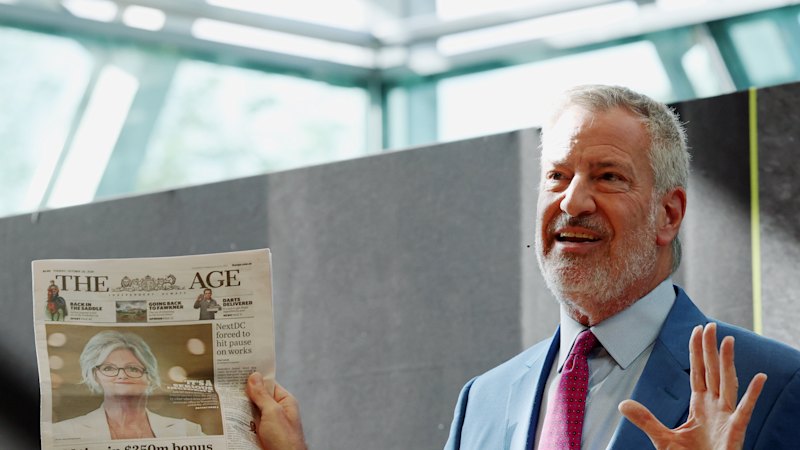
Former New York City mayor Bill de Blasio finished his keynote address by applauding Melbourne, saying it has “all the necessary pieces” to become one of the great cities of the future.
“I’ve travelled the whole world. If ever I’ve seen a city that could succeed in the future, it is Melbourne,” de Blasio says.
De Blasio encouraged Melburnians to “take the bull by the horns” and take initiative in order to ensure the best possible future.
“You have the raw material. You don’t have a lot of time to put it together into a vision. You must have that vision, or your dreams will not be realised,” he says.
“You can succeed if you create a true public vision together. And I believe you will.”
Bill de Blasio criticised the lack of nationwide policies to combat climate change, saying that local governments must pick up the slack when it comes to promoting sustainability.
“National policies are not addressing the climate crisis quickly enough,” he says.
“This must be handled at the local level. Every action helps … aggressive local policies eventually become national policies, because they work.
“We have an obligation to show a different path.”
Bill de Blasio shifted his address to what he foresaw as “the topic of the future, the dominant issue in our lives” – artificial intelligence (AI).
Over the course of the past year, data centres went from something that Americans thought about benignly or not at all, to something that was causing a “massive rebellion”, he said.
Government is “way behind” the public on the issue of AI, de Blasio said.
“The people are hearing the voices from the tech community saying, ‘Something’s really wrong here. There’s tremendous danger. This is out of control. This needs to be paused or regulated.’ The people are getting it really quickly. They are seeing it through the prism of their families, their futures,” the former New York City mayor said.
On the subject of income inequality, Bill de Blasio had a stark warning for Melburnians: “If not addressed, it breeds intense division”.
In his time in office as the New York City mayor, he spoke about fighting income inequality “as often as Donald Trump talks about insane tariffs”, De Blasio said.
His city fought it through measures including raising the minimum wage, improving paid sick leave and creating universal kindergarten, he said.
“If you don’t like an ever more stratified society, you don’t like a sense that only a few are getting ahead, there’s actually a lot you can do about it locally, [at a] state level [and] nationally,” he said.
“But it takes a public commitment to recognising that inequality does not have to be ever-growing and inevitable, that governments and communities can do something about it.”
Bill de Blasio has now turned his focus to the “hot-button topic” of immigration, which he says has made both Australia and the United States into the countries they are today.
Here’s a little of what he had to say about Melbourne’s diverse population.
This city is amazing. How did it get to be amazing? Was it some small group of people who looked all alike and just stayed together and interbred and made it amazing? No. There’s people from all around the world that contributed, and continue to.”
Bill de Blasio is addressing the Melbourne Assembly crowd about homelessness, which was a key focus during his time in office.
The Age previously reported on a $27.8 million statewide expansion of Victoria’s homelessness services, which includes the creation of a “by-name list,” which would seek to create a profile for every rough sleeper.
The former mayor says it is outreach programs like this that are key to tackling homelessness.
“If you don’t address homelessness, it is not just a moral thing. It will hurt your business climate. It will hurt people’s sense of security,” he says.
“There are so many painful realities when you see a homeless person. It feels like a defeat. It feels like something went wrong for all of us.”
Not long after Bill de Blasio left university, New York City had its “worst year in our history”, he said.
It was 1992, and 2200 people were murdered.
There were endless shootings, and endless crimes generally. “Many that never went even reported or investigated,” de Blasio told Melbourne Assembly.
“There was really a decision, and it came out of a process not quite like this, but a true public consensus, in effect, through elections and other measures, that we needed to do something profoundly different.”
KioskNews shows a cleaned-up reading view extracted from the publisher’s page — the original always lives on their site, not ours.