Clouds, but no rain? Moth swarms bamboozle the weather radar
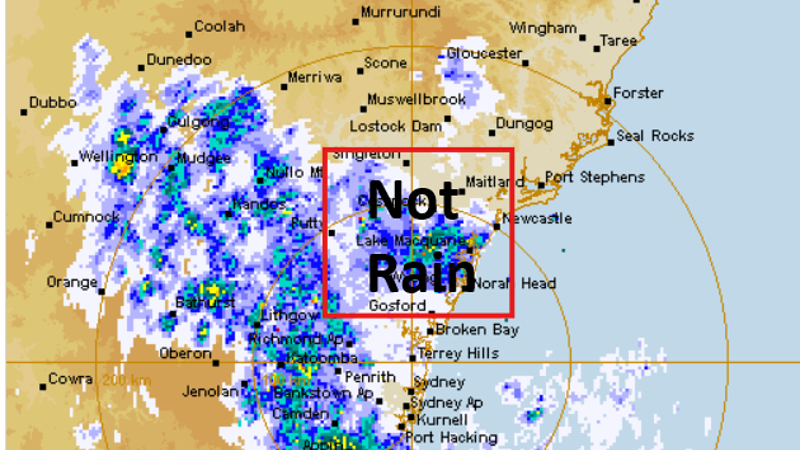
In an epic clash between migration and meteorology, vast swarms of moths are suspected to have bamboozled the state’s weather radars, appearing as rain clouds in a phenomenon that could help scientists save one of Australia’s most infamous and under-threat insects.
Bogong moths are flying south to shelter in the cool caves of the Australian Alps over summer, in thick throngs conservationists are celebrating as a sign their populations are climbing back from a catastrophic crash in 2017.
So mighty are the moth numbers that the Bureau of Meteorology’s instruments are detecting “clouds” on evenings with clear skies and no rain.
“It is possible that radars across eastern New South Wales are detecting bogong moths,” the bureau said in a statement. “The bureau’s radars are not malfunctioning … large numbers of insects can look like very light widespread rain, particularly near sunrise and sunset.”
ABC meteorologist Tom Saunders reported widespread rain lighting up the weather radar like “clockwork” each evening for the past few weeks.
“The only problem is that on most nights, skies are not cloudy and it certainly has not been raining for a month straight,” he wrote, attributing the false signals to bogongs taking flight each evening.
Radar works by blasting out pulses of radio waves, a type of electromagnetic radiation. These radio waves reflect off water particles and “echo” back to the radar antenna.
The timing and the strength of the returning signal allows the bureau to see whether rain, hail or a thunderstorm is on the way. Those radio waves, however, can also bounce off things that aren’t precipitation, including smoke, ash, birds – and moths.
“We can confirm that there has been increased ‘echoes’ displaying on radars across eastern New South Wales that aren’t precipitation,” the bureau said, adding the signals may not be completely caused by moths and there could be other atmospheric factors at play.
‘Now we can go back through the records as long ago as World War II to look for signatures of big clouds of moths.’
Kate Umbers, Western Sydney University
If the phenomenon is caused by moths, it could serve as critical data used to save the species, which is suffering from a lack of data.
“It’s brilliant – it provides us with an example of what the moths look like on satellite radars,” said Associate Professor Kate Umbers, a moth researcher from Western Sydney University.
“Now we can go back through the records as long ago as World War II to look for signatures of big clouds of moths. My goodness, it’s such an important observation.”
Efforts to list the moths as endangered federally were knocked back in 2025 by then-Environment Minister Tanya Plibersek due to gaps in monitoring and population data.
Having a clear signature of what the moths look like on radar could help reconstruct their populations and movements back through the decades, using historical radar signals to help address those critical knowledge gaps.
Radar could also help track down more of the moths’ remote and undiscovered roosts in the alps.
The last well-publicised time moths were detected on radar was during the 2000 Sydney Olympics, when organisers panicked as rain clouds encroached on the closing ceremony, only to be revealed as swarms of bogongs attracted by the stadium lights.
Umbers and her team tagged 14,000 of the moths earlier this year at Mount Kosciuszko. The idea was to find at least some of them as they spread around Australia to finally untangle the mystery of their movements – but every single one went missing.
“The thing is, we don’t know where bogong moths come from, and we don’t know where they go,” Umbers said.
“There’s lots of stories that are repeated all the time that they come from Queensland and fly 1000 kilometres … but there’s no evidence. We’ve never tracked a single moth from one place to the other.”
The lack of hard data about the bogong moth populations has stifled efforts to get the insect listed as threatened under the Environment Protection and Biodiversity Conservation Act.
The bogong moth is listed as endangered on the international IUCN red list, but not because of its actual population number, which isn’t known.
The bogongs are listed under Criterion B, which covers species threatened because of fragmentation or destruction of their geographic range.
For the moths, the listing recognises the alpine caves they shelter within over summer are vulnerable to warming due to climate change.
“Their threatened status has nothing to do with how many there are,” Umbers said. “It has all to do with the declining quality of the habitat that they require.”
In a renewed effort to track moth movement, Umbers and her team recently caught 500 bogongs in the Blue Mountains and dabbed blue paint on their wings.
The hope is that someone will spot a blue-marked bogong, snap a photo and report its location to bogong.org. Doing so would reveal much-needed information about a migration that is apparently mighty this year, but is constantly under threat.
“The first time we find one of these [tracked moths], it’s going to be just remarkably valuable information about where that one little moth has come from and gone to,” Umber said.
The Examine newsletter explains and analyses science with a rigorous focus on the evidence. Sign up to get it each week.

KioskNews shows a cleaned-up reading view extracted from the publisher’s page — the original always lives on their site, not ours.