World nearing heat point of no return
BEST SCENARIO: If countries did act decisively to slash emissions, temperature projections would become less daunting, but the world would still heat up by 1.9°C by century-end
The world is heading for an “irrecoverable overshoot” of global temperature thresholds that would plunge billions of people into disastrous climate impacts, because governments have stalled for so long to cut planet-heating emissions, an analysis found.
Under current policies, the planet would heat up by 2.7°C on average by the end of the century compared with preindustrial times, Climate Action Tracker said in a report. This is up slightly from a prediction of 2.6°C in the group’s analysis conducted last year.
This level of warming smashes the 1.5°C threshold that was agreed by countries a decade ago, but is set to be breached in just a few years.
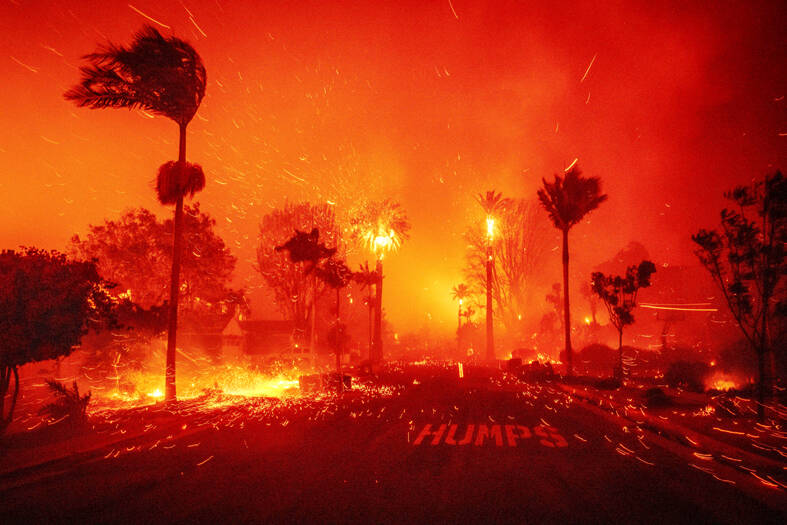
A fire ravages the Pacific Palisades, Los Angeles, on Jan. 7 last year.
Photo: AP
Scientists have warned that beyond this point, already harmful storms, droughts, heatwaves, flooding and other impacts would become intolerable for parts of the world and potentially trigger runaway climate change that would not be contained.
Countries, minus the US, gathered in the Turkish city of Antalya for UN climate talks that have centered on the looming “overshoot” of the temperature target.
This reality should compel governments to act quickly to phase out use of the fossil fuels that are causing the climate crisis, UN Secretary-General Antonio Guterres said.
If countries did act decisively to slash emissions then the future temperature projections would become less daunting, the report said. However, in even the most optimistic scenario — where all pledges, targets and other long-term promises made by countries were fulfilled — the world would still heat up by 1.9°C by the end of the century.
Exceeding 1.5°C warming “cannot be an excuse to open the door to defeatism” and every small increment of temperature rise would be significant, Climate Analytics chief executive Bill Hare said.
While the world is failing to cut emissions in line with the science and countries’ own promises, carbon pollution is set to dip slightly this year and Climate Action pointed to some causes for optimism. Clean energy investment is now double that of fossil fuels, electric car use is soaring and the deforestation of the Amazon in Brazil has fallen sharply.
However, much more will need to be done to avert disastrous climate impacts.
“Governments collectively are simply not moving fast enough to adopt the policies that would enable us to escape from the emerging overshoot trap,” report lead author Sarah Heck said.
Some countries, such as the US, Canada and New Zealand, are even slowing down their climate action to a “staggering level,” she added.
KioskNews shows a cleaned-up reading view extracted from the publisher’s page — the original always lives on their site, not ours.