Seoul’s response to DMZ blast likely to hinge on whether Pyongyang acted intentionally
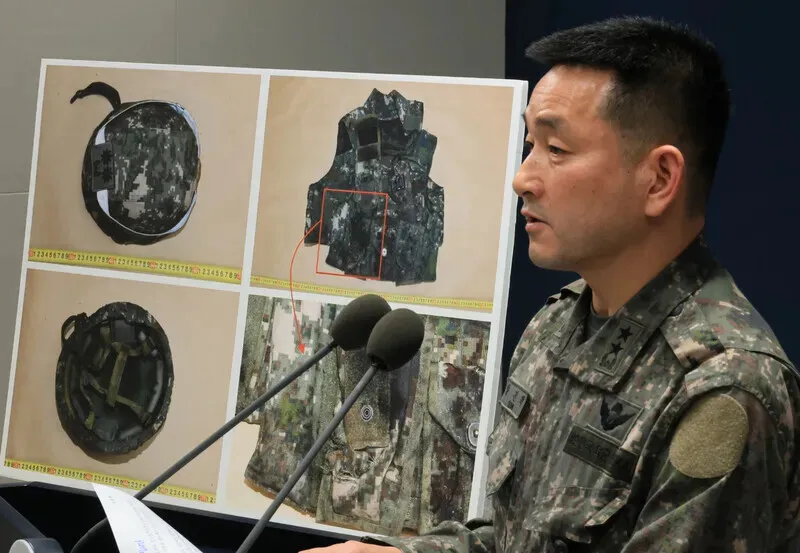
Yang Jin-hyeok, the director of operations at the Joint Chiefs of Staff, gives a briefing on Sept. 28, 2026, regarding the explosion in the DMZ. (Yonhap)
With growing evidence that North Korean troops may have planted the mine that exploded Sept. 21 in the western Demilitarized Zone, Seoul faces questions of how it will respond, and how much that response will depend on whether Pyongyang is deemed to have acted intentionally.
Minister of National Defense Kang Shin-chul on Tuesday testified at a plenary session of the National Assembly’s National Defense Committee that the incident was “a clear violation” of the Armistice Agreement signed in 1953.
“Since North Korea is responsible, we will take corresponding measures,” he said. “We have the necessary steps in place and will implement them in stages.”
Kang pledged an “effective response” spanning inter-Korean relations, global cooperation and military affairs, though stopped short of giving specifics.
President Lee Jae Myung also told a Cabinet meeting he chaired at the Blue House, “We will uncover the truth through a rigorous investigation and take necessary measures.”
Lawmakers of the main opposition People Power Party urged the resumption of propaganda loudspeaker broadcasts toward North Korea, but this is unlikely. Proponents of the idea recall an incident in August 2015, when the revival of such broadcasts the day the North was conclusively identified as the culprit behind a wooden-box mine provocation led to an expression of regret from Pyongyang.
But the latest situation differs from what it was 11 years ago. In June last year, the Lee administration preemptively halted the broadcasts, and resuming them would pose a major political burden as it would be taken as a sign of a shift in the administration’s North Korea policy toward confrontation and hostility.
In August 2015, tensions unfolded through a series of escalating events, beginning with loudspeaker broadcasts aimed at North Korea and followed by an exchange of artillery fire and gunfire between the two sides. The crisis was ultimately defused through high-level talks with Pyongyang, after military tensions had risen to the brink of war and North Korea proposed dialogue.
But since all channels of inter-Korean communication today have been severed, resumption of the broadcasts would pose a major risk of the Korean Peninsula spiraling into an extreme situation.
“Determining if North Korea acted with intent is the key factor in deciding the level of our response,” a diplomatic and national security official told the Hankyoreh.
The August 2015 incident clearly showed the intent of the North’s military to target South Korean soldiers by planting a mine on a patrol path used by South Korean forces 440 meters south of the Military Demarcation Line (MDL).
The latest incident, however, occurred at an unidentified minefield overgrown with vegetation that the South Korean military had not patrolled for over 50 years.
On how to determine if the North acted intentionally, an official from the Joint Chiefs of Staff said, “Since this was a point entered by our side after clearing a search route, we believe at this stage that the evidence is insufficient to designate this a deliberate act targeting our troops, so we need an investigation to clarify this.”
Experts recommend that the response should differ from that in 2015, when the incident was deemed a “deliberate provocation” by North Korea, because intent is not clearly established in this case.
“It’s difficult to consider using anti-North Korea loudspeaker broadcasts because they are such a major negative factor in inter-Korean relations,” Sejong Institute President Kim Jung-sup said. “We must condemn this action and make North Korea promise never to do it again.”
Cho Seong-ryoul, a visiting professor of military studies at Kyungnam University, suggested that given the differing perceptions between the two Koreas of the baseline of the MDL, both sides should “resume military dialogue to demarcate the boundary and set measures to prevent a recurrence.”
“I intend to strongly insist that the two Koreas should use this incident as an opportunity to verify the situation with each other and come to the negotiating table,” Kang told the National Assembly. “It’s not just about the MDL — what’s more important is a communication system. I will make strong requests and work to secure concrete and effective measures covering all these issues.”
KioskNews shows a cleaned-up reading view extracted from the publisher’s page — the original always lives on their site, not ours.