‘Wish Papa was here’: The pain of long-distance parenting for S’pore’s foreign workers
SINGAPORE - While working here for the last 13 years, Bangladeshi migrant worker Sayeed Md Abu missed the birth of both his daughters.
The ache of being apart from his two girls, who are now six and 10, has only grown with time.
“Whenever they are enjoying the moment or having fun, they keep saying ‘wish Papa was here’,” said the 36-year-old wistfully in an interview with The Straits Times in September.
Migrant worker parents like Sayeed shoulder not just the duty of earning a living, but the weight of raising their children from afar. Many grapple with guilt, worry and helplessness, feelings they tend to keep to themselves.
Foreign workforce numbers have risen from 1.2 million in 2021 to 1.65 million in June 2026. While there is no official count of how many migrant workers and domestic workers here are parents, the figures point to a growing number who are leaving their families behind to work in Singapore.
Against this backdrop, some organisations have started free programmes to help foreign workers with long-distance parenting. One is the I.C.A.N. Fathering Workshop run by local charity Centre for Fathering.
The acronym stands for Involvement, Consistency, Awareness and Nurturance, traits the programme encourages fathers to practise, no matter how far they are from their child.
Over 80 migrant workers from three dormitories - PPT Lodge 1A in Seletar, Westlite Ubi and ASPRI-Westlite Papan, near Jurong Island - have attended the workshop since 2025. Among them was Sayeed, an air-conditioning and refrigeration supervisor.
Earlier in 2023, PPT Lodge 1A’s operator Tee Up had started a peer support group called Dads in Dorms after noticing that some workers were stressed about family issues, said Ong Jia Hao, its senior executive of resident engagement.
Migrant worker charity HealthServe later connected the dorm with Centre for Fathering, which brought the workshop to the Dads in Dorms group, while The Salvation Army helped bring the workshop to ASPRI-Westlite Papan.
Heart-to-heart talks
Steven Say, one of the workshop trainers, said migrant worker dads struggle with being an “absentee father”. Some also mistakenly believe that nurturing children is solely their wives’ responsibility.
Fathers play an important role in a child’s upbringing, and there is value in building emotional connection with children even when they cannot be physically present, said Say, 63, a grandfather of three.
Workers are encouraged to contact their families frequently through video call, text or letters.
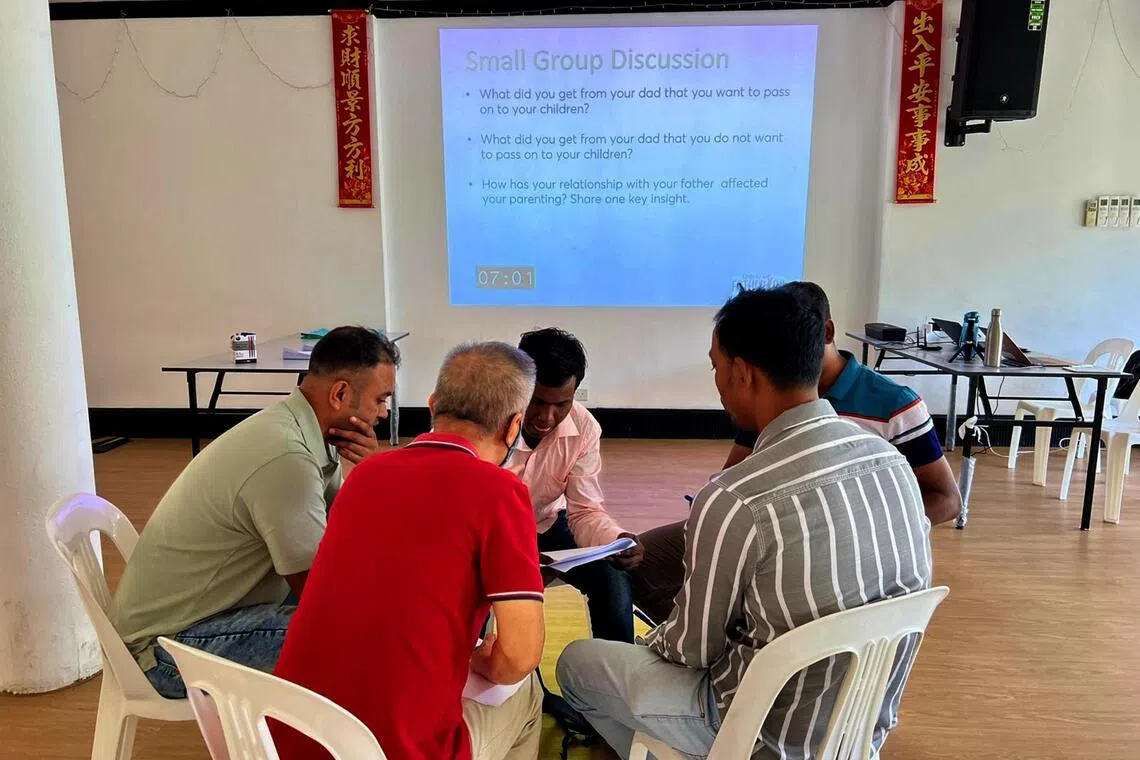
The I.C.A.N workshop guided migrant worker fathers from PPT Lodge 1A on long-distance parenting skills.
PHOTO: CENTRE FOR FATHERING
For Sayeed, the workshop prompted him to reflect on how his behaviour affected his daughters and how he could communicate better with them during their limited time on video calls.
When his elder daughter repeatedly made mistakes in her mathematics exams, he gently explained the importance of being thorough, instead of losing his temper.
“I used to scold her: ‘Why do you have to score like this? You should be better.’ But I realised I have to help her,” said Sayeed. “I need to talk to her heart to heart.”
Construction tiler Pallikondaperumal Jeyasekar, 46, who has two daughters aged seven and 13 living in Tamil Nadu with his wife, feels a pang of sadness when he cannot attend their school functions.
He learnt through the workshop that fatherhood is more than financial provision. Listening to his children’s feelings matters, too.
Recently, he bought them bicycles as he realised they wanted to cycle like other children. Previously, he had opposed the idea out of concern that they might get hurt.
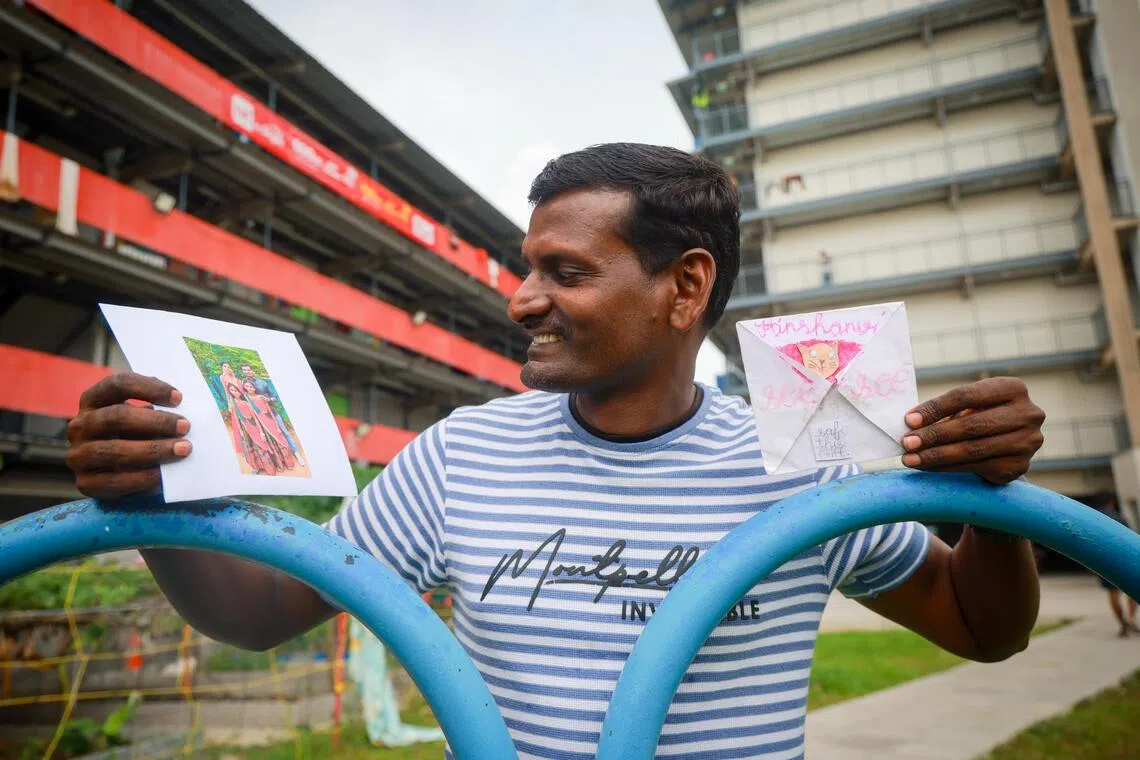
Construction tiler Pallikondaperumal Jeyasekar, 46, who has two daughters aged seven and 13 living in Tamil Nadu with his wife, feels a pang of sadness when he cannot attend their school functions.
ST PHOTO: JASON QUAH
Mum guilt
The emotional toll of separation can take on a different form for mothers.
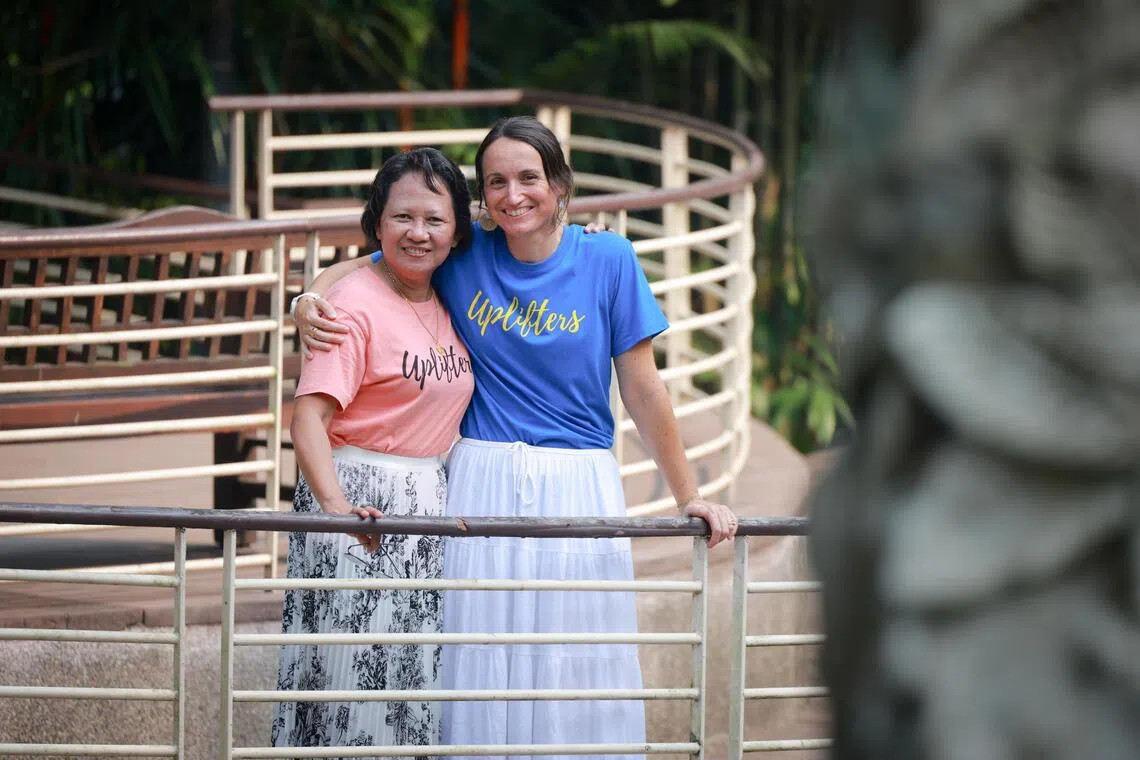
Evelyn Obillo, 47, a Filipina domestic helper (left) and Marie Kretz Di Meglio, the founder of Uplifters (Singapore) Limited (USL).
ST PHOTO: JASON QUAH
Guilt is the main feeling haunting them, said Marie Kretz Di Meglio, the founder of Uplifters (Singapore) Limited (USL), a charity which supports migrant domestic workers.
“We have heard so many stories of domestic workers hiding in the toilets to cry while they were playing with a newborn or toddler, as it reminds them of their own toddler that they had to leave at home,” said Di Meglio.
Evelyn Obillo, 47, a Filipina domestic helper and mother of four who has worked in Singapore for 24 years, put the conflict in words: “We’re guilty that we’re looking after somebody’s child while somebody is looking after ours.
“We ask ourselves, are we bad mothers or what?”
The guilt can make some women accede to their family’s requests for money, as they try to stay connected to their children, said Di Meglio. This may then lead to money management issues.
To help these women and their children, USL piloted an online long-distance parenting programme in 2026. About 20 women including Obillo joined the pilot, which will last till the end of 2026, before the course officially launches in 2027.
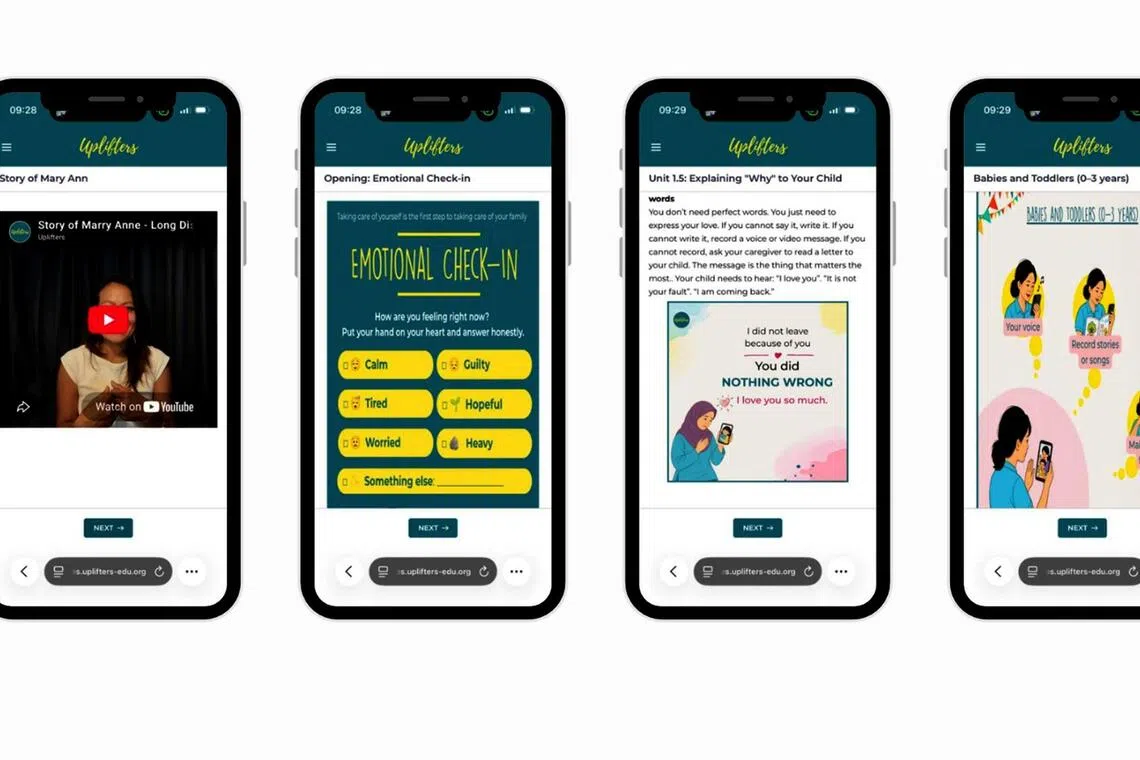
Uplifters (Singapore) Limited's new online long-distance parenting programme for migrant domestic workers comprises 14 online lessons on topics such as emotional wellbeing, conflict prevention and self-care.
PHOTO: UPLIFTERS (SINGAPORE) LIMITED
The programme comprises 14 online lessons on topics such as emotional wellbeing, conflict prevention and self-care. It includes real stories of domestic workers to encourage them that they are not alone, and they do not need to make decisions out of guilt.
One segment offers advice on explaining to children of different ages why their mothers decide to work overseas, such as reassuring young kids that they are not the cause for their mothers’ absence and separation is only temporary.
Mothers are encouraged to bond with their children over shared activities. Those with young children can mail an activity book back home and complete colouring pages together, for instance, via video call.
Obillo, a single mother and a grandmother of three, remembers her parenting difficulties when she first worked here in the early 2000s. She had no days off and was not allowed to call home, leaving letters as her only means of communication.
When she first returned home after four years, her children were cold and aloof. “The bond was almost gone,” said Obillo.
She worked to rebuild the relationship over the years, sending regular messages once she had a mobile phone and returning home for milestones, including her children’s graduations.
The new programme would have been a “survival guide” during those early years, said Obillo, now a mentor for other domestic workers at USL.
Employers can help foreign workers maintain family ties by encouraging regular calls home and being understanding when important family matters arise, said HealthServe’s chief executive Benjamin Kuan.
Proactively ask domestic workers about their families, discuss suitable call times and plan home leave in advance, said USL’s Di Meglio.
She added: “These steps don’t need to be big, but they can make a real difference to a worker’s well-being, their financial stability and their children back home.”
KioskNews shows a cleaned-up reading view extracted from the publisher’s page — the original always lives on their site, not ours.